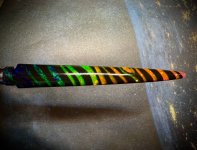
Finish on Acrylic blanks

Signed-In Members Don't See This Ad

Pezhead12554

Member
Joined
Oct 31, 2025
Messages
8
Location
Troy Michigan
What is you progression of grit and final polish on your kitless pens??
I use 240 and sand it both ways (circular and parallel) Then 320, 400, 600, 1000, 1500 and
then Semichrome polishing compound.
 
Signed-In Members Don't See This Ad
I know that works for you - 240, 320 then 400. But how sharp are you tools? I don't use carbide inserts often but when I do, the finish doesn't need anything below 400. Mostly I use HSS tools in the finishing stages and the sharpened chisel finish on the acrylic is at least 600, and that is when I am not careful.

The point is flat work mentality pushes one to use a lower sanding grit than necessary on pens - wood or acrylic. Properly sharpened tools, (or higher quality carbide insert) or proper use of a skew in the finishing stages - will usually decrease the amount of sanding needed.
 
Last edited:
On softer blanks (like Alumilite Clear Slow - Urethane), I usually apply two thin coats of CA such as GluBoost as it provides a harder layer that resists abrasion better than the raw Alumilite. This helps retain the glossy finish longer.

For finishing, I use two different methods:

Method #1: With the lathe at about 1000 RPM, I dry sand with 400, 600, and 800 grit sandpaper then go to wet sanding with standard Micro Surface pads. Then, depending on the finish I follow up with buffing using a sewn cotton wheel and PSI's blue buffing stick followed by a loose flannel wheel with no abrasive.

Micro Surface Pads:
#1500 (25 microns = about 400 ANSI grit)
#1800 (15 microns = about 1200 ANSI grit)
#2400 (12 microns = about 1500 ANSI grit)
#3600 (8 microns = about 2500 ANSI grit)
#4000 (5 microns = about 4000 ANSI grit)
#6000 (4 microns = about 5000 ANSI grit)
#8000 (3 microns = about 7000 ANSI grit)
#12000 (1 micron = about 10000 ANSI grit)

Method #2: With the lathe at about 1000 RPM, I dry sand with 400, 600, and 800 grit sandpaper. Then I bump the lathe up to about 3000 RPM and polish through the six grits of Stadium Pen Blank's Magic Juice. So far I have found no reason to buff following Magic Juice.

Magic Juice (AI Estimated Microns)
#1 (4 to 6 microns = about 3000 to 4000 ANSI grit)
#2 (3 microns = about 6000 ANSI grit)
#3 (2 microns = about 8000 ANSI grit)
#4 (1 micron = about 10000 ANSI grit)
#5 (0.5 micron = about 50000 ANSI grit)
#6 (0.25 micron = about 100000 ANSI grit)

Occasionally with Magic Juice I find a tiny white dot caused by residual polish that gets into a microscopic bubble or pinhole on the blank. Sometimes it can be challenging to get it out of there. For this reason, I often opt for the Micro Surface Pad and buffing method even though I do think that Magic Juice yields a superior glossy finish.

Dave

 
On softer blanks (like Alumilite Clear Slow - Urethane), I usually apply two thin coats of CA such as GluBoost as it provides a harder layer that resists abrasion better than the raw Alumilite. This helps retain the glossy finish longer.

For finishing, I use two different methods:

Method #1: With the lathe at about 1000 RPM, I dry sand with 400, 600, and 800 grit sandpaper then go to wet sanding with standard Micro Surface pads. Then, depending on the finish I follow up with buffing using a sewn cotton wheel and PSI's blue buffing stick followed by a loose flannel wheel with no abrasive.

Micro Surface Pads:
#1500 (25 microns = about 400 ANSI grit)
#1800 (15 microns = about 1200 ANSI grit)
#2400 (12 microns = about 1500 ANSI grit)
#3600 (8 microns = about 2500 ANSI grit)
#4000 (5 microns = about 4000 ANSI grit)
#6000 (4 microns = about 5000 ANSI grit)
#8000 (3 microns = about 7000 ANSI grit)
#12000 (1 micron = about 10000 ANSI grit)

Method #2: With the lathe at about 1000 RPM, I dry sand with 400, 600, and 800 grit sandpaper. Then I bump the lathe up to about 3000 RPM and polish through the six grits of Stadium Pen Blank's Magic Juice. So far I have found no reason to buff following Magic Juice.

Magic Juice (AI Estimated Microns)
#1 (4 to 6 microns = about 3000 to 4000 ANSI grit)
#2 (3 microns = about 6000 ANSI grit)
#3 (2 microns = about 8000 ANSI grit)
#4 (1 micron = about 10000 ANSI grit)
#5 (0.5 micron = about 50000 ANSI grit)
#6 (0.25 micron = about 100000 ANSI grit)

Occasionally with Magic Juice I find a tiny white dot caused by residual polish that gets into a microscopic bubble or pinhole on the blank. Sometimes it can be challenging to get it out of there. For this reason, I often opt for the Micro Surface Pad and buffing method even though I do think that Magic Juice yields a superior glossy finish.

Dave
Hi Dave,

Curious where in this workflow you apply the CA? I would guess after the 800 grit.

I recently got a sample set of magic juice and really liking it over micromesh/zona.

I also switched from sandpaper to 3m foam sanding pads and it's seeming to speed up my process a lot, mainly preventing radial marks from pressing too hard. I am making very curvy pens and was getting deep radial marks on the concave parts that took forever to deal with. The magic juice had been… well… magic! Haven't had an issue with white dots yet thankfully.
 
Back
Top Bottom