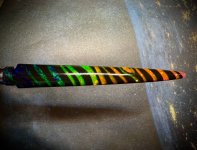
Finish on Acrylic blanks

Signed-In Members Don't See This Ad

Pezhead12554

Member
Joined
Oct 31, 2025
Messages
8
Location
Troy Michigan
What is you progression of grit and final polish on your kitless pens??
I use 240 and sand it both ways (circular and parallel) Then 320, 400, 600, 1000, 1500 and
then Semichrome polishing compound.
 
Signed-In Members Don't See This Ad
I know that works for you - 240, 320 then 400. But how sharp are you tools? I don't use carbide inserts often but when I do, the finish doesn't need anything below 400. Mostly I use HSS tools in the finishing stages and the sharpened chisel finish on the acrylic is at least 600, and that is when I am not careful.

The point is flat work mentality pushes one to use a lower sanding grit than necessary on pens - wood or acrylic. Properly sharpened tools, (or higher quality carbide insert) or proper use of a skew in the finishing stages - will usually decrease the amount of sanding needed.
 
Last edited:
On softer blanks (like Alumilite Clear Slow - Urethane), I usually apply two thin coats of CA such as GluBoost as it provides a harder layer that resists abrasion better than the raw Alumilite. This helps retain the glossy finish longer.

For finishing, I use two different methods:

Method #1: With the lathe at about 1000 RPM, I dry sand with 400, 600, and 800 grit sandpaper then go to wet sanding with standard Micro Surface pads. Then, depending on the finish I follow up with buffing using a sewn cotton wheel and PSI's blue buffing stick followed by a loose flannel wheel with no abrasive.

Micro Surface Pads:
#1500 (25 microns = about 400 ANSI grit)
#1800 (15 microns = about 1200 ANSI grit)
#2400 (12 microns = about 1500 ANSI grit)
#3600 (8 microns = about 2500 ANSI grit)
#4000 (5 microns = about 4000 ANSI grit)
#6000 (4 microns = about 5000 ANSI grit)
#8000 (3 microns = about 7000 ANSI grit)
#12000 (1 micron = about 10000 ANSI grit)

Method #2: With the lathe at about 1000 RPM, I dry sand with 400, 600, and 800 grit sandpaper. Then I bump the lathe up to about 3000 RPM and polish through the six grits of Stadium Pen Blank's Magic Juice. So far I have found no reason to buff following Magic Juice.

Magic Juice (AI Estimated Microns)
#1 (4 to 6 microns = about 3000 to 4000 ANSI grit)
#2 (3 microns = about 6000 ANSI grit)
#3 (2 microns = about 8000 ANSI grit)
#4 (1 micron = about 10000 ANSI grit)
#5 (0.5 micron = about 50000 ANSI grit)
#6 (0.25 micron = about 100000 ANSI grit)

Occasionally with Magic Juice I find a tiny white dot caused by residual polish that gets into a microscopic bubble or pinhole on the blank. Sometimes it can be challenging to get it out of there. For this reason, I often opt for the Micro Surface Pad and buffing method even though I do think that Magic Juice yields a superior glossy finish.

Dave

 
On softer blanks (like Alumilite Clear Slow - Urethane), I usually apply two thin coats of CA such as GluBoost as it provides a harder layer that resists abrasion better than the raw Alumilite. This helps retain the glossy finish longer.

For finishing, I use two different methods:

Method #1: With the lathe at about 1000 RPM, I dry sand with 400, 600, and 800 grit sandpaper then go to wet sanding with standard Micro Surface pads. Then, depending on the finish I follow up with buffing using a sewn cotton wheel and PSI's blue buffing stick followed by a loose flannel wheel with no abrasive.

Micro Surface Pads:
#1500 (25 microns = about 400 ANSI grit)
#1800 (15 microns = about 1200 ANSI grit)
#2400 (12 microns = about 1500 ANSI grit)
#3600 (8 microns = about 2500 ANSI grit)
#4000 (5 microns = about 4000 ANSI grit)
#6000 (4 microns = about 5000 ANSI grit)
#8000 (3 microns = about 7000 ANSI grit)
#12000 (1 micron = about 10000 ANSI grit)

Method #2: With the lathe at about 1000 RPM, I dry sand with 400, 600, and 800 grit sandpaper. Then I bump the lathe up to about 3000 RPM and polish through the six grits of Stadium Pen Blank's Magic Juice. So far I have found no reason to buff following Magic Juice.

Magic Juice (AI Estimated Microns)
#1 (4 to 6 microns = about 3000 to 4000 ANSI grit)
#2 (3 microns = about 6000 ANSI grit)
#3 (2 microns = about 8000 ANSI grit)
#4 (1 micron = about 10000 ANSI grit)
#5 (0.5 micron = about 50000 ANSI grit)
#6 (0.25 micron = about 100000 ANSI grit)

Occasionally with Magic Juice I find a tiny white dot caused by residual polish that gets into a microscopic bubble or pinhole on the blank. Sometimes it can be challenging to get it out of there. For this reason, I often opt for the Micro Surface Pad and buffing method even though I do think that Magic Juice yields a superior glossy finish.

Dave
Hi Dave,

Curious where in this workflow you apply the CA? I would guess after the 800 grit.

I recently got a sample set of magic juice and really liking it over micromesh/zona.

I also switched from sandpaper to 3m foam sanding pads and it's seeming to speed up my process a lot, mainly preventing radial marks from pressing too hard. I am making very curvy pens and was getting deep radial marks on the concave parts that took forever to deal with. The magic juice had been… well… magic! Haven't had an issue with white dots yet thankfully.
 
For pure synthetic blanks (acrylic, polyester, what have you), I usually just sand dry up through 400, then wet sand 600 and 1000, then use scratch free and micro magic waxes, and finally Novus #2 and #1, with a final coat of renaissance wax to help resist fingerprints.

For any blanks that are hybrid wood/synthetic, I do the same process, but only after applying 8-10 coats of CA glue.
 
Hi Dave,

Curious where in this workflow you apply the CA? I would guess after the 800 grit.

I recently got a sample set of magic juice and really liking it over micromesh/zona.

I also switched from sandpaper to 3m foam sanding pads and it's seeming to speed up my process a lot, mainly preventing radial marks from pressing too hard. I am making very curvy pens and was getting deep radial marks on the concave parts that took forever to deal with. The magic juice had been… well… magic! Haven't had an issue with white dots yet thankfully.
Yes, you are spot on, I apply the CA after dry sanding. Sometimes though, depending on how the blank looks, I dry sand up through more grits before I apply the CA. I have a container with strips (about 1" x 2.5") of sandpaper that goes from 800 all the way up to 7000 grit. I find that if I wipe the blank with denatured alcohol to clean it before applying the CA I get a pretty good idea of whether or not I want to sand it up through more grits. You are also spot on about using Magic Juice on figured turnings. That's what I do when I finish pens that I have turned in the Peter Hay (penpal) style. - Dave
 
Yes, you are spot on, I apply the CA after dry sanding. Sometimes though, depending on how the blank looks, I dry sand up through more grits before I apply the CA. I have a container with strips (about 1" x 2.5") of sandpaper that goes from 800 all the way up to 7000 grit. I find that if I wipe the blank with denatured alcohol to clean it before applying the CA I get a pretty good idea of whether or not I want to sand it up through more grits. You are also spot on about using Magic Juice on figured turnings. That's what I do when I finish pens that I have turned in the Peter Hay (penpal) style. - Dave
Thanks! I will give that a try. I'm turning a partially 3D printed blank pen at the moment and I think CA may be good on this one due to the texture differences between the materials. This is after sanding with 600, but will be taking it to at least 1200 first.
 

Attachments

  • IMG_0034.jpg
    IMG_0034.jpg
    387.5 KB · Views: 17
I work a lot with acrylic and I can say that the better the tool, the sharper it is, the better the final surface will be. I generally use 600, 1200 and finally 2500 grit wet sandpaper; it's important to maintain a water flow for better sanding efficiency. Automotive polishing compound is applied with a cotton cloth to finish.
 
What exactly defines this style?
I guess my best answer would have to be that the style is defined by the shape and coves Peter added to his Streamline pens. Peter Hay, known as PenPal on IAP was from Canberra Australia and was a member from November 2006 until his passing in March 2025 at 91 years pf age. I think I am the one that first used the term "Peter Hay style" in reference to the design.

I thoroughly enjoyed both the design and shape of his pens as well as the online conversations we had about two of his cousins. One that left Scotland and traveled with Brigham Young to Salt Lake City to settle. And the other that joined the Martin Hancock party. His father died near the Historic Florence Mill in Omaha, Nebraska, a site that I have driven past many, many times on my way to the Airport and to the College World Series. Peter told me that a friend had given him a piece of the Florence Mill that he had put away carefully waiting to make a special pen. He added that he had put it away so carefully that he couldn't remember where he put it and hadn't been able to find it.

As Oscar Wilde said, "Imitation is the sincerest form of flattery that mediocrity can pay to greatness", so on occasion I turn a Streamline pen (Peter's Favorite Kit) and I do my best to imitate the shape and coves he turned as can be seen in many of the pens he shared on IAP. One of my favorites that he made was from a Hairy Oak that he showed in the post ALLOCASURINA inophoiog (meaning the Hairy Oak). Some of his other work can be seen by visiting the Media pages found here on his Member page.

Dave
 
Back
Top Bottom