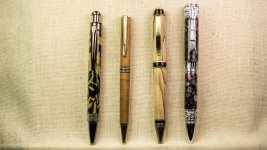
Your lenses are probably not your limitation. I would expect either the 18-55 or the 28-135 to be able to fill most of the frame with a pen and still get it in focus. I would recommend manual focus instead of letting the camera try to autofocus. If you find your camera manual online, you should be able to find how to use "live view" and the zoom buttons on the top right of the back panel to get a 10x view of what your lens is seeing in real time. That makes precise manual focus like shooting fish in a barrel.
The trickiest part about getting a good-looking pen photo is lighting. Without getting into a super long dissertation on it, the two things you probably want are a light source large enough, and way to control where that light spills.
Light in photography is often described as either "soft" or "hard." Soft light is what you want for most product photography. That means instead of casting hard-edged shadows, it tends to "wrap around" the subject and create a much more even, flattering look without harsh shadows; sometimes without much shadow at all. The way to get that is by making sure that the light source is larger than and/or closer to the subject. That's why photography studios that do portraits usually have gigantic softboxes and shoot-through umbrellas. They're spreading out the source of the light (usually a flash) so that it's much larger compared to their (human) subject. The good news is, your subject is a relatively small pen. That means you don't need to spend $300 on a 6' octobox to get nice soft lighting. You just need some kind of diffuser that is ideally larger than the pen. Lots of DIY options exist. You could point your flash or light source at an 8x10 square of white matboard and have the light bounce off of that as a reflector. If it's close to the pen and just out of frame, you should get really nice soft light.
If you're going for a light background, it doesn't much matter if your light spills all over the place. In my most recent crack at taking some nice photos of pens I've made, I really wanted a dramatic black background. That made it much more important to control the light and make sure it was hitting the pen, but not hitting the background, to the extent possible. I did that by using what's called "flags" (in my case just pieces of black whatever I could find) to block the light as it came out of my light panel, so that it would hit the pen, but not spill onto the black background. Without these, the background was more gray, and not convincingly "dark", so the pen didn't pop out like I wanted it to.
It occurs to me as I type that when you say you've tried with the flash, you might be referring to the built-in on-camera flash on your T7. I'll advise you to skip that entirely. The direction the light comes from is every bit as important as how soft it is and how well the spill is controlled. Almost nothing looks very good with light coming at it directly from the front, 2 inches above the lens. You'll want to use a different light source. That could be an inexpensive manual speedlight (the Godox TT520II is under $50). It could be an LED panel (which is what I'm currently using to photograph my pens). It could be a cheap clamp light with a regular lighbulb from Home Depot.
Anyway this has gotten long. Let me show you a picture of my setup and the results. You'll find that the lighting is hands-down the most important difference between a good and less-good pen photo. Even a cheap phone camera will make a great photo if the lighting is good. Your T7 and existing lenses should be more than up to the task.
Setup photo. Notice reflective black plastic base to sit on, matte black leather background (a notebook I had handy). Light coming from the right - as close as I could get it without being in the frame, to make it maximally soft. To the left of the pen a regular sheet of white printer paper to act as a reflector, and bounce back some of the light onto the left side of the pen so the contrast between the right and left wide wouldn't be as dramatic. The light source angled away from the background to keep light off of it and let the background stay dark. The flag on the left side of the light source primarily to stop light from shining directly into the lens and causing a flare. Sorry for the rotation of the photo. The forum doesn't seem to have a way to set the orientation.
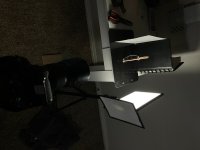
Phone photo from my 4-year old iPhone SE (the model with the least impressive camera). Same basic lighting setup, but before I added the black background or controlled the light spilling. Still easy to see how nice the soft light makes the pen look, regardless of camera.
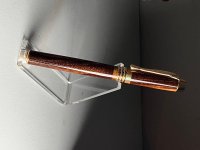
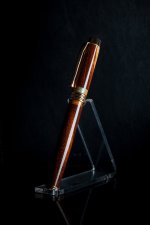
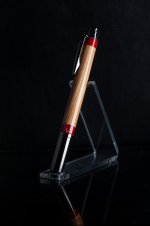
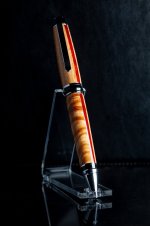
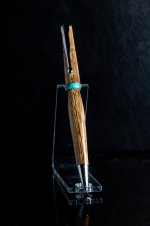
A few end results taken with the actual camera and the exact setup shown in the first photo.