Segmenting was a flop

Signed-In Members Don't See This Ad

Woodchipper

Member
Joined
Mar 15, 2017
Messages
7,272
Location
Cleveland, TN
Tried cutting some walnut and maple on the bandsaw. Here's what happened: BS has a 3 tpi blade. Got lots of tear out. Segments weren't square or flat. Going to see what members posted for cutting segments. Table saw is a Ryobi BT-3000 and has no miter slots. As mentioned, I'll search and see what is available. Suggestions are welcome as always.
 
Signed-In Members Don't See This Ad
There are two decent solutions to the BT-3000:
1. Build a surface with slots which will accept a sled with runners. This will reduce the depth of cut a little but for pen blanks, the benefit should well outweigh the loss.

2. Replace it with a decent saw.

For instance, this old Craftsman, https://knoxville.craigslist.org/tls/d/maynardville-sears-craftsman-10-inch/7914570910.html, is priced fairly and is the old Emerson Electric Co. design.
If everything operates smoothly, all it really needs is an upgrade Rip Fence.
These are often found for between $75-150.
Those saws still have parts available today.
It was—and is—a well engineered design.
 
I don't know you abilities, but I build my own 7 1/4" segmenting saw with a sled several years ago and still use it.

The BT 3000 has an add-on miter slot, and it will take two to do what you want - if you want a sled using miter slots on each side. I know of two people a few years ago that built sleds that moved along the side of the saw blade housing and did well and accurate. Before I built my own 7 1/4" segmenting saw, I used the BT3000 with a sled.

Here is the basic 7 / 71/4" segmenting saw. The sides don't show it but I had an aluminum strip on the side; the sled had rollers on the side and adjustments the same way that miter gauge bars have to keep the bars from having slop. So my cuts were accurate and dead on. If it got out of whack - I could tune it up with a bit of turnings with an Allen wrench.
https://www.penturners.org/media/imported-photo-from-leehljp.3523/

The sled
https://www.penturners.org/media/imported-photo-from-leehljp.3515/


Sled on a sled for precision adjustments
https://www.penturners.org/media/imported-photo-from-leehljp.3509/

After these pictures were taken I added clamp downs so that my hands would not be near the blade and also added a clear acrylic flip up top so that I could see without sawdust flying in my face.
 
Every saw weather tablesaw, bandsaw, scrollsaw skil saw, and many others have a way to cut both with the grain and across grain. Just the nature of a blade either going up and down or around. That saw looks like it has a sliding miter table and that is why no miter slots. Many ways to build jigs for that saw. Build it off the miter sled, build it off the fence, or build it off the sides of the table. You have to be open minded and google is your friend. There are many videos of different methods.

As far as bandsaw that blade is way to course for that kind of work. Also again easy to build jigs to be used on the bandsaw for various cuts. There is no one jig that does it all. There is no one attachment that does it all to any saw. Various companys offer many options and that is what they make sales on. After market gizmos and gadgets.

 
Disclaimer: I do not do segmenting.

Band saws by design will generally not give you a smooth straight cut. The blade is too flexible and wanders and twists. I have mine tuned in quite well and am very happy with how it cuts for cutting blanks, re-sawing, etc., but I would never expect it to give me the clean straight and accurate type cut I assume is necessary for segmenting.
 
One suggestion if you are limited to the bandsaw for cutting is to use one blade for curved cuts and a different one for straight cutting. once you do a curve with a blade, it seems to change the dynamic of the blade making it a bit harder to do dead straight cuts. A normal blade for curved cuts is usually narrower as well, which again makes it harder to do dead straight cuts. A 3/4 inch wide blade vs a 1/4 or so blade will both cut well, but will vary greatly in how well they hold a straight line. Same with the pitch and how the teeth are oriented. I keep a tag on my saw indicating which blade is installed (straight or curve cutter) and try keep them both for their tasks. If I want really good, straight lines however, its the table saw's job. If I have to use the bandsaw, I add one more step and run the cut pieces through a drum sander to clean them up.

I like these for good straight cuts Woodslicer

Kevin
 
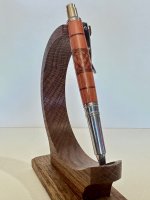
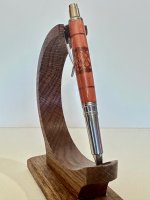
I use my bandsaw quite regularly for creating segmented blanks. The blade I typically use is a 3/16, 10tpi. You need to cut slowly for smoother cuts. Goes without saying the saw needs to be tuned and the blade properly tensioned. Bandsaws are great for segmenting and in fact on some designs they are the only saw that would work. One I can think of is an 8
sided Celtic knot. You could cut it on a table saw but you'll just end up with an unrecognizable blob. Here's one I recently finished, all bandsaw work.
 

Attachments

  • IMG_6304.jpeg
    IMG_6304.jpeg
    360 KB · Views: 17
  • IMG_6303.jpeg
    IMG_6303.jpeg
    367 KB · Views: 17
Back
Top Bottom