How hard is it to re-grind a skew?

Signed-In Members Don't See This Ad

BHuij

Member
Joined
Apr 23, 2025
Messages
332
Location
Utah
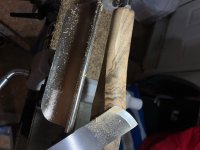
I recently picked up a CryoTek 1" rounded skew. I already had a 1/2" skew for smaller detail work, and I've been using both skews pretty extensively in recent weeks as I make chess pieces.

I was curious to try the rounded style grind after watching some videos on it, which is why I went with this one when I was shopping for a larger skew a couple of months ago. It seems like the primary advantage of the rounded grind is that it's a little more forgiving on planing cuts, while some of the disadvantages are that it's not quite as good for peeling cuts, v-grooves, or scraping cuts in most situations.

I actually love this skew, but after getting in many hours of lathe time with both this one and my smaller skew (which has a straight grind instead of a rounded shape), I'm finding I prefer a straight grind. I don't struggle to get smooth planing cuts with the smaller/straight skew anyway, and I'm finding the rounded shape isn't quite as good of a fit for the way I like to turn. It's also more of a pain to sharpen than the straight skew.

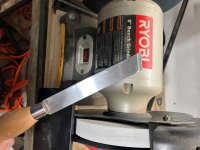
How hard would it be to re-grind this thing to straight? What would the steps for that look like? I have a coarse stone wheel (I think 64 or 80 grit) on my grinder, though it almost never gets used because I have not really had much occasion to re-profile my tools. Mostly I just use my finer white aluminum oxide wheel (I think it's maybe 240 grit?) for regular sharpening on most of my tools, or at least my gouges. Actually I only used the grinder on this skew one time right after I bought it. Everything since then has been touch-up with a drop of mineral oil on my 1200 grit diamond card, and a few passes to get it back to scary sharp when needed.

I can find a fair number of tutorials online for how to take your straight-ground skew and add a radius/curve to it, but nothing for how to go in the opposite direction :D

I have the Easy Grind system from CSUSA (platform, extendable V-arm, etc.) and it works great. Far as I can tell, it's equivalent to the Wolverine system that I used in woodshop class back in the day.
 
Last edited:
Signed-In Members Don't See This Ad
It's easy. Use the platform, not a jig, and set the platform position and angle to give you the bevel length (an alternate way of describing the angle of the grind) that you want.

If you mark the desired angle of skew on the platform (maybe put some tape down first so it's easy to remove), one line to the left and one to the right it makes it easier to get both sides the same.
 
Duncan said it all. The idea is to keep both sides equal and use a piece of tape 90 degrees to the sides and tape all around the skew. Figure out what angle you want. That is up to you. plenty of videos of how to select angles. Then set you platform to that and have at it. Slowly gring to shpe. When you marked the tape it should be to the least amount of material need to take off. You can do that with a square held on the side and line up to cutting edge. You can mark that with a sharpie and then put tape on. Try not to go below tape line or you have to move the finish line each time you do. Not hard to do at all. You really do not need to go to a course stone. Your standard sharpening stone will get it done easily.
 
Sorry to hear that you don't like the rounded edge. I am the opposite - it's one of the most used tools in my collection. But if you want to grind it straight, as @duncsuss said, its easy but will take a bit of time. Go slow and be sure not to burn the tool, as the hardness of the cryo tools is greatly accomplished through heat/cold treatments in making the steel - too much heat will leave you with a less than durable edge. If the tool starts to pick up color grinding (usually blue), slow down as you are overheating it. A course grey wheel is best for removing a lot of metal quickly, so maybe stick to that one until you have it almost fully shaped, then move to the finer one to establish the edge. Doug Thompson has a good video on YouTube for reshaping tools - he is a bit of a pro at it. One of Doug's Video's

Kevin
 
I don't hate the rounded edge, but after having now done enough work with both different shapes, I find I slightly prefer the straight one. No worries.

I'll give this a shot. I am inclined to do the bulk of the shaping with my most coarse wheel specifically for heat reasons. I'm mostly happy with my aluminum oxide for normal sharpening, but its not a slow speed grinder and it does build up heat really quickly.

As long as I'm not heating the metal past a certain point, is there any problem with using a bowl of water to quickly bleed off excess heat throughout the process?
 
As long as I'm not heating the metal past a certain point, is there any problem with using a bowl of water to quickly bleed off excess heat throughout the process?
I've heard conflicting answers to this question.

Some say "dip the tip into water after a few seconds grinding to cool it off."

Others say "High Speed Steel is weakened by the rapid cooling that happens when you do that."

I suggest you ask this question of a metallurgist or tool maker. Hobbyist turners are unlikely to have an answer based in science.
 
From all I have read on metal forums, as long as you don't turn HSS red it does not affect it. I grind quite a few HSS tool bits for my metal turning and have to dip them in water to be able to hold them.
 
I am not a metallurgist by any means, but I was told that dipping gouges in water to cool them down is not the best of ideas. I think that if the tool needs to be dipped to cool it, the damage to the metal is already done. But I would think there are smarter people out there with more experience than me on this one. Using a normal speed grinder is tougher than a slow speed at controlling heat, but I think with some good care, you should be able to make it work.
 
I find this odd that water hurts grinding tools. All the grinders like Tormek use water as a cooling agent. When I drill blanks on the lathe or use a forstner bit to drill holes I use denatured alcohol to cool. Maybe try that.
 
I understand that if steel is heated up past a certain point and then quenched in water (rapidly cooled down to below a certain point) that can do things like messing with a temper or a cryo treatment.

So I'm not asking "should I grind my tools until they're discoloring and glowing and then dip them in water before I keep going" so much as "If I use water to reset my tool temperature back to near room temp very frequently as I reshape, making sure that the steel at no point gets hot enough to start changing colors, am I in good shape?"
 
I understand that if steel is heated up past a certain point and then quenched in water (rapidly cooled down to below a certain point) that can do things like messing with a temper or a cryo treatment.

So I'm not asking "should I grind my tools until they're discoloring and glowing and then dip them in water before I keep going" so much as "If I use water to reset my tool temperature back to near room temp very frequently as I reshape, making sure that the steel at no point gets hot enough to start changing colors, am I in good shape?"
I would never grind any tool where it starts turning colors of any kind. In our world we need to learn patience and this is something as each generation goes by it gets worse and worse. Look at the driving on roads today. You take your life in your hands so much more these days because people are in such a hurry to go nowhere. Same goes for working in a shop. If you are in hurry of any kind I suggest get out and get out quickly. You will hurt yourself. Slow will get the job done. I say you will be just fine. No I am not a metalergist and do not want to be one. But have shapened many planer blades, chiesels, and other tools and water is fine to keep tool cool. You are not using ice water man. This is just one man's opinion. Again though a rag soaked in denatured alcohol will work as well. do not dunk in a bowl of alcohol.
 
Any liquid, water or alcohol. will give the same cooling effect. Alcohol just evaporates a bit faster. The trick is...don't grind the tool so much that it gets hot in the first place.
Besides, scotch is too expensive to cool turning tools.
 
Final suggestion. It might be best to just buy a straight edge skew of the size you want. leave this one with the Alan Lancer curve to it in case you decide you may want to use it. Never have enough skews. I have about 6 of them floating around the shop.
 
Back
Top Bottom