
Finish Question - Need to Preserve the Contrast in the Figure

Signed-In Members Don't See This Ad

d_bondi

Member
Joined
Jun 19, 2023
Messages
1,485
Location
Utah
Hello Everyone,

I am making a sleeved (ebonite) kitless pen with a nicely figured piece of Mun Ebony Burl. I would really like to keep the contrast between the light and dark in the figure. I use CA for my finish on 98% of my pens and plan to do so on this one as well. The problem is that CA darkens the wood, which many times is fine, but in this case it has the effect of darkening everything and muting the contrast of the light and dark.

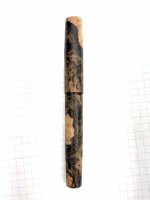
Here is a picture of the work in progress with no finish on it. You can clearly see the great light and dark differences in the figure.
79AF020A-0A4D-4C82-B53F-7A836EE5DFE1_1_102_a.jpeg

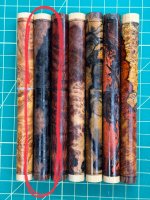
Here is a photo of this same piece of wood, earlier in the process and before shaping. It has a single coat of ultra thin CA (GluBoost) to protect the wood. See how the CA darkened everything and kind of ruins all the great contrast in the figure?
B2A52392-426F-49D1-BDB6-C4CED96858A3_1_102_a.jpeg

So here is the ask... is there anything that I can use to seal the wood to preserve the great contrast of color in the figure that won't darken it and that I can still put a GluBoost CA finish on?

Thanks in advance!

David
 
Signed-In Members Don't See This Ad
Not the same but maybe worth a try.
I was finishing pens made with maple and I got "annoyed" by the appearance after applying CA finish, basically the light color was turning into a mid-brown. I ended up applying a first coat of Rubio Monocoat White 5% or Cotton White (can't remember which I used) before CA and no color change of the maple! Haven't had a chance to try on other woods yet.
 
Since I've been mostly working with other materials and GluBoost or CA, I haven't experienced this, but I recently did a heavily burled table slab with Rubio Monocoat and I can say that the contrast in the wood held up just fine. One thing I did prior to the Monocoat was to use a wood hardener called PC Petrifier on the slab as parts of it were a bit punky, effectively sealing off the wood so that may have stopped it from darkening - and the PC Petrifier did not change the wood tone at all. The PC Petrifier is water based and easily applied. It's made local to me, but I think Home Depot and Amazon carry it. PC Petrifier Maybe if you have some other pieces of the burl, do some tests to see if this might work. They advertise it to turners who work with spalted wood by us and a few use it, but it's not a food safe solution, so not viable for bowls but it is nontoxic, so no issue with pens (or my table).

My thoughts would be to try the wood hardener and then the Rubio and see what happens. It is a shame to see the amazing color of that wood go to sad brown!!

Kevin
 
I've not been in the exact situation you are facing, but in general I've found water based finishes to cause less darkening than the oil based ones, and lacquer (as opposed to shellac). Things I've used include Minwax Poly-acrylate finish, rattle-can lacquer, and Hydrocote water-based lacquer.

I have a stick of ebony that is "black and white" (not sure if it's mun ebony or some other kind), I'll sand the stick and test the Hydrocote and the rattle-can and get back to you. Might take a couple of days as we have some stuff scheduled.
 
My first thought was lacquer or shellac, let dry and cure, then hit it with GluBoost. Do you have a small piece you can experiment with?
 
I've been trying the U-Beaut finishes lately. They have a white shellac that is used on lighter colored woods so as to not darken the woods.
This video describes all their finishes/polishes. I got the EEE-Ultra shine and Shella wax from Amazon (they drop shipped from PSI on one of the items).
 
Not the same but maybe worth a try.
I was finishing pens made with maple and I got "annoyed" by the appearance after applying CA finish, basically the light color was turning into a mid-brown. I ended up applying a first coat of Rubio Monocoat White 5% or Cotton White (can't remember which I used) before CA and no color change of the maple! Haven't had a chance to try on other woods yet.
Hi Fred (@Fred Bruche), thanks for the response. I have many questions...

You were able to put a high gloss CA finish over the top of the Rubio Monocoat? What prep did did you need to do after the Rubio and before the CA? How long did you have to wait for the Rubio to cure before doing so?
 
Last edited:
Since I've been mostly working with other materials and GluBoost or CA, I haven't experienced this, but I recently did a heavily burled table slab with Rubio Monocoat and I can say that the contrast in the wood held up just fine. One thing I did prior to the Monocoat was to use a wood hardener called PC Petrifier on the slab as parts of it were a bit punky, effectively sealing off the wood so that may have stopped it from darkening - and the PC Petrifier did not change the wood tone at all. The PC Petrifier is water based and easily applied. It's made local to me, but I think Home Depot and Amazon carry it. PC Petrifier Maybe if you have some other pieces of the burl, do some tests to see if this might work. They advertise it to turners who work with spalted wood by us and a few use it, but it's not a food safe solution, so not viable for bowls but it is nontoxic, so no issue with pens (or my table).

My thoughts would be to try the wood hardener and then the Rubio and see what happens. It is a shame to see the amazing color of that wood go to sad brown!!

Kevin

Hi Kevin (@NJturner), thanks for the response.

I looked up this PC-Petrifier and it looks interesting. I may need to grab some.

The customer wants the High Gloss CA finish. He carries and uses the wood pens I make for him, so it needs to be something that is truly durable like CA. Have you tried CA over the PC-Petrifier?
 
Last edited:
I've not been in the exact situation you are facing, but in general I've found water based finishes to cause less darkening than the oil based ones, and lacquer (as opposed to shellac). Things I've used include Minwax Poly-acrylate finish, rattle-can lacquer, and Hydrocote water-based lacquer.

I have a stick of ebony that is "black and white" (not sure if it's mun ebony or some other kind), I'll sand the stick and test the Hydrocote and the rattle-can and get back to you. Might take a couple of days as we have some stuff scheduled.
Hi Duncan (@duncsuss), thanks for the response.

Black and White is also called Pale Moon Ebony. For testing purposes, it might be a reasonable control.

Can you put CA over lacquer? I thought that I read somewhere that it wasn't advised.
 
Last edited:
My first thought was lacquer or shellac, let dry and cure, then hit it with GluBoost. Do you have a small piece you can experiment with?
Thanks for responding Kent (@bugradx2).

Have you put CA over the top of these before? I have heard you can with shellac, but have heard that CA over Lacquer can be problematic. Just curious.
 
I mix my own dewaxed shellac from flakes and it's a sealer which should prevent discoloration while allowing still giving CA something to adhere to.
Thanks for the response Gary (@GaryMGg).

Does the shellac amber/yellow the lighter wood? It has been a while since I used shellac, but I seem to recall that it "warms" the colors. This piece is on the cooler end of the spectrum and I'd like to maintain that.
 
I've been trying the U-Beaut finishes lately. They have a white shellac that is used on lighter colored woods so as to not darken the woods.
This video describes all their finishes/polishes. I got the EEE-Ultra shine and Shella wax from Amazon (they drop shipped from PSI on one of the items).

Hi @Mortalis, thanks for the response.

I have trued friction polishes before and even have some of the U-Beaut products. Have you applied CA over this? That is a requirement for this commission, the hard protective high gloss I can get from the CA.
 
Thanks for everyones responses, and sorry for the follow-up questions!

Has anyone tried using Mylands Cellulose Sanding Sealer under CA? I wonder if this would work...
 
I have not read all the responses, so if this has been stated before, my apologies.

I have faced a similar situation before when using black palm wood. I chose not to apply any coat on the pen. The wood is dense enough that I was able to simply sand it down to 5000 grit. On some other woods I have used bees wax as the only coat after sanding it to 5000. The only downside of bees wax is the smell. Some people my not like the honey smell. You can try carnauba wax instead.

I hope this helps.
 
I have not read all the responses, so if this has been stated before, my apologies.

I have faced a similar situation before when using black palm wood. I chose not to apply any coat on the pen. The wood is dense enough that I was able to simply sand it down to 5000 grit. On some other woods I have used bees wax as the only coat after sanding it to 5000. The only downside of bees wax is the smell. Some people my not like the honey smell. You can try carnauba wax instead.

I hope this helps.
Thank you for the response Manoj (@manojd). I have worked with Black Palm quite a bit. I am surprised that you had success with it with no finish. The darker parts are quite hard and dense while the lighter is very punky. I "stabilize" it with CA during the turning process, otherwise it has a tendency to spontaneously separate (explode) while turning. I really like the way Black palm finishes with CA.

This Mun Ebony, being burl, is not all dense enough to leave unfinished. The lighter sap wood would soak up anything it came in contact with. A dangerous and undesirable quality for a fountain pen.
 
- Can you apply CA over Rubio Monocoat?
Google response: You cannot apply CA over a cured Rubio Monocoat finish. Because Rubio relies on waxes and a unique molecular bond with raw wood fibers, CA glue will not adhere or cure properly
- Can you apply CA over lacquer or shellac
Google response: Shellac, yes. Lacquer, no
- Can you apply CA over PC-Petrifier
Google response: Since PC-Petrifier hardens and seals the wood fibers, it may prevent the penetration required for CA glue to cure effectively
- Can apply CA over Myland's Cellulose Sanding Sealer
Google response: Yes, as long as the sanding sealer has fully cured (typically 1–2 hours minimum) before applying CA
 
Thanks for responding Kent (@bugradx2).

Have you put CA over the top of these before? I have heard you can with shellac, but have heard that CA over Lacquer can be problematic. Just curious.
I would have to go and double check but I'm pretty certain I've done CA over lacquer but it had a lot of time to fully cure before I did the CA.
 
- Can you apply CA over Rubio Monocoat?
Google response: You cannot apply CA over a cured Rubio Monocoat finish. Because Rubio relies on waxes and a unique molecular bond with raw wood fibers, CA glue will not adhere or cure properly
- Can you apply CA over lacquer or shellac
Google response: Shellac, yes. Lacquer, no
- Can you apply CA over PC-Petrifier
Google response: Since PC-Petrifier hardens and seals the wood fibers, it may prevent the penetration required for CA glue to cure effectively
- Can apply CA over Myland's Cellulose Sanding Sealer
Google response: Yes, as long as the sanding sealer has fully cured (typically 1–2 hours minimum) before applying CA

Thank you @Mortalis, I had googled all of those.

Was hoping for some feedback from first hand personal experience from this group. I have learned to be skeptical of Google (and AI) responses.
 
Thanks for the response Gary (@GaryMGg).

Does the shellac amber/yellow the lighter wood? It has been a while since I used shellac, but I seem to recall that it "warms" the colors. This piece is on the cooler end of the spectrum and I'd like to maintain that.

The folks I used to buy from aren't around but these guys have a good reputation:

Blonde flakes
 
Hi Kevin (@NJturner), thanks for the response.

I looked up this PC-Petrifier and it looks interesting. I may need to grab some.

The customer wants the High Gloss CA finish. He carries and uses the wood pens I make for him, so it needs to be something that is truly durable like CA. Have you tried CA over the PC-Petrifier?
Hi David-
No, the project was a 3' x 5' table top - way too large for a CA coat. I was concerned about the Rubio Monocoat as it says it needs to soak into the wood, and with the Petrifier, that is just not really possible as it sets up like an epoxy finish, but I have to say the Rubio went on very nice and is holding up well. The finish is a semi-gloss, like a soft shine which was what I was shooting for. I'm totally out of Petrifier or I'd try it for you. Home Depot by us carries it, but as it's a local company, that may be why. May not be available in Utah......I'll ask the folks in my turning club if anyone has given it a shot.

Good luck!!

Kevin
 
Hi David-
No, the project was a 3' x 5' table top - way too large for a CA coat. I was concerned about the Rubio Monocoat as it says it needs to soak into the wood, and with the Petrifier, that is just not really possible as it sets up like an epoxy finish, but I have to say the Rubio went on very nice and is holding up well. The finish is a semi-gloss, like a soft shine which was what I was shooting for. I'm totally out of Petrifier or I'd try it for you. Home Depot by us carries it, but as it's a local company, that may be why. May not be available in Utah......I'll ask the folks in my turning club if anyone has given it a shot.

Good luck!!

Kevin

Thanks Kevin (@NJturner), I ordered it from Amazon. $10 and it will be here tomorrow. I'll test it out.

I am doing a test with the Mylands Cellulose Sanding Sealer and a Minwax Wood Hardener (had it on hand).

Color wise, the Mylands might work and I don't think the Minwax will, it darkened the wood immediately.
 
Back
Top Bottom