Drilling angled holes through thin trim metals

Signed-In Members Don't See This Ad

BHuij

Member
Joined
Apr 23, 2025
Messages
323
Location
Utah
I want to include some thin bits of aluminum and brass in my segmenting (0.5mm thick brass, 0.8mm thick aluminum), but I want the trim to sit at a 30* or even 45* angle (maybe even steeper someday) off from "horizontal" in the direction of the hole for installing brass tubes into the blank.

In the past I've gotten lucky once or twice with cutting and gluing the segments prior to drilling to make up a blank, and then drilling carefully through all layers. But more often than not, when I try that, even my fully cured 24 hour epoxy will fail at glue joints, particularly ones between wood and metal. No amount of surface prep (acetone cleaning, sandpaper scuffing) or playing around with clamping pressure during glue up seems to prevent this.

So the vast majority of my segmenting has been done by pre-drilling every component material, and then cutting whatever angles, and finally gluing it all up around the axle of the brass tube.

Problem is, I can't just drill a straight hole through a strip of aluminum flashing and expect it to sit properly between pieces of wood that are cut at a 45* angle, for obvious reasons. Yet I can't think of a good way to drill cleanly through at the required angle prior to glue up. Any suggestions? I have a hand drill and I'm set up to drill on my lathe, but I don't have a drill press.
 
Signed-In Members Don't See This Ad
So, what I would do is get yourself a larger square block of wood. Then find a piece of aluminum tube, whose hole is just slightly smaller than the drill bit you are going to use for your tube. This piece of aluminum tubing needs to have enough wall thickness that will allow you to drill out the center with your tube drill bit. Drill and epoxy in this aluminum tube into the large block of wood. Then cut your angled slot into the block, but not all the way through. You will need to match your slot size to the thickness of your aluminum or brass sheet. Place the sheet into the slot and then clamp it in from the top. Drill through the aluminum sleeve and through the brass or aluminum piece. Remove the clamp and then clean up the hole in your brass piece with a hand champfer bit or cartridge reamer.
Then glue in the brass piece to your segmented blank. You could create an alignment pin from a piece of hdpe.

You are effectively creating a drilling sleeve that allows you to pre-drill your shim stock.
 
Another technique I have used is to fully encapsulate the segmented blank with strips of wood and Gorilla expanding urethane glue. Use rubber bands to hold the strips of wood in place until the glue cures. You're basically creating an exoskeleton. Once the glue has expanded and dried, you can drill through the blank, and the exoskeleton will hold everything together. You can then turn the big fat blank down to size.
 
I have a number of picts that I will present below. The main difference between what I do and what may work for you in this manner is that you would have to drill at an angle. SOME of the picts are BLURRY but you can make out the purpose of the picture.

in brief, I basically laminate a sheet of brass or aluminum between two half inch (at least) thick pieces of quality plywood (screwed together well), mark my drill holes, then drill. Unscrew the two sheets of plywood. Cutting the segment pieces out with tin shears will distort them, but a hammer and a small anvil will flatten them. My brass segment holes are round; yours will be oblong if you drill them at an angle.

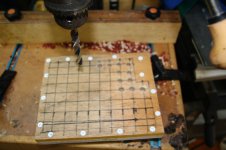
the pict below is the grid that I played out a piece of brass.

1.JPG

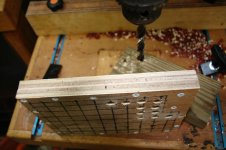
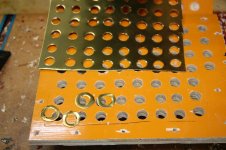
This picture shows two sheets of plywood screwed together with the brass sheet in between (which cannot be seen). The purpose of placing the brass (aluminum) between two sheets of plywood is to keep the bit from twisting the thin brass or aluminum as it drills.

2.JPG


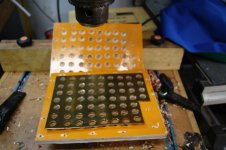
This is what it looks like after taking the two layers of plywood apart:

3.JPG

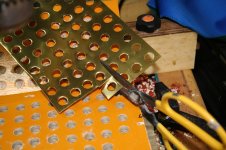
Next I cut semi-round circles around the holes. Of course they will twist and distort.

4.JPG

This is what a generalized circle of brass will look like, but not flat:

5.JPG

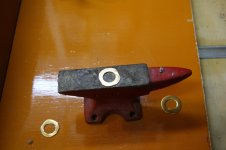
I flatten the circles with a hammer on an anvil or flat piece of thick steel: For me, it is ready to be used in a segment: I do a bunch at a time, because it is not worth it to go to that trouble for just enough for one pen at a time.

6.JPG

I am not sure if this helps for what you need or not, but it is the way I do it for 90° drilling. WHILE these are not perfectly round, they do well enough that I can turn them in the blank very gently without them heating up too much that would cause the glue/adhesive from detaching from the blank as it was turned to round. It did not hurt my turning tools of choice but I did keep them sharp.
 
Last edited:
The issue is the tip of the drill bit flute will touch the metal and dig under it and pull it right away from the glue joint breaking the glue joint. I have had some luck in gluing reinforcements to the blank. I have also thought of taking a drill bit and filing a "flat" on the bit flute parallel to the axis of the bit. In effect this converts the upward force to a twisting force.

There is an entire science to making cutting edges perform in particular materials and situations.
 
Last edited:
I have had the best luck drilling thin metal segment materials by scuffing and gluing them with epoxy and then drilling with bits designed for drilling plastic materials. These drills have a 60-degree point angle (very pointy). The steep angle lets the bit cut with less downward pressure which helps reduce the tendency for drills to grab the material. - Dave
 
Back
Top Bottom