Any chip carvers here?

Signed-In Members Don't See This Ad

Tieflyer

Member
Joined
Jan 3, 2013
Messages
173
Location
St. Louis
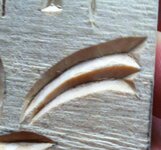
While completely re-doing my wood shop due to life's little glitches I've taken up trying to learn chip carving. Have had a few A-ha! moments already and wondered if any of you do this as well. Have to remind myself to let the tool do the work but getting there!

image.jpg
 
Signed-In Members Don't See This Ad
I don't know what kind of wood that is, but get some basswood. It's tough enough to learn a technique on the right material, but using the wrong wood will give you fits. At first thought, I'd say you went too deep, too fast. Concentrate on smoooooooooth. Long sweeping curves. Slide your bracing thumb on the wood as you pull the knife. Usually the end cut like that is one facet, made in one cut. Get any information you can from Wayne Barton. He is a robot at this work. Took a weekend class with him at a Woodcraft years ago. Also, if you can't see yourself in the bevel of the knife, it's not sharp enough.

 
While completely re-doing my wood shop due to life's little glitches I've taken up trying to learn chip carving. Have had a few A-ha! moments already and
wondered if any of you do this as well. Have to remind myself to let the tool do the work but getting there!

Hi Jeff; Haven't CC'd for a few years now. I taught a basic 3 hr. course at LV in Toronto East for about 10 years or so. I also had my own small business where I gave weekend lessons.

I took a weekend course with Dennis Moor (www.chippingaway.com) as well as a 1 week course with Wayne Barton in Haliburton cottage country when he used to visit Canada on a teaching tour.

Basswood is certainly the wood of choice, but Butternut is great for CCing also.

I always taught students their knives should be sharp, shiny, & smooth to flow through the wood rather that cutting the wood. Ceramic stones are also a must for sharpening CC knives. Never oil stones as they have a tendency to wear away and put a curve in your knife edge. Ceramic stones stay flat forever!

Here's a hint if your Basswood is too dry, and has a tendency to chip out where you don't want it to. Place the piece you are carving in an ice chest with a margarine container of water for a few days. The Basswood will take on some moisture and be very easy to carve.

Practice 1/2 hr. a day for 3 mths and you will have an aha! moment in that time. It will turn to fun and not work.

One last tip -- your tongue must always protrude from the right side of your mouth when carving!:laugh:
attachment.php


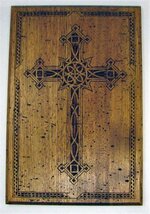
One of Barton's patterns on carved on Wormy Butternut!
 

Attachments

  • Chip Carving 027 (Small).jpg
    Chip Carving 027 (Small).jpg
    43.8 KB · Views: 255
I don't chip carve but hand carved a lot of flutes. To carve a flute your tongue must be stick out the side of your mouth that represents the side of the piece you are working on.

It is the tongue that truly guides the knife.

Nice carving by the way.
 
Protrude from right side while chip carving...protrude based on side of flute being carved. These lessons sound the most important but going to need Chapstick! I just got a book and DVD by Barton, lets see what I can get through over the weekend!
 
Back
Top Bottom