trimming blanks

Signed-In Members Don't See This Ad

montmill

Member
Joined
Jan 26, 2008
Messages
818
Location
13528 Old Hwy. G Montfort, Wisconsin
I believe Dave has mentioned he made a jig to trim the corners off his blank on the bandsaw so it didn't have sharp corners when turning. I wonder if anyone else does that and if so, would you mind sharing a photo of the jig? It seems like that would speed up the process as well as make a smoother first few passes with the gouge. Thank you.
 
Signed-In Members Don't See This Ad
I think in the time to trim the corners, I could put the blank on the mandrel and bushings and turn to round. I find that the corners of synthetic materials takes a bit more time than wood.
 
I do it on segmented blanks. I don't use a jig, just use my disk sander. I've seen where some use a round over bit on a router table. It doesn't take much. I've never seen the need for a jig.
 
I believe Dave has mentioned he made a jig to trim the corners off his blank on the bandsaw so it didn't have sharp corners when turning. I wonder if anyone else does that and if so, would you mind sharing a photo of the jig? It seems like that would speed up the process as well as make a smoother first few passes with the gouge. Thank you.

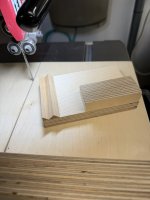
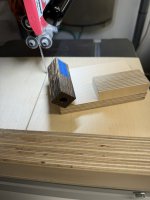
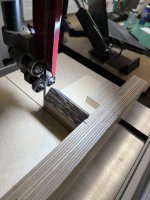
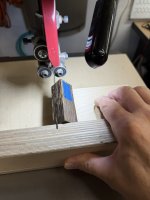
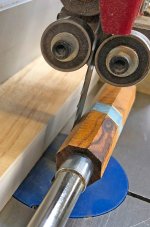
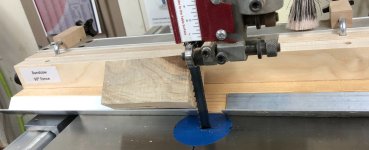
The jig I use is a simple one that I set on the crosscut sled I made for my bandsaw. I do hold the piece with my right index finger and that does get within 1/4" of the meat saw blade, so be careful. I suppose I could add a hold down. Here are a few photos.

9BD0B300-BB92-4D37-A120-8424230D0AA4_1_102_o.jpeg 9244AAB4-1396-4DD8-8F80-B3E13EF295EF_1_102_o.jpeg C3F18345-C57C-4A56-9B83-F529D9644A1C_1_102_o.jpeg 7EB13877-3EA7-4F9E-9D9F-FF1279F288BB_1_102_o.jpeg 600D22AB-7BCF-4E9F-BDA5-2BEB345B303F_1_102_o.jpeg

I think in the time to trim the corners, I could put the blank on the mandrel and bushings and turn to round. I find that the corners of synthetic materials takes a bit more time than wood.

Maybe you can, maybe not. I'm thinking not, but for me it isn't a race. It doesn't take long to trim off the corners and have an octagonal work piece.

To put it in context, I am doing this when I have sleeved a wood blank with ebonite or some other material and will be turning the piece on a machined threaded mandrel that is threaded into that machined ebonite. I want to reduce the stress on the ebonite liner, its threads, and the epoxy joint.
 
I do it on segmented blanks. I don't use a jig, just use my disk sander. I've seen where some use a round over bit on a router table. It doesn't take much. I've never seen the need for a jig.
I often use a round over bit in my router table, and as Ken mentioned - especially with segmented blanks, and acrylics too.

The jig I use is a simple one that I set on the crosscut sled I made for my bandsaw. I do hold the piece with my right index finger and that does get within 1/4" of the meat saw blade, so be careful. I suppose I could add a hold down. Here are a few photos.

Maybe you can, maybe not. I'm thinking not, but for me it isn't a race. It doesn't take long to trim off the corners and have an octagonal work piece.

To put it in context, I am doing this when I have sleeved a wood blank with ebonite or some other material and will be turning the piece on a machined threaded mandrel that is threaded into that machined ebonite. I want to reduce the stress on the ebonite liner, its threads, and the epoxy joint.

Router table or band saw: The issue here is how convenient it is to use either. I don't use my router table daily, sometimes weekly or even occasionally monthly, and the table gravitates to a "catch all" table. (And my router table has two routers in it.) When I am making segmented blanks, I have learned to clean my router table off in advance. I am not a "neatnik" 🙄, and have to prepare before hand, but when I do, it sure helps.
 
Last edited:
I use two different jigs depending on the size of the blank.

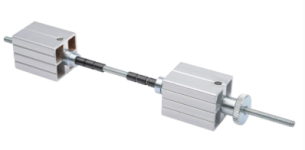
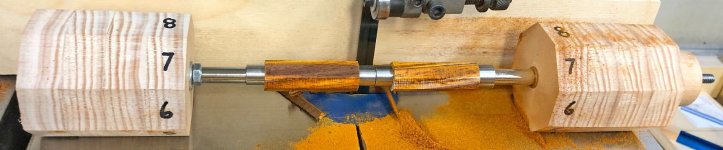
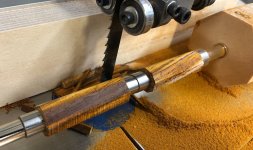
The one I made for pen blanks indexes off of the center of the blank so even if the blank was drilled crooked, the bandsaw cuts the blank so it is symmetrical around the tubes. It is is essentially some octagon shaped blocks with a hole through the middle to accept a 1/4" threaded rod. The blanks go on the rod like a mandrel with the bushings. The amount of material removed is controlled by sliding the octagon ends against the bandsaw fence and rotating it 45-degrees after each cut. It is based on the design of the one that PSI used to sell but with wood octagons rather than aluminum squares. (See the pictures below).

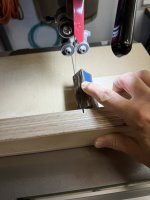
The other jig I use is simply a piece of 90-degree angle aluminum mounted to a board that I clamp to my bandsaw fence. The stock rides in the aluminum angle and is rotated 90-degrees after each cut. It works for larger stock (like for bottle stoppers) and pen blanks that are not drilled and tubed for bushings. The jig was roughly based on a Jig printed in Wood Magazine. (See the picture below).

Dave

PSI's Corner-B-Gone
PSI Corner-B-Gone.PNG

My Variation of the Corner-B-Gone

IMG_2637 Cropped.jpg
IMG_2638 Cropped.jpg IMG_1747 Cropped 2.jpg


My Jig for Larger and Non-Drilled blanks

IMG_5446 Cropped.jpg
 
I think in the time to trim the corners, I could put the blank on the mandrel and bushings and turn to round. I find that the corners of synthetic materials takes a bit more time than wood.
I'm here too.
By the time you set up the jig and cut the four corners off then mount the blank on the lathe and now start the rounding process, IMO, has to to take longer.
I mount my blank (I TBC) I work from the center out to the ends and using a skew or roughing gouge takes no more than a couple minutes per blank.
 
I'm here too.
By the time you set up the jig and cut the four corners off then mount the blank on the lathe and now start the rounding process, IMO, has to to take longer.
I mount my blank (I TBC) I work from the center out to the ends and using a skew or roughing gouge takes no more than a couple minutes per blank.

For many, and especially with delicate blanks, segments and those hard chipping acrylic ones and with ironwood type, it is not about the time at all. I fully understand the tedious first few seconds or maybe 20 or so, the hard surfaced edges as they "chip" off. As to rounding the square edges off before putting on the lathe - it sure brings peace of mind.
 
Oh yeah? Well mine is more highly sophisticated and higher engineered. 😏

IMG_20260111_154727731.jpg


IMG_20260111_154744135.jpg


IMG_20260111_154830070.jpg


Detailed drawings and measurements are available for purchase. 😉
 
Back
Top Bottom