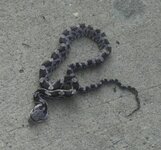
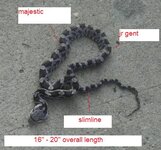
This guy showed up at the office today

Signed-In Members Don't See This Ad

GoodTurns

Member
Joined
Apr 20, 2007
Messages
4,145
Location
Bowie, MD, USA.
Can any of you experts ID the little guy? He has been safely delivered to the woods on the other side of the parking lot...just wondering if I was in any danger... he did coil up and shake his tail at me but it was reminiscent of a two year old shaking a fist...more cute than scary!
 

Attachments

  • snake by the door.jpg
    snake by the door.jpg
    32.9 KB · Views: 574
Signed-In Members Don't See This Ad
Can't see the head real well but it could be a hognose, they can very greatly in color and pattern depending on location.
 
There are 2 snakes that will shake their tales like a rattle snake; the Bull Snake and the Rat snake. The thing throwing me off about this guy is the shape of his head. Triangular shaped heads is thought to be THE common trait among pit vipers. But not all snakes with triangular shaped heads are venomous. I believe this to be a small Bull Snake. Most Rat snakes have a very distinguishable arrowhead shaped pattern on the top of their heads, but I don't see one here. I have also never seen one with such a strong triangular shaped head.
 
I've sent the pic to a friend: "Dr Tom 'SnakeBoy' McDonald" to see what he thinks... In the meantime you can see him with a couple of critters on Tucson's "Morning Blend" here: Tohono Chul Park - Tucson Morning Blend

Tom's a heck of a guy... and no one I know needs a grade from him anymore (he's a college professor as well), so I'm not just saying that.
 
He may not be poisionous but the glands on the side of his head indicates otherwise. Looks like a Northern Copperhead and if they are anything like the Southern Copperhead it will lay there and look at you like your crazy until you are in range. On the other hand he may have simply tried to swallow one of those pen barrels sideways.
 
Last edited:
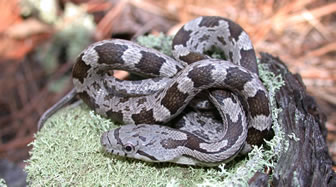
While the size and shape of the head would certainly suggest a venomous snake, I believe it is a juvenile Gray Rat Snake. On some juvenile snakes the head can appear a bit too large for the body giving the impression of a venomous snake. That said, I like snakes and I would never pick up a snake with a head shaped like that if I was not positive of what kind of snake it was. There are too many nut-case people (IMHO) out there that get a kick out of keeping venomous snakes as pets and every once in a while one gets out or is let go because it's no more fun to take care of. I'd be very careful picking up any snake you can't easily identify.

Jim Smith
 
Last edited:
Elaphe obsoleta

Species Profile: Rat Snake (Elaphe obsoleta) | SREL Herpetology

elaobs3.jpg


Watch this video.
Black Snake that thinks it's a rattler - YouTube

ANIMAL BYTES - Black Rat Snake

FUN FACTS
1. Black rat snakes are one of the longest snakes in North America, occasionally reaching lengths of 8 feet.

2. When threatened, rat snakes will "rattle" their tail, fooling other animals into believing they are venomous.

This is one that has been around for many years now.
IMG_1238.JPG


IMG_1235.JPG


I am 100% positive the snake you posted is a rat snake.


http://www.dnr.state.md.us/wildlife/Plants_Wildlife/herps/Squamata/EasternRatsnake.asp

JuvERatsnake_ScottSmith.jpg
 
Last edited:
Its a good thing you didnt kill it. I posted a picture of one I killed a couple months ago and you would have sworn from so of the people on here I was a heartless no good murderer. When it comes to snakes if I dont know what kind it is, its a dead snake till I know.
Problem hear it again but whatever.
 
Tom SnakeBoy McDonald: Consensus is that if it's a native species and not someone's escaped pet then it's probably a juvenile black rat snake. The wide head is what confused me, and it's confusing others as well.
10 minutes ago · Like

Tom SnakeBoy McDonald: Juveniles can be a bitch to ID.

Looks like he agrees with several others. Tom teaches college out in AZ, and loves reptiles of all types especially snakes. Watch the video link I posted above... Tom's a nutter!
 
Its a good thing you didnt kill it. I posted a picture of one I killed a couple months ago and you would have sworn from so of the people on here I was a heartless no good murderer. When it comes to snakes if I dont know what kind it is, its a dead snake till I know.
Problem hear it again but whatever.

Ok i'll bite. Killing the snake is good how? Because you have psychological disorders involving paranoia, fear, phobias etc.. does not warrant a mindless killing of something that is not understood.

An agile climber, gray rat snakes are at home from the ground to the tree tops in many types of hardwood forest and cypress stands, along tree-lined streams and fields, and even barns and sheds in close proximity to people. Within its range, almost any environment rich in rodents, and vertical escape options, proves a suitable habitat for the gray rat snake. As scent-hunters these powerful constrictors feed primarily on rodents, birds, and their eggs as adults, while neonates and juveniles prefer a diet of frogs and lizards.

As the name itself implies, the primary diet of the rat snake are mice and rats. This is the reason that these snakes are very commonly seen in fields and country homes. However, as these snakes pose no threat to human life, they are often used as a natural form of rodent control. Farmers prefer having the rat snakes in their farms as they help get rid of all the rodents that destroy their crops and grains.

The rat snakes are also frequently seen in chicken coops and poultry farms. People make a mistake by thinking that the snake is after the eggs or the chickens but the fact is that these snakes are actually scouting for the rodents that live in this area. However, if the population of the rodents is scarce, then the rat snakes are known to eat small birds. Incidents have been reported when these snakes have climbed trees as high as 30 feet to get to a bird's nest.

I fail to see how killing this type of creature is a 'good' thing. Wild rats harbor insects which causes plague, west nile and a load of other viruses, diseases and the like.

Considered responsible for the Black Plague during the Middle Ages, rats are still well-known carriers of over 70 diseases. From the transmission of bubonic plague to typhus and Hantavirus, rat infestations can prove harmful to human health.

One of the most dangerous rat-borne diseases is the bubonic plague and its variants.

Rat urine is responsible for the spread of leptospirosis, which can result in liver and kidney damage. Complications include renal and liver failure, as well as cardiovascular problems. Approximately half of the reported cases of leptospirosis are fatal.

Lymphocytic choriomeningitis, a viral infectious disease, is transmitted through the saliva and urine of rats. This disease results in fever, malaise, appetite loss, muscle aches, headache, nausea and vomiting. Victims may also experience inflammation of the central nervous system and can contract meningitis or encephalitis. Some individuals experience long-term effects of lymphocytic choriomeningitis, while others experience only temporary discomfort.

 
Back
Top Bottom