
JasonM
Member
About a week ago, I spent time with family up in the back woods of southern Arkansas helping them to clean and pack up the estate of my wife's grandfather, affectionately known in the family as "Gramps".
As he passed last spring we've all had time to grieve and the weekend was much more a feeling of celebration for a true member of the greatest generation. He was one of those who would straighten bent nails to save the cost, could fix anything, and would just as soon do everything for himself because he knew HE would do it right. =)
Among the tasks while there was to burn off a large pile of brush and debris that had collected in an area on the back acreage where he often burned branches, leaves, and the like.
In the piles were several larger pieces of wood from some deadfall he had cleared to make room for a storage shed. Most of it was rotting and beyond use. But there were several sizeable pieces of what Gramps often referred to as "ironwood" still in decent shape. Upon inspection, I thought I saw some spalting in some of the pieces and my brother helped me to grab some before the fire was set. Gramps had sent me some blanks he made from it before. It definitely requires super sharp tools and usually more sharpening during turning. But the results are always nice.
I brought it home and cut it down to blanks and found some wonderful looking stuff inside!
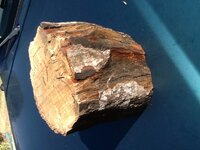
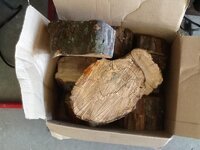
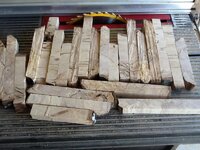
To my knowledge, ironwood is a fairly generic term that is used for a large variety of trees. If anyone has any more info about what I've got here, I'd love to know more. I've attached some photos - pre and post cutting. The blanks pictured are what I got after cutting down just about a third of what I brought home!
The wood ranges from caramel to yellow. Is pretty fibrous around the edges, and the way the bark peels off in sheets reminds me of cottonwood or birch. But I don't think it's either of those.
Thanks everyone! (And thanks, Gramps!!)
As he passed last spring we've all had time to grieve and the weekend was much more a feeling of celebration for a true member of the greatest generation. He was one of those who would straighten bent nails to save the cost, could fix anything, and would just as soon do everything for himself because he knew HE would do it right. =)
Among the tasks while there was to burn off a large pile of brush and debris that had collected in an area on the back acreage where he often burned branches, leaves, and the like.
In the piles were several larger pieces of wood from some deadfall he had cleared to make room for a storage shed. Most of it was rotting and beyond use. But there were several sizeable pieces of what Gramps often referred to as "ironwood" still in decent shape. Upon inspection, I thought I saw some spalting in some of the pieces and my brother helped me to grab some before the fire was set. Gramps had sent me some blanks he made from it before. It definitely requires super sharp tools and usually more sharpening during turning. But the results are always nice.
I brought it home and cut it down to blanks and found some wonderful looking stuff inside!
To my knowledge, ironwood is a fairly generic term that is used for a large variety of trees. If anyone has any more info about what I've got here, I'd love to know more. I've attached some photos - pre and post cutting. The blanks pictured are what I got after cutting down just about a third of what I brought home!
The wood ranges from caramel to yellow. Is pretty fibrous around the edges, and the way the bark peels off in sheets reminds me of cottonwood or birch. But I don't think it's either of those.
Thanks everyone! (And thanks, Gramps!!)
Attachments
Last edited: