

egnald
Member
Greetings from Nebraska.
All of these have been spoken for. Thank You Very Much!
PM's are being sent to work out payment and shipping details.
Once again, Thank You!
I am usually buying exotic wood blanks rather than selling them, but I have run into a situation where I need to put a few up for sale.
About 15 years ago I was acquiring rare Laotian burl blanks from a fellow named Souphong Manikhong who lives with his family in Laos, but is also part owner of a family wood art business in California along with his brother Souphom. Souphong sources rare and exotic woods from Laos and brings them to California to support his families wood sculpture business. The blanks that they provide to me are for the most part the scraps left over from the large pieces that they use. I retired about 5 years ago just as the COVID craziness started. In that time I lost contact with the Manikhongs so my source for these rare burls has dried up. If you are interested, this is a link to an old YouTube video from KCRA Chanel 3 in Sacramento about them.
These are a few sets that I have put together. Each set contains 15 blanks and I am asking $125 for each set including shipping. I will be shipping USPS Priority Mail, so only sales to those with shipping addresses in the USA - Sorry. PayPal is my preferred payment method. Of course if someone should buy more than one set I will adjust the shipping accordingly. (I know it sucks but just like everything else the cost for Priority Mail has also gone up).
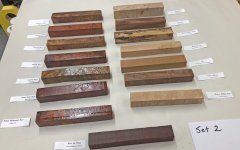
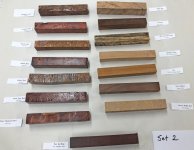
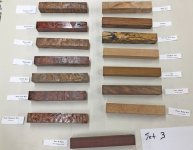
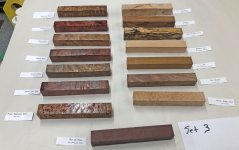
The blanks all measure a little shy of 3/4-inch and are about 5-inches long give or take. The pictures are of the actual blanks in each set. I tried to photo them on an angle to show two sides in each picture. Souphom told me he sprays a light coat of shellac on them to help seal them and to provide an indication of how the wood might look after it is finished. So you can identify them I will print and attach a label on each blank. Although they are not stabilized they are pretty dense and I have made pens with all of them. The Redwood Burl is the least dense of all of them.
Please make your request in this public thread so that everyone can see what has been spoken for and I will PM you with my PayPal details and to get your shipping information.
Best Regards,
Dave
PS I am also including a few extra blanks that are not from Laos. They include Maple Burl, Brown Mallee Burl from Australia, and Bois de rose, an extremely rare rosewood that only grows in a narrow costal forest on the tiny African island of Madagascar, Cocobolo from Costa Rica, Claro Walnut, Ipe from South America (Brazil?), Black and White Ebony from Laos, and Bradford Pear from my front yard in Nebraska!
Each set has three pictures. One from two different sides and a third that is from a shallow angle to help show the sides. You should be able to zoom in by clicking on the thumbnails.
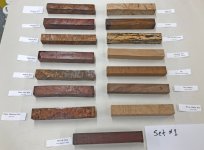
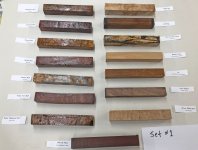
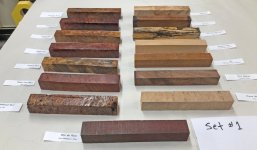
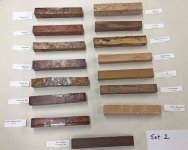
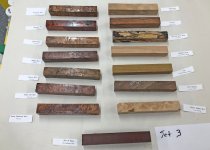
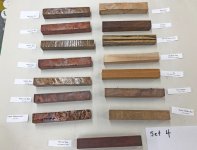
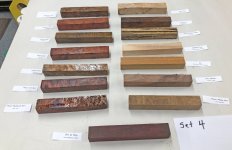
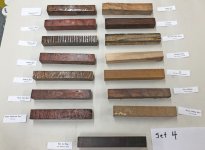
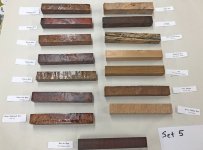
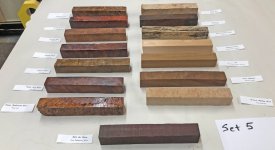
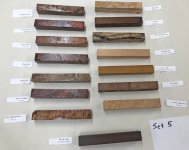
Here are a few details about the different species in the sets.
Rambutan burl is one of the members of the Soapberry family that bears fruits. Rambutan is very similar to the lychee. It is not usually harvested for the lumber but for the fruit. Wikipedia has a nice article on Rambutan. Of all of them I think this one is my favorite. I don't know for sure why other than how exotic looking the Rambutan fruit is.
Pyinma burl is a highly figured exotic hardwood from S.E. Asia. It is also sometimes called Asian Satinwood and Crepe Myrtle in the US market and often produces some of the deepest 3-dimensional curl in the world. Burls are rare in the species, but when they are found they yield tight and exceptional patterns.
Amboyna burl is often called the King of Burls. It is highly prized with an intricate and swirly grain and vibrant color ranging from golden yellow to deep red. The burls harvested in Laos are generally denser and have deeper colors because they come from old growth trees.
Afzelia burl is also called Makamong burl in Southeast Asia. It is a beautiful burl that is rare on the world market. Similar in appearance to Amboyna burl, Afzelia burl usually has a more varied figure.
Sindora burl is very rare even in Southeast Asia. It yields a very gnarly and highly figured grain with a wide variety of brown, golden, and tan colors that is highly sought after by fine artisans. The gnarly grain makes the wood very resistant to splitting which is an excellent attribute for pen turners.
Asian Iron Burl is a Southeast Asian wood with a golden-orange color. It is very similar to Asian Amboyna Burl in density and workability but is usually lighter in color. It takes a high natural polish and has good workability with sharp tools. The species is extremely rare, is highly prized, and is rarely exported.
Asian Redwood burl is commonly found in Myanmar, Thailand, Laos, Cambodia, and Vietnam. It is highly valued for its red lumber and is currently considered an endangered species in Southeast Asia due to overharvesting. It has an attractive veined structure and is easy to polish. These are the lightest (by weight) of the burls I have. They also may have a few inclusions where the other species do not.
Maple Burl is domestic and is more readily available than most other burls.
Brown Mallee burl is a golden-brown burl from the Australian Eucalyptus.
Bois de rose is a very rare deep burgundy color when it is freshly cut but it darkens to a dark Bing cherry color with exposure and age. As it only grows in a small costal forest on the tiny African island of Madagascar, trade in Bois de rose is heavily restricted by CITES due to a highly endangered species status. I got this from a luthier that had some very old pre-ban stock, so it has darkened in color already. (Although it is not a burl, this is likely the most rare and valuable blank of the entire lot).
Cocobolo is a true rosewood and it is becoming increasingly rare. This Cocobolo was imported directly from Costa Rica several years ago. Unfortunately Cocobolo has all but disappeared in Costa Rica due to illegal logging practices. At present the primary legal sources come from Nicaragua.
Claro Walnut is commercially important as it is used as rootstock on most walnut orchards. The roots are very robust and are usually grafted to English Walnuts to provide improved yields.
Ipe is pronounced EE-pay. It is an extremely dense tropical hardwood prized for outdoor projects like decking, siding, and furniture. Unlike most woods, Ipe does not float in water.
Black and White Ebony is a rare, prized hardwood known for its dramatic contrast of creamy white with inky black streaks. It is a challenging wood to work with because it cracks easily.
Bradford Pear or Callery pear is a species native to East Asia. It was widely planted in the US as a fast growing tree, ideal for landscaping; however, it is increasingly regarded as an invasive species. This blank came from a storm damaged tree that was growing in my front yard.
All of these have been spoken for. Thank You Very Much!
PM's are being sent to work out payment and shipping details.
Once again, Thank You!
I am usually buying exotic wood blanks rather than selling them, but I have run into a situation where I need to put a few up for sale.
About 15 years ago I was acquiring rare Laotian burl blanks from a fellow named Souphong Manikhong who lives with his family in Laos, but is also part owner of a family wood art business in California along with his brother Souphom. Souphong sources rare and exotic woods from Laos and brings them to California to support his families wood sculpture business. The blanks that they provide to me are for the most part the scraps left over from the large pieces that they use. I retired about 5 years ago just as the COVID craziness started. In that time I lost contact with the Manikhongs so my source for these rare burls has dried up. If you are interested, this is a link to an old YouTube video from KCRA Chanel 3 in Sacramento about them.
These are a few sets that I have put together. Each set contains 15 blanks and I am asking $125 for each set including shipping. I will be shipping USPS Priority Mail, so only sales to those with shipping addresses in the USA - Sorry. PayPal is my preferred payment method. Of course if someone should buy more than one set I will adjust the shipping accordingly. (I know it sucks but just like everything else the cost for Priority Mail has also gone up).
The blanks all measure a little shy of 3/4-inch and are about 5-inches long give or take. The pictures are of the actual blanks in each set. I tried to photo them on an angle to show two sides in each picture. Souphom told me he sprays a light coat of shellac on them to help seal them and to provide an indication of how the wood might look after it is finished. So you can identify them I will print and attach a label on each blank. Although they are not stabilized they are pretty dense and I have made pens with all of them. The Redwood Burl is the least dense of all of them.
Please make your request in this public thread so that everyone can see what has been spoken for and I will PM you with my PayPal details and to get your shipping information.
Best Regards,
Dave
PS I am also including a few extra blanks that are not from Laos. They include Maple Burl, Brown Mallee Burl from Australia, and Bois de rose, an extremely rare rosewood that only grows in a narrow costal forest on the tiny African island of Madagascar, Cocobolo from Costa Rica, Claro Walnut, Ipe from South America (Brazil?), Black and White Ebony from Laos, and Bradford Pear from my front yard in Nebraska!
Each set has three pictures. One from two different sides and a third that is from a shallow angle to help show the sides. You should be able to zoom in by clicking on the thumbnails.
Here are a few details about the different species in the sets.
Rambutan burl is one of the members of the Soapberry family that bears fruits. Rambutan is very similar to the lychee. It is not usually harvested for the lumber but for the fruit. Wikipedia has a nice article on Rambutan. Of all of them I think this one is my favorite. I don't know for sure why other than how exotic looking the Rambutan fruit is.
Pyinma burl is a highly figured exotic hardwood from S.E. Asia. It is also sometimes called Asian Satinwood and Crepe Myrtle in the US market and often produces some of the deepest 3-dimensional curl in the world. Burls are rare in the species, but when they are found they yield tight and exceptional patterns.
Amboyna burl is often called the King of Burls. It is highly prized with an intricate and swirly grain and vibrant color ranging from golden yellow to deep red. The burls harvested in Laos are generally denser and have deeper colors because they come from old growth trees.
Afzelia burl is also called Makamong burl in Southeast Asia. It is a beautiful burl that is rare on the world market. Similar in appearance to Amboyna burl, Afzelia burl usually has a more varied figure.
Sindora burl is very rare even in Southeast Asia. It yields a very gnarly and highly figured grain with a wide variety of brown, golden, and tan colors that is highly sought after by fine artisans. The gnarly grain makes the wood very resistant to splitting which is an excellent attribute for pen turners.
Asian Iron Burl is a Southeast Asian wood with a golden-orange color. It is very similar to Asian Amboyna Burl in density and workability but is usually lighter in color. It takes a high natural polish and has good workability with sharp tools. The species is extremely rare, is highly prized, and is rarely exported.
Asian Redwood burl is commonly found in Myanmar, Thailand, Laos, Cambodia, and Vietnam. It is highly valued for its red lumber and is currently considered an endangered species in Southeast Asia due to overharvesting. It has an attractive veined structure and is easy to polish. These are the lightest (by weight) of the burls I have. They also may have a few inclusions where the other species do not.
Maple Burl is domestic and is more readily available than most other burls.
Brown Mallee burl is a golden-brown burl from the Australian Eucalyptus.
Bois de rose is a very rare deep burgundy color when it is freshly cut but it darkens to a dark Bing cherry color with exposure and age. As it only grows in a small costal forest on the tiny African island of Madagascar, trade in Bois de rose is heavily restricted by CITES due to a highly endangered species status. I got this from a luthier that had some very old pre-ban stock, so it has darkened in color already. (Although it is not a burl, this is likely the most rare and valuable blank of the entire lot).
Cocobolo is a true rosewood and it is becoming increasingly rare. This Cocobolo was imported directly from Costa Rica several years ago. Unfortunately Cocobolo has all but disappeared in Costa Rica due to illegal logging practices. At present the primary legal sources come from Nicaragua.
Claro Walnut is commercially important as it is used as rootstock on most walnut orchards. The roots are very robust and are usually grafted to English Walnuts to provide improved yields.
Ipe is pronounced EE-pay. It is an extremely dense tropical hardwood prized for outdoor projects like decking, siding, and furniture. Unlike most woods, Ipe does not float in water.
Black and White Ebony is a rare, prized hardwood known for its dramatic contrast of creamy white with inky black streaks. It is a challenging wood to work with because it cracks easily.
Bradford Pear or Callery pear is a species native to East Asia. It was widely planted in the US as a fast growing tree, ideal for landscaping; however, it is increasingly regarded as an invasive species. This blank came from a storm damaged tree that was growing in my front yard.
Last edited:


