Question about light bulbs and electricity

Signed-In Members Don't See This Ad

bensoelberg

Member
Joined
Aug 19, 2010
Messages
782
Location
Bakersfield, California
I just bought a new lamp to point at my lathe and have a question about the bulb that I put in it. The packaging on the lamp says that the max wattage for the lamp is 100. The bulb that was included is one of the new CFL bulbs that says that it is equivalent to a 50w bulb, but is actually only 15w. If I want the light to be brighter than it currently is, can I buy a CFL like this one? (http://www.1000bulbs.com/category/55-watt-cfl-compact-fluorescents/) It is 55 watts, but is equivalent to 250 watts. I don't really know very much about electricity other than if I flip a switch, stuff turns on so I figured I'd ask before doing something stupid.
 
Signed-In Members Don't See This Ad
The 100 watt limit is for incandescents. The limit is because if the heat generated by the bulb. Since CFL's don't produce near the heat of an incandescent you can go much higher. I on't even know if you can find a CFL that produces the same heat as a 100 watt incandescent.
 
Yes

I just bought a new lamp to point at my lathe and have a question about the bulb that I put in it. The packaging on the lamp says that the max wattage for the lamp is 100. The bulb that was included is one of the new CFL bulbs that says that it is equivalent to a 50w bulb, but is actually only 15w. If I want the light to be brighter than it currently is, can I buy a CFL like this one? (http://www.1000bulbs.com/category/55-watt-cfl-compact-fluorescents/) It is 55 watts, but is equivalent to 250 watts. I don't really know very much about electricity other than if I flip a switch, stuff turns on so I figured I'd ask before doing something stupid.

Yes, the rating is for actual wattage unless otherwise stated is for incondescent bulbs.
 
Yes, you can. The 100 watt rating is the maximum amount of power the fixture is designed to carry to the bulb. (That includes heat dissipation.) It doesn't matter if the bulb is incandescent or fluorescent.

Of course you COULD put a bulb that is higher than the rated maximum, but you run the risk of overheating the fixture, reducing the life of the bulb, or worse, starting an electrical fire! :eek: Keeping the wattage of your bulb at or below the manufacturer's specs for a fixture is always the best, and safest, bet. :biggrin:

Incidentally, the CFL that you reference will only draw 55 watts, but puts out the lumens of a 250 watt bulb. (Or somewhere thereabouts...) You're all good with that one!
 
Last edited:
I'd stick an 80 watt incadecent bulb in there. Cfl or whatever the suck..they cost a fortune and although they can put out more light. Its different light which is hard to see and they use less electricity but contain mercury or somethin not good for landfill.
 
The 5000K will make it very bluish. The 2800K will be too yellowish, IMHO. These will affect the colors as you see them while you are finishing them - versus what they look like in normal light and daylight. My daughter and a few others that I know do not like the 4000K and above. Just be aware of the color of the two choices that are listed on the page - are not used where color production choices are essential . . . as often is the case in pen making.

When I was in Japan, I used bulbs in the mid 3000K to 4000K range. It is hard to find bulbs easily in these ranges here in the States. I have found them on occasion, but not easily.
 
Last edited:
The 5000K will make it very bluish. The 2800K will be too yellowish, IMHO. These will affect the colors as you see them while you are finishing them - versus what they look like in normal light and daylight. My daughter and a few others that I know do not like the 4000K and above. Just be aware of the color of the two choices that are listed on the page - are not used where color production choices are essential . . . as often is the case in pen making.

When I was in Japan, I used bulbs in the mid 3000K to 4000K range. It is hard to find bulbs easily in these ranges here in the States. I have found them on occasion, but not easily.

Lowes sells 6500k Daylight spiral CFL's under the Bright Effects brand.

Dan
 
5500K is the closest to natural sunlight that you can get and usually gives you the best color rendition. Look for bulb with the very highest Color Rendition Index (CRI) that you can find. This is a scale of 0-100 with 0 being the worst and 100 being the best. Below 5500k and the light will be warmer (more red). Above 550k and it will be cooler (more blue).
 
Its different light which is hard to see...
I'm with Jeff. Fluorescent light is diffuse. It doesn't cast the hard shadows needed to see small imperfections (such as sanding scratches). Bright, aimable incandescent light is much better for lathe illumination. I use two small halogen lamps on goosenecks to light my turnings. They're hot, but my workpiece is bright and sharp.

Regards,
Eric
 
If you are headed to using CFL -- may I suggest you use two lamps and consider one being set to shine across more from behind the turning (to show scratches). I like a mix of halogen and "spot style" CFL.

Your eyes are the key -- how good is your vision and how focused are you on surface quality?
 
I would be a bit cautious about making assumptions here.

The electrical rating assigned to light fixtures is actually governed by the ability of the fixture to withstand and dissipate heat. Older porcelain fixtures (remember those?) had much higher ratings than modern plastic fixtures.

That said, the problem is that the rating on some modern appliances is a bit vague. And to complicate matters, CFLs are commonly described in terms of the incandescent bulb that provides equivalent light output. I suspect that this is mainly a transitional situation that will resolve itself as CFLs (and eventually LEDs) become more common and incandescents totally disappear from the market.

I recently bought a grinder that has a gooseneck light fixture and that carries a 60w rating. Now, the fact is that the light output of a 60w incandescent bulb that is within inches of the subject being lit (which is the case for my grinder) is more than adequate. But the problem is that the rating does not explicitly SAY '60w incandescent or equivalent'. Instead, it said something about '60w A profile'. "A profile" is a term commonly applied to CFLs that are contained in an oval glass envelope (ie, you can't see the spiral). 'A profile' bulbs are often used where the lamp itself will be visible, or where there is a need to protect the lamp from the environment (eg, in an outdoor application). 'A profile' can also be applied to incandescent bulbs because the term actually describes the shape of the glass envelope. But in stating that the fixture on the grinder was rated for a '60 w A profile' bulb, it wasn't totally clear to me that it meant '60w incandescent or equivalent', or if the rating anticipated that the user would choose a CFL and the manufacturer was specifying that the bulb should have the outer shell to protect the spirals from flying debris.

The other point is that while CFLs do provide a diffuse light, the same can be said of ordinary frosted household incandescent bulbs. If you want to reveal detail, you need to use a 'point source' lamp. That's a theoretical concept that describes a light source with no diffusion at all. The closest we can come practically to that concept is an unfrosted bulb.
 
this is an issue I seldom see mentioned. But before I say it I want to say that I use florescent all the time. Just be aware. Florescents strobe faster than the human eye can detect. This effect can cause machinery that is running to actually look like it is not. A band saw blade that is running at just the right speed will look like it is not moving at all. a table saw blade etc. So just be careful when using when using florescents. The thing I always imagine is turning on my saw or lathe etc and the blade or turning looks like it did not move. my first instinct would be to reach out and try to move the blade etc. to figure out what is wrong. Incondescent light does not have the strobe effect. I was always told to always have at least one incondescent light shining on your work. I have a lamp that holds both types of lights but will use only florescent often. I also never touch a machine that has the switch on. just my rule of thumb in order to keep both of mine.
 
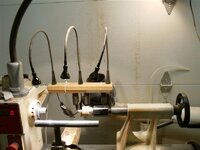
I got this idea from another site. These are LED lights from Ikea. Each light is $9.95 and the goose neck is about 24 inches long. ( maybe 18 did not measure). This way you put the light where you want it. I have seen some guys with 6 lights. The mounting arm in the back can have a second arm attached with a pivot point if needed. I have a power strip mounted underneath the arm with a power on and off.
 

Attachments

  • DSC00047 (Medium).JPG
    DSC00047 (Medium).JPG
    64.2 KB · Views: 116
I'd stick an 80 watt incadecent bulb in there. Cfl or whatever the suck..they cost a fortune and although they can put out more light. Its different light which is hard to see and they use less electricity but contain mercury or somethin not good for landfill.

Not only this but they are bad for your eye's over long periods of time. So having them in your face is a bad idea. Also they do not cast shadow's very well and us woodturners need to see that when you are sanding larger objects. JMTCW.

Lin.
 
Facts and myths:

CFLs are harmful to the environment because they contain mercury. The facts are that
- CFLs contain less mercury than the amount put into the air from a fossil-fuel-fired power plant producing the electricity required to power an incandescent lamp that produces the same light output
- the mercury in modern CFLs is an amalgam - similar to the filling in your teeth - that prevents free mercury from getting into the environment. However, it is true that older CFLs, as well as the tubular fluorescent lamps that have been in widespread use since the 1940's, contained free mercury.

CFLs create a stroboscope effect that is dangerous around machinery. The facts are that
- tubular fluorescent lamps with simple magnetic ballasts had a notorious stroboscopic effect. Not only were they potentially dangerous around machinery, they also had neurological effects because the flashing was rather slow because it was synchronized with the relatively low 60 (or 50) Hz line frequency. The consequence was headaches.
- tubular fluorescent lamps with electronic ballasts operate at higher frequencies than flourescents with magnetic ballasts, so the stroboscopic effect is at a much higher frequency. As a result, less risk of headaches (I once worked in an office that had 400Hz fluorescent lighting that was designed specifically to prevent headaches) and less risk of a stroboscopic effect.
- CFLs have an electronic ballast contained in the plastic lamp base and operate at even higher frequencies than tubular fluorescents with electronic ballasts. Hence, less of a problem.
- but, the stroboscopic effect is real and is something to be aware of.

LEDs are better than CFLs. The facts are that
- LEDs have about the same energy efficiency as CFLs. The advantage of LEDs over CFLs is life expectancy. CFLs will last 8000-10000 hours (incandescents last about 1500 hours), while LEDs can last upwards of 50000 hours.
- LEDs have a sharper color spectrum - that is, they produce light that is more nearly a pure color compared with both CFLs and incandescents. This can be a good thing (think Christmas decorations) or a bad thing (think pasty blue) depending on what you are looking for.
- LEDs are more nearly 'point source' lamps than either CFLs or incandescents. So if you are looking for sharp shadows, LEDs will do it for you better than the other choices.
- incandescent lamps operate directly at line voltage and generally don't require any form of power conversion. CFLs operate at a high frequency, and required an electronic ballast. LEDs are DC and require a 'driver' (ie, a power supply). So on a first-cost per lumen basis, incandescent lamps will always be less expensive than either CFLs or LEDs simply because they are less complicated.
 
Dave, I like that but it sure interferes with dust collection.
Dave,
My dust collector comes up just under the arm. In fact it is the black object just behind the arm. You could attach it to the lathe somewhere else but I have it connected to the place where the guard snaps in.
 
5500K is the closest to natural sunlight that you can get and usually gives you the best color rendition. Look for bulb with the very highest Color Rendition Index (CRI) that you can find. This is a scale of 0-100 with 0 being the worst and 100 being the best. Below 5500k and the light will be warmer (more red). Above 550k and it will be cooler (more blue).

I thought that the ratings would be the same. It is good to know this, but the 5500k that I had in Japan was very bluish. I had some 5500K in our house (in Japan) and several people made comments (negatively) about it. Because of that kind of complaint, the Japanese mfg's introduced a bulb several years ago that was wrapped in a "green" boxes that was around 4000K. The 5500K lights were in "blue" boxes.

I have some 5500K bulbs here in my house here in the states and my daughter complains about them. I don't know where I found (in the Memphis area) the 4000K range but they seem to be more natural.
 
Last edited:
5500K is the closest to natural sunlight that you can get and usually gives you the best color rendition. Look for bulb with the very highest Color Rendition Index (CRI) that you can find. This is a scale of 0-100 with 0 being the worst and 100 being the best. Below 5500k and the light will be warmer (more red). Above 550k and it will be cooler (more blue).

I thought that the ratings would be the same. It is good to know this, but the 5500k that I had in Japan was very bluish. I had some 5500K in our house (in Japan) and several people made comments (negatively) about it. Because of that kind of complaint, the Japanese mfg's introduced a bulb several years ago that was wrapped in a "green" boxes that was around 4000K. The 5500K lights were in "blue" boxes.

I have some 5500K bulbs here in my house here in the states and my daughter complains about them. I don't know where I found (in the Memphis area) the 4000K range but they seem to be more natural.

Hank,

I think it is more of what we are used to. Incandescent bulbs are typically 3000-4500 and are what we are used to. Natural sunlight is more "blue" than incandescents. I know that in photography, 5500k is the best since it has the widest spectrum and is closest to natural outside light. I also don't like 5500k for general lighting in the house. It is too cold and does not feel right.
 
Also, folks, we might as well get used to CFLs or LEDs. On January 1, 2012, it will become illegal to manufacture any light that is not at least 30% more efficient than 100 watt incandescents. They say this is not a ban on incandescents but by default, it is. 100 watt incandescents will no longer be manufactured in the US and Canada after January 2012. Then the restrictions keep getting tighter until finally in 2014, the requirement will be the equivalent of nothing more than 40 watt incandescents.

Pretty funny, really. Stop making incandescents to save energy and reduce greenhouse gases but as a result, the US manufacturers are closing down and all the CFL production is in China. We know that the Chinese are really concerned with greenhouse gasses and the environment!
 
I'm stockpiling and have been for some time, incandescent lightbulbs. I was right..the CFL bulbs contain mercury inside them. They must be disposed of properly, not just tossed in the trash, but we all know most people will just junk them in the dumpster and they'll be in the landfills leaking mercury into the water supply. Do people want to burn a little more coal or oil of which can be pretty nicely filtered for the atmosphere pollution and every power plant in the world combined spews less than one active volcano in a year, or have a nice glass of mercury to wake up to? There is a movement afoot to stop that law from coming in to effect. I remember the ban on paper bags..gotta use plastic. Look where that got us. The original automobile..ran on alcohol. Used to go camping and use any ole wood we found on the ground in the woods to make a fire..now that's illegal so we can have monster forest fires raging across the state. A whole lot of good them greenbaggers have done for us...all they care about is ability to tell us what to do and the money that puts in there pockets. AAAARGH !!!!!!!!:at-wits-end::at-wits-end::at-wits-end::biggrin:
 
I have 200 of the150/200/250 3 way bulbs hoarded. I use them in my reading lamps. I am getting old and need good light to read by. CFL's don't cut it.
 
Last edited:
Back
Top Bottom