Lathe Explosion Recovery

Signed-In Members Don't See This Ad

mrhulot

Member
Joined
May 30, 2025
Messages
6
Location
philadelphia
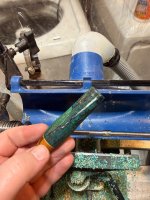
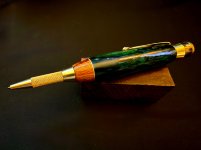
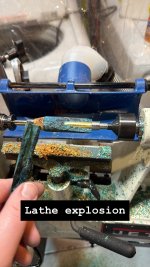
I had some stabilized wood explode on me. After a previous weekend of bad luck with cracking and splitting, I wanted to push through and fix this. I ended up re-sealing it with some blue glow powder/CA and I think the seafoam-esque mix works well! I like the extra weight up top because it lets me rest it in my hand and move around the shop without gripping too tight.

I believe it's a PSI Kit and abrasive paste with pens plus for the finish (my favorite). Little video on it — I was proud to recover from the blow out and get back in the groove.
 

Attachments

  • 46B906CD-7BCD-449F-9756-C7AA4ED5C5ED.jpeg
    46B906CD-7BCD-449F-9756-C7AA4ED5C5ED.jpeg
    416.9 KB · Views: 59
  • IMG_0501.jpeg
    IMG_0501.jpeg
    637.7 KB · Views: 58
  • IMG_0523.jpeg
    IMG_0523.jpeg
    318.8 KB · Views: 58
Signed-In Members Don't See This Ad
Nice Recovery!!

Unsolicited Feedback: It appears to have separated from the tube pretty cleanly. What do you glue tubes in with? Do you scuff the tubes before gluing?
 
Nice Recovery!!

Unsolicited Feedback: It appears to have separated from the tube pretty cleanly. What do you glue tubes in with? Do you scuff the tubes before gluing?
I usually use a gel CA (maybe from gluboost?), but this time I used a 5 min epoxy. I've used it before, but this was my first time measuring from 2 bottles instead of the duo-push stick. It fractured on the opposite end I pushed in from so I'm thinking either poor coverage or a bad mix.

Always give em a good scuff though!
 
Agree with the glue comment from @d_bondi, but as @dschem also says people think they have a mandrel saver on the lathe, so tailstock pressure is a non-issue, but that is a misconception. The mandrel saver often makes people bear down even harder on the tailstock connection because they may get slippage with the mandrel saver. Last comment to this is to make sure your blank ends are trimmed true when using a mandrel saver as a high spot on the edge will take the most force which can cause uneven stress in the blank and also cause a fracture.
 
Regardiing the blank- I scuff it with 150 grit even if scuffed at the factory, wipe it with acetone. I use Two Ton epoxy squeeze bottles and gauge the mix by the size of the amount on the scrap paper.
 
I've been doing chuck or TBC turning lately so a too-tight mandrel saver is a highly likely cause — I set it pretty tight due to slippage as @NJturner mentioned.

@Woodchipper has eyeballing it worked out in your experience? I've only used the bottles this once but I was thinking of getting a cheap kitchen scale (if the two bottles' densities are similar)
 
@Woodchipper has eyeballing it worked out in your experience? I've only used the bottles this once but I was thinking of getting a cheap kitchen scale (if the two bottles' densities are similar)
I have been eyeballing and it works just fine for me.

That said, the scale idea has my inner enginerd's curiosity piqued!! 🫣
 
I buy Devcon Two Ton Epoxy in 4-1/2 ounce bottles. Nozzle makes it easy to eyeball the size of the epoxy. Has working time of 30 minutes so one has loads of time to insert the tube and adjust if needed. I let the blank(s) sit overnight before turning the blanks. How strong is it???? I used it to build golf clubs. IMO, a scale wastes too much time if it is 5 minute epoxy. Lay a dime or nickel on the medium and use that as an example for the epoxy parts. BTW, I use small post-it notes. Use a sheet, let the epoxy set and toss.
 
Back
Top Bottom