Irish Bog Oak - CA or friction polish?

Signed-In Members Don't See This Ad

CaseyK

Member
Joined
Feb 6, 2026
Messages
27
Location
Angels Camp, CA, USA
I'm going to be turning some Irish Bog Oak here in the next few days, got the blanks from the Irish Pens site. I'll be using the Celtic kits from PSI in various finishes. I've not worked with Bog Oak before but it seems that it will be pretty straightforward. I want to do justice to the wood so would you recommend using CA, or would you go with one of the friction polishes/waxes? 95% of my work has been with CA so I'm most familiar with those processes. My most recent excursion into the land of friction polish actually turned out well on 9 bottle stoppers but I'm not sure if that was skill or just pure dumb luck.

Thanks
 
Signed-In Members Don't See This Ad
I just started doing CA finishes. I had been doing friction polish and had been getting really nice results (EEE and Mylands liquid friction polish), especially when I started using a grain filler in really thin layers in between sanding. I've gotten really good results with both. I personally prefer the more durable finish you get with CA, though I haven't had any issues with friction polish, other than the time it takes to fully cure before handling. You just need to be careful to keep the applications super thin. So it's really a matter of preference. If you want a more natural looking finish and aren't in a hurry, go with the friction products. If the pen is actually going to be used a lot, go with CA. Being that the Celtic kits look kind of heavy, I'd most likely use the CA myself. Post pics when you're done!
 
Bog Oak needs to show its age with all its fissures. Some people get Bog Oak, fill in the fine lines, finish with CA, and it may as well be a piece of resin.........let it look like it is a few thousand years old.
I usually just buff mine and put a coat of Renaissance wax on.
There is a chap on this site from Ukraine who has turned hundreds of Bog Oak pens and he only uses Walnut oil.
There is a picture of one of his in the IAP collection.
 
I lifted this quote from @yaroslaw .........

I made more than a 1000+ pens from Bog Oak and found out that the best finish is a food-grade walnut oil. Give it plenty of time to soak in, buff it with steel wool, clean the residue and that's all. If you want a little more shine, the white diamond polish will do the trick without killing the texture.
 
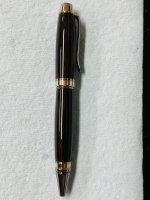
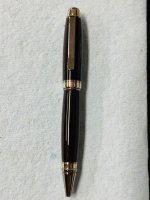
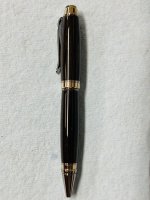
I just turned a big oak pen a few days ago. I did a CA finish but will probably use Mylands next time.
 

Attachments

  • IMG_7172.jpeg
    IMG_7172.jpeg
    497.7 KB · Views: 11
  • IMG_7173.jpeg
    IMG_7173.jpeg
    495.1 KB · Views: 11
  • IMG_7174.jpeg
    IMG_7174.jpeg
    486.4 KB · Views: 11
This discussion is what I was hoping for. I love the CA finish but after finally getting the blanks into my hands the CA somehow doesn't fit with the reality of the Bog Oak.

I have walnut oil, Aussie oil, tung oil, and the 1:1:1 homemade friction polish, so there are options. The problem is that I'm not familiar with the nuances of these finishes so I'll have to think about this. And ask about this.

Thanks folks, please keep the info/feedback/knowledge coming.
 
I agree that Bog Oak needs to be felt when you pick it up and use the pen. I think even a friction polish would be too much.
I've used CA and it just doesn't look like a special pen. I used Lacquer (dont remember if it was spray or not) like John described and I found the feel of the pen made it special. Just enough to seal the wood, you dont need a heavy coating. I would think Walnut or Tung oil would be a nice finish also.
1795734917042.jpeg
 
Last edited:
What would be the history to Bog Oak. I see its a peat bog enriched log but what would be the reasoning? Buried from flooding?
 
Bog Oak refers to the fallen branches and trunks of Oak trees that were submerged in Bogs, preserved from decay because of the anaerobic conditions. The acid in the bog water reacts with the tannins in the timber to naturally stain it black.
 
It is advertised to be 1000's of years old. No, that is not an extra '0'.
The supplier will have certificates of the timber's age that are supplied with the blank.
 
Back
Top Bottom