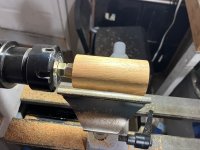

I am working on a slightly oversized chess set. The pieces all have a base diameter between 1" and 1.5", and each one has a hole drilled in the base that I will fill later with weight before putting felt on the bottom.
I'm struggling to figure out the best way to hold these pieces on the lathe. I have a Nova chuck with standard 2" jaws (too large to grip my 1.5" stock). I bought a set of spigot jaws, the smallest ones I could find, and they'll fit inside a mortise that's 1" in diameter. I thought that would be good enough, but the pawns in particular are so thin in the walls around a 1" hole in the base that the expansion pressure necessary to hold them still tends to crack the wood.
I tried using my worm screw that came with the chuck, and drilling a smaller 3/8" hole in the bases instead. It held fine, but was difficult to thread in straight, so it caused a lot of wobble when the tailstock support goes away at the end of the shaping process for each piece. It was also difficult to remove, and because it requires my 2" jaws to hold in the chuck, it posed access problems to the base when I was trying to sand.
So far my best results have come from turning a tenon on the wood down to 3/4" for my largest ER32 collet. Then I can drill a hole (I used a 10mm bit but there's lots of flexibility there) through that tenon and deeper into the workpiece as well. I can then flip it and mount in my collet chuck, turn and sand just fine, it's very concentric and very secure, and after finishing is done, I can just use the bandsaw to chop off the tenon.
That works okay, but it's tedious and wastes wood.
I'm imaging something similar to this screw arbor. A threaded base in the neighborhood of 10-12mm or so would work great for the size of pieces I'm turning. I don't really need it to be permanently attached to its own MT2. It could literally just be a bar that I grab in my collet chuck, has ~10mm length of threading at the end, and ideally some kind of washer or flared bit behind the threads for the base of the workpiece to abut against, so things stay aligned and concentric on the lathe.
Does such a mandrel exist?
If not, would it be realistic to make one out of something like 5/8" brass or aluminum rod? I have dies, though no fancy floating die holder that fits my tailstock or anything like that.
I'm struggling to figure out the best way to hold these pieces on the lathe. I have a Nova chuck with standard 2" jaws (too large to grip my 1.5" stock). I bought a set of spigot jaws, the smallest ones I could find, and they'll fit inside a mortise that's 1" in diameter. I thought that would be good enough, but the pawns in particular are so thin in the walls around a 1" hole in the base that the expansion pressure necessary to hold them still tends to crack the wood.
I tried using my worm screw that came with the chuck, and drilling a smaller 3/8" hole in the bases instead. It held fine, but was difficult to thread in straight, so it caused a lot of wobble when the tailstock support goes away at the end of the shaping process for each piece. It was also difficult to remove, and because it requires my 2" jaws to hold in the chuck, it posed access problems to the base when I was trying to sand.
So far my best results have come from turning a tenon on the wood down to 3/4" for my largest ER32 collet. Then I can drill a hole (I used a 10mm bit but there's lots of flexibility there) through that tenon and deeper into the workpiece as well. I can then flip it and mount in my collet chuck, turn and sand just fine, it's very concentric and very secure, and after finishing is done, I can just use the bandsaw to chop off the tenon.
That works okay, but it's tedious and wastes wood.
I'm imaging something similar to this screw arbor. A threaded base in the neighborhood of 10-12mm or so would work great for the size of pieces I'm turning. I don't really need it to be permanently attached to its own MT2. It could literally just be a bar that I grab in my collet chuck, has ~10mm length of threading at the end, and ideally some kind of washer or flared bit behind the threads for the base of the workpiece to abut against, so things stay aligned and concentric on the lathe.
Does such a mandrel exist?
If not, would it be realistic to make one out of something like 5/8" brass or aluminum rod? I have dies, though no fancy floating die holder that fits my tailstock or anything like that.