Capacitor? or Switch?

Signed-In Members Don't See This Ad

maxwell_smart007

Lead Moderator
Staff member
Joined
Aug 4, 2007
Messages
6,771
Location
middle of nowhere in the great, white North
My small disk sander won't turn on - it doesn't make any noise at all when I turn the switch...

Does that sound like a capcitor issue?
There's a capacitor in easy access, but the numbers are partially worn off...

The switch is advertised as dust proof, but that's just advertising, probably...
 
Signed-In Members Don't See This Ad
Well, if you are sure there is power getting to it then switch it on. Give it a quick spin by hand. If it runs then the cap is goosed.
 
Not to insult you, but are you sure it's plugged in and the breaker didn't trip? I had one friend who spent hours taking things apart to find out he had tripped the breaker.

If you are sure you have power to the outlet and know your way around a multimeter, you should be able to check to see if there is power out of the switch.

Ed
 
Could be any number of things.
I assume you have checked the socket that you have plugged into, with another power tool?
Could be a loose or broken wire in the cable in or from the plug to the machine. Loose or broken wire as the cable goes into the sander body. ( with it switched on, wiggle the cable around - if it jerks or runs, then the cable is damaged)
Is there a fuse in the sander housing? normally near where the cable goes in.

If it's a good one and not too old then fix it. If it's old and crappy then use the opportunity to upgrade:biggrin:
 
Andrew,

As an aging electrician I advise you these machines can give you a fatal bite, why not concede and seek expert help, the adage you only live once is true.

In this litigeous country where you live also where I live my conclusion or solution is on my own to examine and repair or never give advice to club members any more even finding damaged units many times irrepareable and like Skippy says consider replacement.

Kind regards Peter.
 
Peter is of course 100% correct. If you can't fix it safely then get help.


Peter, you spoiled my evil plan !!!!! :mad: He's a ....a....:eek: I don't even want to say the word.......a.......a .........moderator :wink:
 
I find myself wondering "If the answer is always 'That could be dangerous so don't work on it', doesn't that defeat the purpose of a forum that is dedicated to the use of potentially deadly tools, equipment and materials to make pens". I suppose the legal ramifications of saying anything that could be even remotely considered to have resulted in a member of the herd removing themselves can't be ignored. So it would appear to be prudent to either never offer advice or caveat the daylights out of it on the forums (unless you have no assets that would attract the attention of the legal profession).

Since I suggested testing the power out of the switch, it seems I should jump on the bandwagon here and throw out some caveats.

Don't use your tongue to check whether there is power to the tool.

Don't use your fingers to check whether there is power to the tool.

If you are working with electricity and you don't understand how what you are doing can kill / maim you if you do it wrong, then don't do it at all.

Ed

Who notes that the word electricity could be substituted with just about any tool, piece of equipment or material in the last caveat.......
 
Try doing a continuity test through the wiring by putting an ohm meter or continuity test light between the two plug terminals and switching it on and off.
 
Ed, unfortunately your reply has loads of merit. That seems to be the way of the world these days. But we do have a duty of care to those that we give advice to. The problem I have is that there are some people that offer advice where they know absolutely nothing about the subject.
I remember where some fool was giving advice on a pressure pots based on his 'guess' !!
I too was going to mention the multi meter fault finding route but if he did know how to use one then he could have found the fault quicker than posing the question here.

As folks are doing more and more self fixes to their equipment these days, then maybe forums like this could have moderators or resident experts that could be relied on to give good advice and edit foolish answers.

LOL, I know some of mine would be trimmed down a bit !!:biggrin:
 
Try doing a continuity test through the wiring by putting an ohm meter or continuity test light between the two plug terminals and switching it on and off.


Jeesh !!! And what exactly would he do with the results??? How many Ohms is good or bad for his machine???? What if it has a NVR switch??? How will the capacitor affect his result???? He's not an electrician, if he knew how to do those things he wouldn't have asked the question!!!:wink:
 
I know my way around electricity - and I know how a housing wire system works, but not the ins and outs of small motors! :smile:

The outlet and breakers are fine, so the problem is the machine...I have not yet found any wires that look suspect, and all the wire nuts are tight, so it seems that the issue is likely the switch or the capacitor, considering that I never smelled any burned wiring or had any other symptoms when last using this machine..

My issue is that i don't know exactly how to check a switch for functionality, using a multimeter...
 
Ok, I'll try and talk you through it if you want.

Does your machine have a single on/off toggle switch or one press-button for on and another for off?

Does your Machine have electronic variable speed?

Do you have a multimeter?
 
Ok, I can only speak from experience here. I do own a multimeter tool and know how to use it. This is the safest way to ensure electrical parts are working as they should to isolate an issue.
But I found myself without the meter and a machine that would not turn on. I too wondered if it was the switch or capacitor. So I jumped the switch out, while the machine was unplugged, and then plugged it in the outlet. The machine started up, thus my switch was needing replaced. So... I upgraded the unit and said it wasn't safe to use in its current state! :biggrin:
I don't encourage anyone to do what I did as it could cause injury to you physically, mentally, emotionally and to the checking account. Especially when the LOML may know the truth.
What ever you try, do it safely!
 
Andrew Ed and Skippy,

Perhaps I can expound on my remarks and clarify my personal position as a licenced Sparky
I am subject to the law in any way I behave electrically including going to gaol in the event of following my advice or any work I carry out.

On the other hand If you wire a lead to an extension cord on a building site and remain anonymous and kill someone very little happens, I was electrocuted on a building site as a young man this way, no positive action occurred. this resulted in the first instance with a live mixer.

Go ahead and be prepared I say Ed but remember discretion is the greater part of valour. I note so many times in hardware stores this item must be installed by a licensed Electrician but is sold to anyone over the counter.

Parklander best advice with foolish caveats defeat the purpose that of saving lives look at the road rules and the direct result of ignoring them.

Trust you enjoy your woodwork and metalwork everyone to his own free agency it will be a sad sad day if ever we inflict casualties on anyone by giving unsound advice especially in electrical matters. Skippy pointed out someones guess on a pressure vessel.

Kind regards Peter.
 
I find myself wondering "If the answer is always 'That could be dangerous so don't work on it', doesn't that defeat the purpose of a forum that is dedicated to the use of potentially deadly tools, equipment and materials to make pens".
Just to remind those that might have forgotten, or not know England and others like down under. Use 220volt house current, not the110/120volt here in the states. Not that can't kill you.
:clown:
 
The outlet and breakers are fine, so the problem is the machine...I have not yet found any wires that look suspect, and all the wire nuts are tight, so it seems that the issue is likely the switch or the capacitor, considering that I never smelled any burned wiring or had any other symptoms when last using this machine..

My issue is that i don't know exactly how to check a switch for functionality, using a multimeter...

The odds are slightly in the favor of switch or wire over capacitor, because they often die horribly (burn/smoke) and since you don't see that, I'd concentrate on the easier stuff first. See Skips questions - what type of switch and is there a variable speed?

If its a simple on/off, its pretty easy to check (UNPLUGGED!).

Dean
 
Try doing a continuity test through the wiring by putting an ohm meter or continuity test light between the two plug terminals and switching it on and off.


Jeesh !!! And what exactly would he do with the results??? How many Ohms is good or bad for his machine???? What if it has a NVR switch??? How will the capacitor affect his result???? He's not an electrician, if he knew how to do those things he wouldn't have asked the question!!!:wink:
Any reading implies that there is no break in the wire - no reading says there is an open circuit somewhere it could be the wire - if it has brushes it could be the brushes - or it could be the motor coil....

If you are getting nothing when you plug it in and turn it on there is a good chance that you have a broken wire or loose connection. unplug it and look - use an ohmeter if you have one and check from the plug to the connection inside. Power cords usually break near the plug or near where they enter the machine - the two points that are subject to the most stress and flexing.
 
Look out... the world might just be ending! Smitty and I openly agreed on something! JUST KIDDING! Its good to see you posting Leroy - I know life is rough in your world these days!
 
Try doing a continuity test through the wiring by putting an ohm meter or continuity test light between the two plug terminals and switching it on and off.


Jeesh !!! And what exactly would he do with the results??? How many Ohms is good or bad for his machine???? What if it has a NVR switch??? How will the capacitor affect his result???? He's not an electrician, if he knew how to do those things he wouldn't have asked the question!!!:wink:

Testing continuity would tell if the circuit was open and that was causing the problem -meaning a bad switch or a wire loose or burned out somewhere- or it was closed and still not running that it was something more than just a switch or wire. This would be the first test in a series of tests to determine the problem, the results determining the next step. Being just a sander it is more than likely just a simple switch.

And if someone is incapable of understanding attaching a meter between the two terminals on a plug to test continuity he probably shouldn't be operating machinery of any kind in the first place but I don't assume that people asking questions who have the knowledge to operate machinery are unable to understand performing a simple basic test that could begin to answer them.

BTW, how many ohms? Simple, anything less than infinite means there is continuity through the closed circuit, which is why most VOM meters have a continuity check that just sounds a tone if current passes (or a light that lights up if it is of that kind). I thought everyone that could understand the difference between a capacitor and a switch would be able to understand that sort of thing.
 
If it is a DeWalt, there's a really good chance it is the switch. DeWalt has changed the switch design 3 times on their small orbital sander.

Easy way to check is to open the switch compartment and use alligator clip leads to bypass the switch. If the sander runs, the switch is shot. If not, it's another problem.
 
:eek::eek: This may take a few minutes. For those of you that know all the answers already, you may as well stop reading now. Or as one suggested, go to bed. The only smart answers to this question were given by Peter from Australia and one other. If you aren't sure what you are doing, Don't Do It!! And, buy a new tool !! Is your life worth $50 for a new tool? I was an electro/mech tec for almost 40 years in the worlds largest paper mill. I worked with micro volts to 200,000 volt transmission lines. The most dangerous and largest killer by far in the world is 120 volts. Anything above that will generaly blow you off, but not without damage. A cap, if charged, can kill you with no power attached to it. It only takes 1/2 amp across your heart to kill you!! An old style TV tube can hold 100,000 volts for years. I have seen experanced tecs have meters blow up in there hands because they were in a hurry and had the wrong voltage settings or they were testing for ohms on a hot line. Knowing a little bit about electricty is just enough to get you killed !!! If you must play with fire, go to Home Depot or some other home store and buy a lite stick. Same idea as testing Christmas lites. You only have to hold it cloce to the outlet, wires, or switch and it will tell you by light or noise if you have power and where it stops. (broken wire, bad switch or bad cap) You need a special meter to test a cap, and you should discharge it first before testing !! Don't work on anyting with the power on unless you know what you are doing. Be careful not to put your hand on a machine that is plugged in and not running or you may be the new ground wire. Whatever you do, do it safely !! Voltage it like the stray shot in the woods. It's the one you don't see or hear that will kill you. Pease !! Jim S
 
Last edited:
Sorry guys - family wedding this weekend, so we had some libations to pour tonight...might not be a good evening to work on the switch - but I'll take any advice!

I have a multimeter that I've never once used - I'll have to dig it up! :smile:

I'll get a picture tomorrow if the camera decides to work again. It's a single rocker switch, and as I mentioned, there was no sign of any smoke, hissing, smell of any sort, etc...just worked one day last month when I used it last, and nothing now when I try the switch again...
 
Switch has two reds and white...

Resistance checking (for Ohms) should be done between the two reds, correct, as the switch acts as an interrupt on the hot wire? Check while the switch is on? (but not plugged in)...

A picture would be helpfull - if its interrupting the reds, I don't know why the white would go into it. But if your theory is right (and its a decent one), the resistance between the 2 red points should go to 0 when the switch is on, and go high when off.

If your theory is right, you should get near 0 resistance between the white wire and one prong of the outlet.. and the other prong should connect to one of the reds (both when switch is on). That will help you figure out if there is a break in the wire somewhere else coming in.
 
Switch has two reds and white...

Resistance checking (for Ohms) should be done between the two reds, correct, as the switch acts as an interrupt on the hot wire? Check while the switch is on? (but not plugged in)...

A picture would be helpfull - if its interrupting the reds, I don't know why the white would go into it. But if your theory is right (and its a decent one), the resistance between the 2 red points should go to 0 when the switch is on, and go high when off.

If your theory is right, you should get near 0 resistance between the white wire and one prong of the outlet.. and the other prong should connect to one of the reds (both when switch is on). That will help you figure out if there is a break in the wire somewhere else coming in.

:eek::eek: If you two have to ask these questions, you should not be playing with electricty !!! Both of you are moderators of this site and should know better than to give electrical advice to anyone if you are not licenced. Take the switch out discharge the cap and remove it. Take it to Home Depot or some other store that sells electrical supplys and they will check it for you for free. If it's small enough, take the whole thing there in one piece. "Theory and I don't know" will get you killed !!!! Jim S
 
Last edited:
Troubleshooting a switch with the power off and while not touching the capacitor is something I'm comfortable doing, Jim.

There are no electrical supply stores around here that sell switches, so I'll have to order one if that's what's required - would be nice to know if that's the issue, however, before I spend a lot on shipping, as returns wouldn't be easy.

I just need a how-to on reading the multimeter, as that's not something I've a lot of experience with.
 
:eek::eek: If you two have to ask these questions, you should not be playing with electricty !!! Both of you are moderators of this site and should know better than to give electrical advice to anyone if you are not licenced. Take the switch out discharge the cap and remove it. Take it to Home Depot or some other store that sells electrical supplys and they will check it for you for free. If it's small enough, take the whole thing there in one piece. "Theory and I don't know" will get you killed !!!! Jim S

Oh, Jim...

A couple of things:
1) Testing out an unplugged power tool with a multimeter is a pretty low risk endeavor comparitively speaking.
2) You do realize that this site is based around using power tools, which themselves are dangerous. I suggest you head down to the TOS, specifically this page: Safety Information - International Association of Penturners
3) The reason 120 volts is the biggest killer is not anything special about that voltage, its because its the one that the most population has access too on a daily basis. Yes, unplugged devices can cause concern, but our power tools do not contain high capacity capacitors and tubes like the old TVs do.

We get your concern, but in general people reading the advise here have to use their own judgement on what they do with what they read. We deal with power tools, not knitting needles. There is danger here, no doubt - but that doesn't mean we can't discuss it.

 
Ok, so I did some exploratory multi-metering with the tool unplugged, and found the following.

(Probably should reiterate - I am not checking a plugged-in tool - always unplugged - I would never work on anything powered!)

Multimeter reads 1 until circuit completed, (i.e. crossed probes), in which case it reads 0....

Checked the neutral from prong end to where it meets the switch - reads 0 (so no resistance)
Black from prong to switch - reads 0
For some reason, they go to two reds after this point going into the motor area (hidden) and two whites coming out of it...annoying, to say the least, and confusing if one were to think that the white was neutral...it's not!

red wire to white wire going into capacitor (merett nut connection) - reads 0
other red wire to other white wire going into capacitor (merett nut connection) - reads 0

One half of switch (neutral side) to connection on same side - reads 0 when switch is on
other half of switch (hot side) to connection on same side - reads 1 when switch is on...

Therefore, it must be that the switch is buggered as it reads high (max) resistance when the switch is on, so no continuity...correct?
 
:eek::eek: If you two have to ask these questions, you should not be playing with electricty !!! Both of you are moderators of this site and should know better than to give electrical advice to anyone if you are not licenced. Take the switch out discharge the cap and remove it. Take it to Home Depot or some other store that sells electrical supplys and they will check it for you for free. If it's small enough, take the whole thing there in one piece. "Theory and I don't know" will get you killed !!!! Jim S

Oh, Jim...

A couple of things:
1) Testing out an unplugged power tool with a multimeter is a pretty low risk endeavor comparitively speaking.
2) You do realize that this site is based around using power tools, which themselves are dangerous. I suggest you head down to the TOS, specifically this page: Safety Information - International Association of Penturners
3) The reason 120 volts is the biggest killer is not anything special about that voltage, its because its the one that the most population has access too on a daily basis. Yes, unplugged devices can cause concern, but our power tools do not contain high capacity capacitors and tubes like the old TVs do.

We get your concern, but in general people reading the advise here have to use their own judgement on what they do with what they read. We deal with power tools, not knitting needles. There is danger here, no doubt - but that doesn't mean we can't discuss it.
:frown::frown: Answers to your points!! 1. Many new and old machines use large caps to start their motors at low speed, these caps stay charged for some time with or without power. 2. This is a disclaimer saying that the IAP is not responsable for the advice given by it's members. And you must have missed the part about being "thoroughyl familiar with their operation". 3. Is a totaly a false statement. A lot of countrys run on 220 volts. Check your fuse box. Thats 220 volts comming in there. The reason most people are killed by 120 volts is because it makes your muscles spasem and you can't let go from the sorce. This causes the muscles of the heart to go into fibrillation. Fibrillation - Fine, rapid fibrillar movements that replace the normal contraction of the ventricular muscle of the heart. Or in plain words, no blood flow, you die. By the way, answer your personal E-mail once in awhile!! Jim S
 
Ok, so I did some exploratory multi-metering with the tool unplugged, and found the following.

(Probably should reiterate - I am not checking a plugged-in tool - always unplugged - I would never work on anything powered!)

Multimeter reads 1 until circuit completed, (i.e. crossed probes), in which case it reads 0....

Checked the neutral from prong end to where it meets the switch - reads 0 (so no resistance)
Black from prong to switch - reads 0
For some reason, they go to two reds after this point going into the motor area (hidden) and two whites coming out of it...annoying, to say the least, and confusing if one were to think that the white was neutral...it's not!

red wire to white wire going into capacitor (merett nut connection) - reads 0
other red wire to other white wire going into capacitor (merett nut connection) - reads 0

One half of switch (neutral side) to connection on same side - reads 0 when switch is on
other half of switch (hot side) to connection on same side - reads 1 when switch is on...

Therefore, it must be that the switch is buggered as it reads high (max) resistance when the switch is on, so no continuity...correct?
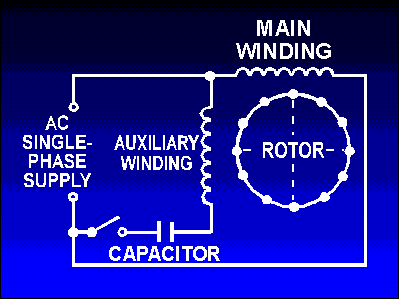
Here is a common connection set up.....

32NE0450.GIF


On a motor the size you're looking at, there is no chance that you'll get a lethal shock because the capacitor fully charged - which in an AC circuit is highly unlikely - can't supply sufficient current​
 
Ok, so I did some exploratory multi-metering with the tool unplugged, and found the following.

(Probably should reiterate - I am not checking a plugged-in tool - always unplugged - I would never work on anything powered!)

Multimeter reads 1 until circuit completed, (i.e. crossed probes), in which case it reads 0....

Checked the neutral from prong end to where it meets the switch - reads 0 (so no resistance)
Black from prong to switch - reads 0
For some reason, they go to two reds after this point going into the motor area (hidden) and two whites coming out of it...annoying, to say the least, and confusing if one were to think that the white was neutral...it's not!

red wire to white wire going into capacitor (merett nut connection) - reads 0
other red wire to other white wire going into capacitor (merett nut connection) - reads 0

One half of switch (neutral side) to connection on same side - reads 0 when switch is on
other half of switch (hot side) to connection on same side - reads 1 when switch is on...

Therefore, it must be that the switch is buggered as it reads high (max) resistance when the switch is on, so no continuity...correct?
Here is a common connection set up.....

32NE0450.GIF


On a motor the size you're looking at, there is no chance that you'll get a lethal shock because the capacitor fully charged - which in an AC circuit is highly unlikely - can't supply sufficient current


Although Smitty is absolutely correct, it is even MORE certain you will not do yourself damage, since you unplugged the circuit and have NO power.:biggrin::biggrin::biggrin:
 
I find myself wondering "If the answer is always 'That could be dangerous so don't work on it', doesn't that defeat the purpose of a forum that is dedicated to the use of potentially deadly tools, equipment and materials to make pens". I suppose the legal ramifications of saying anything that could be even remotely considered to have resulted in a member of the herd removing themselves can't be ignored. So it would appear to be prudent to either never offer advice or caveat the daylights out of it on the forums (unless you have no assets that would attract the attention of the legal profession).

Since I suggested testing the power out of the switch, it seems I should jump on the bandwagon here and throw out some caveats.

Don't use your tongue to check whether there is power to the tool.

Don't use your fingers to check whether there is power to the tool.

If you are working with electricity and you don't understand how what you are doing can kill / maim you if you do it wrong, then don't do it at all.

Ed

Who notes that the word electricity could be substituted with just about any tool, piece of equipment or material in the last caveat.......

I think you're comparing apples and oranges. Power tool dangers are generally visible. Spinning blades, pinch hazards, rotating shafts, etc. are much easier to visibly "respect". I don't think it's unwise to offer warnings about an invisible killer like electricity or the fire hazards of boiled linseed oil. It's not because anyone is worried about being sued, it's because we care about our friends.
 
Ok Jeff, first off apologies for 'you know what'. :wink:

If it's true that we really don't want to see our friends get hurt then why are we allowing 'you know what's' to answer these types of threads?

My post got deleted for calling someone a name. But the poor advise that could get someone hurt remains??:confused:
 
Your caring is noted... now leave people alone.

There are some of us who live by these:

From makezine.com:
If you can't open it, you don't own it: a Maker's Bill of Rights to accessible, extensive, and repairable hardware.

THE MAKER'S BILL OF RIGHTS
  • Meaningful and specific parts lists shall be included.
  • Cases shall be easy to open.
  • Batteries should be replaceable.
  • Special tools are allowed only for darn good reasons.
  • Profiting by selling expensive special tools is wrong and not making special tools available is even worse.
  • Torx is OK; tamperproof is rarely OK.
  • Components, not entire sub-assemblies, shall be replaceable.
  • Consumables, like fuses and filters, shall be easy to access.
  • Circuit boards shall be commented.
  • Power from USB is good; power from proprietary power adapters is bad.
  • Standard connecters shall have pinouts defined.
  • If it snaps shut, it shall snap open.
  • Screws better than glues.
  • Docs and drivers shall have permalinks and shall reside for all perpetuity at archive.org.
  • Ease of repair shall be a design ideal, not an afterthought.
  • Metric or standard, not both.
  • Schematics shall be included.

Oh, and I ride my bike without a helmet too...
 
Signed-In Members Don't See This Ad
I find myself wondering "If the answer is always 'That could be dangerous so don't work on it', doesn't that defeat the purpose of a forum that is dedicated to the use of potentially deadly tools, equipment and materials to make pens". I suppose the legal ramifications of saying anything that could be even remotely considered to have resulted in a member of the herd removing themselves can't be ignored. So it would appear to be prudent to either never offer advice or caveat the daylights out of it on the forums (unless you have no assets that would attract the attention of the legal profession).

Since I suggested testing the power out of the switch, it seems I should jump on the bandwagon here and throw out some caveats.

Don't use your tongue to check whether there is power to the tool.

Don't use your fingers to check whether there is power to the tool.

If you are working with electricity and you don't understand how what you are doing can kill / maim you if you do it wrong, then don't do it at all.

Ed

Who notes that the word electricity could be substituted with just about any tool, piece of equipment or material in the last caveat.......

I think you're comparing apples and oranges. Power tool dangers are generally visible. Spinning blades, pinch hazards, rotating shafts, etc. are much easier to visibly "respect". I don't think it's unwise to offer warnings about an invisible killer like electricity or the fire hazards of boiled linseed oil. It's not because anyone is worried about being sued, it's because we care about our friends.
I agree. On the other hand there is no need to go overboard and be totally alarmist. I would never tell anyone to work on a 'live' circuit even though I routinely do it myself but I've worked with electricity for over 50 years and know a little bit about how to keep from killing myself.
 
Back
Top Bottom