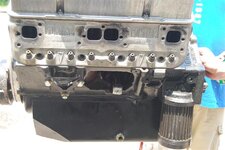
$5000.00 Hand Grenade

Signed-In Members Don't See This Ad

EBorraga

Passed Away July 17, 2022
In Memoriam
Joined
Oct 19, 2009
Messages
4,049
Location
Louisville, KY
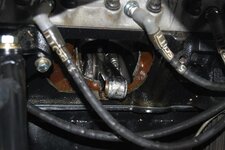
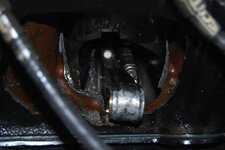
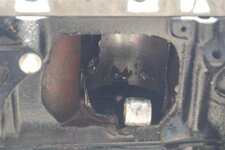
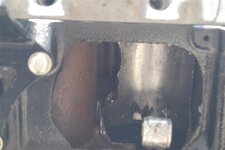
As some of you know, my Saturday's are full of Dirt Modified Racing. Last night we were racing in a $5000.00 to win 30 lap race. We lead from lap 4 to lap 29. Entering turn 3 the engine decided to blow up. Not really sure what happened, but i'm pretty sure the wrist pin broke. We were turning 8400 rpm's as well. Here's a few pics for those that have never seen the side of a small block chevy blown apart.
 

Attachments

  • DSC_0090 (Small).JPG
    DSC_0090 (Small).JPG
    47.9 KB · Views: 377
  • DSC_0092 (Small).JPG
    DSC_0092 (Small).JPG
    40.1 KB · Views: 290
  • DSC_0093 (Small).JPG
    DSC_0093 (Small).JPG
    37.6 KB · Views: 328
  • DSC_0094 (Small).JPG
    DSC_0094 (Small).JPG
    36.2 KB · Views: 269
  • DSC_0095 (Small).JPG
    DSC_0095 (Small).JPG
    51.7 KB · Views: 384
Signed-In Members Don't See This Ad
I saw a few of those in my former life as a mechanic.

But still...

Ouch.

It's amazing just how fast all the money, work, and care you put into those race engines can just disappear...
 
I saw a few of those in my former life as a mechanic.

But still...

Ouch.

It's amazing just how fast all the money, work, and care you put into those race engines can just disappear...

I agree with you, LOTS OF MONEY AND TIME!! This thing gave no warning. Oil temp and pressure was normal, then kaboom.
 
Back in the day when I had race cars I had a bunch of those over the years. Once at a end of season open comp race (no restrictions on engines and we ran against the sprint cars) we added Nitro(tipping the can_) to the tank for a little extra HP. Broke the track record and as he let off going down the backstretch to enter the pits, the was this huge explosion. we found what was left of the Crank on the ground under the car with some of the rods and pistons still attached. End of one nice 370 small block. Back then we built our own engines so they were not so expensive and we could run half a season before changing to a fresh engine and then put the 370 in for the big races.
 
Was that the engine your buddy put together for you? If I recall from the post, that engine was really expensive!

Will JB Weld fix the hole? Sorry, just had to throw in a little humor. I hope it dulls the pain.
 
Saw a couple boat motors and outboards that looked like that. The only good thing about the situation was they weren't mine. That sure smacks you in the wallet.
 
It's to bad that it happened so close to the finish line, but I'm surprised that it didn't happen allot sooner then it did. Did you all look and see the thickness of the cylinder wall? Or maybe I should say how thin the cylinder wall is, that has had to have been bored out a time or two
Len.
 
From another site:
DEFINITION OF ACCELERATION


One top fuel dragster 500 cubic-inch Hemi engine makes more horsepower than the first 4 rows of stock cars at the Daytona 500.

It takes just 15/100ths of a second for all 6,000+ horsepower of an NHRA Top Fuel dragster engine to reach the rear wheels.

Under full throttle, a dragster engine consumes 1-1/2 gallons of nitro methane per second; a fully-loaded 747 consumes jet fuel at the same rate with 25% less energy being produced.

A stock, Dodge Hemi, V8 engine cannot produce enough power to drive the dragster's supercharger.

With 3,000 CFM of air being rammed in by the supercharger on overdrive, the fuel mixture is compressed into a near-solid form before ignition. Cylinders run on the verge of hydraulic lock at full throttle.

At the stoichiometric (stoichiometry: methodology and technology by which quantities of reactants and products in chemical reactions are determined) 1.7:1 air/fuel mixture of nitro methane, the flame front temperature measures 7,050 degrees F.

Nitro methane burns yellow. The spectacular white flame seen above the stacks at night is raw burning hydrogen, dissociated from atmospheric water vapor by the searing exhaust gases.

Dual magnetos supply 44 amps to each spark plug. This is the output of an arc welder in each cylinder. Spark plug electrodes are totally consumed during a pass. After halfway, the engine is dieseling from compression, plus the glow of exhaust valves at 1,400 degrees F. The engine can only be shut down by cutting the fuel flow.

If spark momentarily fails early in the run, unburned nitro builds up in the affected cylinders and then explodes with sufficient force to blow cylinder heads off the block in pieces or split the block in half.

In order to exceed 300 mph in 4.5 seconds, dragsters must accelerate an average of over 4G's. In order to reach 200 mph (well before half-track), the launch acceleration approaches 8G's. Dragsters reach over 300 miles per hour before you have completed reading this sentence.

Top fuel engines turn approximately 540 revolutions from light to light! Including the burnout, the engine must only survive 900 revolutions under load. The redline is actually quite high at 9,500 rpm.

Assuming all the equipment is paid for, the crew worked for free, and for once NOTHING BLOWS UP, each run costs an estimate $1,000.00 per second.

The current top fuel dragster elapsed time record is 4.428 seconds for the quarter mile (11/12/06, Tony Schumacher, at Pomona, CA). The top speed record is 336.15 mph as measured over the last 66' of the run (05/25/05 Tony Schumacher, at Hebron , OH).
-----
Putting all of this into perspective:

You are driving the average $140,000 Lingenfelter, 'twin-turbo' powered, Corvette Z06. Over a mile up the road, a top fuel dragster is staged and ready to launch down a quarter mile strip as you pass. You have the advantage of a flying start. You run the 'Vette hard up through the gears and blast across the starting line and pass the dragster at an honest 200 mph. The 'tree' goes green for both of you at that moment.

The dragster launches and starts after you. You keep your foot down hard, but you hear an incredibly brutal whine that sears your eardrums and within 3 seconds, the dragster catches and passes you. He beats you to the finish line, a quarter mile away from where you just passed him.

Think about it, from a standing start, the dragster had spotted you 200 mph and not only caught, but nearly blasted you off the road when he passed you within a mere 1,320 foot long race course.

....... and that my friends, is ACCELERATION.

 
Was that the engine your buddy put together for you? If I recall from the post, that engine was really expensive!

Will JB Weld fix the hole? Sorry, just had to throw in a little humor. I hope it dulls the pain.

This was one of the three that we built. This was the least expenssive of the 3, but was still a big chunk of change.
 
Last edited:
It's to bad that it happened so close to the finish line, but I'm surprised that it didn't happen allot sooner then it did. Did you all look and see the thickness of the cylinder wall? Or maybe I should say how thin the cylinder wall is, that has had to have been bored out a time or two
Len.

It had plenty of thickness and was only bored .10 over.
 
Wow. Being a dirt pit guy for a bit, that sure sucks. Especially at that stage of the race but the excitment of 39 laps is almost worth it.
 
Yep seen that many times in my racing days, I used to run a blown street legal 64 dart in NHRA, back in my 20's and 30's, went through 5 blocks myself during that time.

It can get expensive. But there nothing like pure Cubic inches and Horsepower. :biggrin:
 
Hmmm pontiac heads on a chevy or corporate block?

It's a 400 GM Bowtie Block. The Pontiac heads are some very unique aluminum one's that were on a drag car. The amount of work done to them make's my head spin. The only problem with them is the dang port's for the headers. Schoenfield had to make a special set just for it, and now if i change the head's i have to get different header's. But as Chuck told me, It's only money and you can't take it with you:biggrin:.
 
From another site:
DEFINITION OF ACCELERATION


One top fuel dragster 500 cubic-inch Hemi engine makes more horsepower than the first 4 rows of stock cars at the Daytona 500.

It takes just 15/100ths of a second for all 6,000+ horsepower of an NHRA Top Fuel dragster engine to reach the rear wheels.

Under full throttle, a dragster engine consumes 1-1/2 gallons of nitro methane per second; a fully-loaded 747 consumes jet fuel at the same rate with 25% less energy being produced.

A stock, Dodge Hemi, V8 engine cannot produce enough power to drive the dragster's supercharger.

With 3,000 CFM of air being rammed in by the supercharger on overdrive, the fuel mixture is compressed into a near-solid form before ignition. Cylinders run on the verge of hydraulic lock at full throttle.

At the stoichiometric (stoichiometry: methodology and technology by which quantities of reactants and products in chemical reactions are determined) 1.7:1 air/fuel mixture of nitro methane, the flame front temperature measures 7,050 degrees F.

Nitro methane burns yellow. The spectacular white flame seen above the stacks at night is raw burning hydrogen, dissociated from atmospheric water vapor by the searing exhaust gases.

Dual magnetos supply 44 amps to each spark plug. This is the output of an arc welder in each cylinder. Spark plug electrodes are totally consumed during a pass. After halfway, the engine is dieseling from compression, plus the glow of exhaust valves at 1,400 degrees F. The engine can only be shut down by cutting the fuel flow.

If spark momentarily fails early in the run, unburned nitro builds up in the affected cylinders and then explodes with sufficient force to blow cylinder heads off the block in pieces or split the block in half.

In order to exceed 300 mph in 4.5 seconds, dragsters must accelerate an average of over 4G's. In order to reach 200 mph (well before half-track), the launch acceleration approaches 8G's. Dragsters reach over 300 miles per hour before you have completed reading this sentence.

Top fuel engines turn approximately 540 revolutions from light to light! Including the burnout, the engine must only survive 900 revolutions under load. The redline is actually quite high at 9,500 rpm.

Assuming all the equipment is paid for, the crew worked for free, and for once NOTHING BLOWS UP, each run costs an estimate $1,000.00 per second.

The current top fuel dragster elapsed time record is 4.428 seconds for the quarter mile (11/12/06, Tony Schumacher, at Pomona, CA). The top speed record is 336.15 mph as measured over the last 66' of the run (05/25/05 Tony Schumacher, at Hebron , OH).
-----
Putting all of this into perspective:

You are driving the average $140,000 Lingenfelter, 'twin-turbo' powered, Corvette Z06. Over a mile up the road, a top fuel dragster is staged and ready to launch down a quarter mile strip as you pass. You have the advantage of a flying start. You run the 'Vette hard up through the gears and blast across the starting line and pass the dragster at an honest 200 mph. The 'tree' goes green for both of you at that moment.

The dragster launches and starts after you. You keep your foot down hard, but you hear an incredibly brutal whine that sears your eardrums and within 3 seconds, the dragster catches and passes you. He beats you to the finish line, a quarter mile away from where you just passed him.

Think about it, from a standing start, the dragster had spotted you 200 mph and not only caught, but nearly blasted you off the road when he passed you within a mere 1,320 foot long race course.

....... and that my friends, is ACCELERATION.


Thanks! I will show this to SWMBO so that she will realize once and for all, that I'm "cheap to keep" :) :)
 
I'm a little curious about the square exhaust ports on those heads. I'm more familiar with the D port or the round Ram Air heads.
I went with a friend to a truck pulling test and tune Saturday. He has a Pro Street truck and a Pro Stock truck. Due to his brain flatulence, he didn't get to pull with the Pro Street. With the Pro Stock he came out with the sled at 5900 rpm. At the 75 ft. mark he used the rest of the throttle. If you've never heard a stroked, high compression, big block turn 9800 rpm, you need to try it. 52,000 lb. sled and he had to stop with a fence a light pole against the front weight box, at 399.98 feet. Average ground speed was 27 mph.
 
I'm a little curious about the square exhaust ports on those heads. I'm more familiar with the D port or the round Ram Air heads.
I went with a friend to a truck pulling test and tune Saturday. He has a Pro Street truck and a Pro Stock truck. Due to his brain flatulence, he didn't get to pull with the Pro Street. With the Pro Stock he came out with the sled at 5900 rpm. At the 75 ft. mark he used the rest of the throttle. If you've never heard a stroked, high compression, big block turn 9800 rpm, you need to try it. 52,000 lb. sled and he had to stop with a fence a light pole against the front weight box, at 399.98 feet. Average ground speed was 27 mph.

Randy, these are actually Brodix 10 or 11 heads, i'm not 100% on which one. They were made for Pro Stock drag cars about 15 years ago. They had to make them for Pontiac, which is why they have Pontiac on them, but they are the exact same heads as a chevy except for the square port. The port design had something to do with the rules at the time. These heads still flow as good as my PBM Pro Filer heads. Hope this helps some.
 
Back
Top Bottom