
Another CA finishing question … or two

Signed-In Members Don't See This Ad
Joined
Nov 26, 2025
Messages
74
Location
RI, USA
I did my second and third pieces using CA to finish, a Slimline pen and pencil pair. I'm following the steps in a video that suggests two thin, two medium, and two more thin coats, then wet micromesh to 12000, then One Step plastic polish. The finish overall is decent - I'm getting the gloss that I want, but two issues persist now. I'm being doubly careful to have bo tool marks from turning, then dry sanding from 160 to 800 grit, being sure that there are no low spots on the bare wood before applying CA.

First, I cannot get a smooth application of the medium CA. It leaves ripples that require a LOT of re-sanding before proceeding to wet sanding. The medium stuff comes out of the bottle very thick - it doesn't even absorb into the paper towel like the thin does, it just comes off in a think blob that is very difficult to spread evenly. To address this on my last pair of blanks, I did 8 coats of thin only, which greatly improved the surface pre-micromesh, but I don't think it's filling in the grain as well as a few coats of medium does. Is there a trick to this, or a particular brand that's better for finishing? I'm wondering if maybe I'm using too cheap a brand of CA (I'm using IXIRPRO from Amazon).

Second, by the time I'm done with sanding, I'm getting a number of micro-cracks (for lack of a better term) that are too small to see until they start collecting white sanding powder. I tried giving them another wipe with DNA before polishing, which cleaned up a lot of them, but not all. I have not seen any of these on pens and other stuff I've finished with EEE and friction polish. My biggest reason for trying CA is my concern about the durability of these, plus not having to wait weeks for the EEE and polish to fully cure.

Overall I'm pleased with the early results, but I really need to resolve these issues so I can start putting out pieces worthy of gifting.
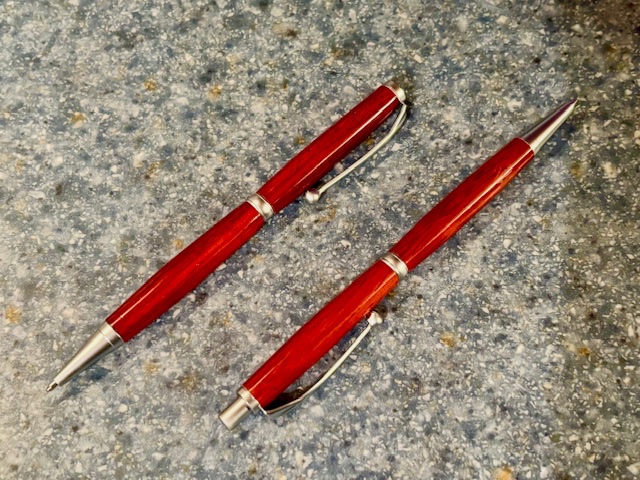
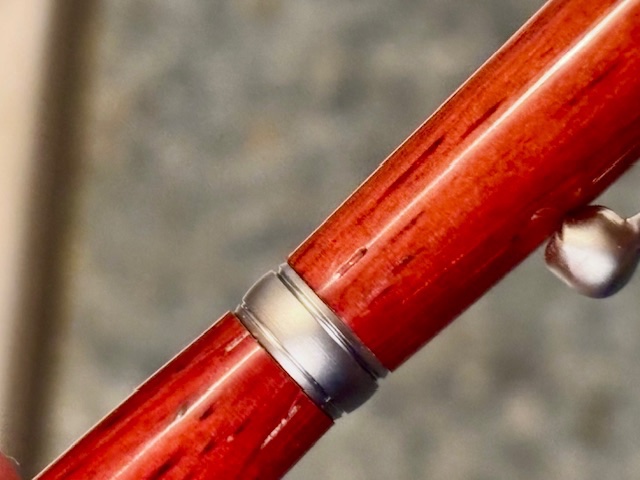
IMG_1829.jpeg

IMG_1831.jpeg
 
Signed-In Members Don't See This Ad
For smoothing, I suggest using craft foam sheets as the applicator, not paper towels. I use small pieces of craft foam, add the CA to the foam, then use that to apply it to the pen body. Lots less ridges. Also, use less CA per application and only swipe the body once or twice at most. If you keep wiping as it is setting up, you will get a lot of roughness. If you are using accelerator, use less. It tends to make the white and cracks. Accelerator comes in different formulas, be sure yours is compatible with your CA.

Lastly, switch to GluBoost vs regular CA. It works WAY better.

Kevin
 
Not sure what brand of CA you're using. Some are formulated for gluing and some are formulated for finishing. There are several brands that people use for finish and I honestly don't know what they all are.

I use GluBoost because the guys who taught me to make pens all use GluBoost and that's what I learned with and have stayed with because it's worked well for me. One thing I will highlight is it's extreme adapability to different application methods and uses. I've used it on large turnings and on small ones. Meaning the way I apply it to a large turning like a cigar holder or ornament is different than how I apply it to a pen. I personally know 5 different turners who apply it differently to pens with spectacular results. As @NJturner suggests, it does not require a lot of product when applying either which could the source of your rippling. (it was for me) Their accelerator is guaranteed to not cause white spider cracking or blooming too. CA can sometimes build on the end of a blank and it can cause issues with your assembly. You'll want to have a method to lightly sand the ends of your blanks to make sure you don't have an issue.

I don't know for sure what wood you've used in your pens but it's possible that may have caused your cracks too. I have a gorgeous pen sitting on my desk that's super pretty but it will never leave my house because I found out after the fact that red mallee can crack like crazy.

Lastly, if you don't have a set of the urethane finishing bushings get a set of them. They will help with the finishing process and keep CA off your turning bushings if you use them.
 
Personally I wouldn't go in with the expectation that you'll be able to apply so evenly that you don't need to level the finish before polishing. When I CA finish (which is how I finish the vast majority of my pens), I actually don't use thin at all. Maybe I'll try it sometime to see if it makes a difference, but I just do 8-10 coats of medium CA. I do try and get as even coverage as I can, but once the 10th coat is cured, I wet sand with 600 grit to level it, then 1000 grit, and move into polishing steps (I'm using CSUSA's polishing waxes and then Novus 2). Seems to come out great, very glossy, very durable.
 
When I apply a CA finish, I wipe it back and forth over the wood until it's smooth, then let it dry. I use paper towels, and it seems to suffice.
The video below shows how the zebrawood looks after applying a CA finish, and I haven't used micro mesh yet. It's already a little glossy and has no ridges. Maybe this will help?


as some have stated above. they use craft foam, but I agree with woodchopper that I prefer paper towel. Specifically blue shop towels rather than kitchen paper towel - it seems to hold up much better and is less rough.

Also, you may be both shooting yourself in the foot and doing too much work with your dry sanding. When doing a CA finish, I first get nice clean final cut with my tool (I use carbide, but a good sharp skew can do even better) and start at 400 (320 if needed) and sand to 600. All you are trying to do is getting out any small radial marks, then the CA will cover the finish. Starting at 180 you may be actually adding more scratches than getting out.

Regarding layers, I like doing 3-4 thin flex then 3-4 medium flex. I only use excelerator every other pass - or ideally not at all but it takes longer. Then, wet sand with 600/800 and use zona paper. finish with novus or maguires (still unsure which I like better).

And yes, I imagine a higher quality CA will help.

if there is one thing you get from this thread... practice, iterate, and find a method that works for you.
 
Very helpful info from everyone here!

Points brought up that I'd like to address:

I am using those white-ish nonstick bushings for all my finishing once dry sanding is done, switching over from the turning bushings before any pastes or liquids are applied.

The blanks I've used so far for this CA experiment have been the relatively cheap ones that come in assortment packs from PSI. They feel very light and porous compared to the better hardwoods I've used, but I don't want to possibly ruin and waste the good stuff until I'm more comfortable that I know what I'm doing.

When spraying on accelerator, I just give it two very short blasts from about 1 ft away with the lathe turning.

The CA glue and accelerator I'm using came in a package (from Amazon, because I'm a registered cheapskate). The brand is IXIRPRO, and it includes 1 bottle each of thin, medium, and thick CA, and a large aerosol can of accelerator. It's described as being good for adhesives and for wood finishing, but I'm guessing it's more 'can be used for' than 'is good for'. I've been trying to be very careful about keeping the layers as thin as possible and still cover the entire blank. The thin applies nice and evenly. The medium looks and feels very thick; I squeeze out a circle about half the size of a dime, and when I apply it, it just grabs the blank and comes off in one chunk, making it very difficult to spread across the length of the blank. I try to do it in a single sweep, but I can see the ripples forming right away. The ripples are so high, I need to go down to 320 grit to take them down - starting with 600 grit would take forever. I did expect to have to do some leveling before hitting the Micromesh, but not that much.

So I'm thinking that perhaps this particular brand's medium is just too think, and probably better for dabbing and filling cracks and chips than finishing. I was looking at a couple of alternatives from PSI - Super Gold Thin Odorless CA that's supposed to cure to be more flexible and less prone to cracking; or Pen Finishing Ultra Cure that's described as medium-thin viscosity that's good for gap filling. But now I think I'm gonna do a little more research on GluBoost before dropping any more coin on this. I see some good reviews of the Mercury products, so I might have to give that a good look, too.

What I think I'm going to try first, after watching a few more vids, is just turning the lathe by hand while applying the CA layers, maybe starting with the medium first. Could be my slowest lathe speed (around 750 RPM) is creating too much friction and drying the medium CA too fast. I see a Mark Dryer clip where he never starts the lathe while applying just a few layers, starting with medium. I don't know, I see lots of experimenting coming up.

Thank you all again for all the helpful info.
 
+1 for GluBoost Fill & Finish. It is a CA designed for finishing.

I used Starbond successfully for a while but made the switch to GluBoost and would not even consider switching back.

A bonus of the GluBoost is that the smell and associated CA and Accelerator nastiness seems significantly lower/less.

As a career project manager who also taught project management, I completely understand the whole "registered cheapskate" perspective. I will tell you that your time, and frustration, is worth more than the money you are saving on cheap CA. :oops:

Good Luck! :)
I'm a retired project manager too (IT)! In my defense (of being a cheapskate, not a project manager), I bought this CA package a year ago, just after I started down this road to the poor house, before I had much of a clue of what I was doing. I had only tried it once, then went with friction wax and polish finishes, until I decided to give it another run very recently. Remember the old Valvoline tv ad, 'motor oil is motor oil'? Well I thought CA glue is CA glue. I'm now learning that the latter is no less true than the former. 😁.

Defense exhibit #2: my receipts for purchases made within the past month that utterly defy my cheapskatedness. A new bench top drill press, many times more capable than my old one. A new slow speed bench grinder to sharpen turning tools that my old high speed grinder would ruin. Two new turning tools for turning resins and acrylics. About 30 new pen kits (Christmas is right around the corner). A bunch of alumilite and Aquabright blanks. New tool rests. Drill bits for acrylics. Another small tool organizer for the bushings I'm running out of storage for. Assorted other turning accessories. I'm afraid to even think about tallying those all up. Totally blown my hobby budget for the rest of the year is an understatement (major project management fail right there!). But a GluBoost pack is next on my list as soon as finances allow.

All that aside, thanks for the advice!
 
From your description of the Medium CA glue that you got from Amazon I'd say your statement about it is correct. It sounds way too thick. If it's an off brand and a year old at your house it could be considerably older than that. It may be starting to set up.

I use a paper towel and wipe back and forth across the blank with lathe going around 750 RPM. It will help to smooth out the ripples.
Excellent point - that's exactly how the medium goop feels trying to squeeze it out of the bottle. I think my turning splurge needs one more piece of cake.

UPDATE: Well, a GluBoost combo pack is on the way. Ordinarily I'd be in the doghouse for yet another frivolous purchase, but as luck would have it, my wife confiscates about half of the pens coming out of the shop, and most of the recipients of the rest as gifts are her family and friends. Thank you once again for the great advice and suggestions.
 
Last edited:
Excellent point - that's exactly how the medium goop feels trying to squeeze it out of the bottle. I think my turning splurge needs one more piece of cake.

UPDATE: Well, a GluBoost combo pack is on the way. Ordinarily I'd be in the doghouse for yet another frivolous purchase, but as luck would have it, my wife confiscates about half of the pens coming out of the shop, and most of the recipients of the rest as gifts are her family and friends. Thank you once again for the great advice and suggestions.
and here I was anticipating you were going to say she confiscates all the M&M's coming out of your Exotic Blanks orders! That's what happens at our house.

As with anything else, you'll find something that works for you with the GluBoost and continue to "turn out" wonderful projects. If you ordered the full set, be mindful of the ultrathin because it probably deserves the name crazy thin or something. it moves fast.
 
Wow, CA glue that is thick as honey - that's a new one! Trash can time...

I just finished turning nearly 30 pens for a Pens for The Troops project - slimlines with wood bodies. It's a wonderful charity I do every year, but use it to test some things out along the way, since it's the only time I do volume turning. I bought some Mercury Flex CA due to a friends recommendation and it did work pretty nice, but it was SUPER sensitive to different accelerators. I had a few cans of accelerant from various vendors in the shop (ran out of Mercury's), so thought I would use them up during the project. I had some stuff from "RED BARON" that I bought at a show, which I have used for glue work not finishing, and as soon as I sprayed it on the Mercury CA it instantly turned everything white! I tried it on nearly 5 pens with exactly the same result. I then tried another brand and it did pretty much the same, but it looked more like light snow on the finish, versus a full storm - lots of white spots on the finish. The Mercury branded accelerator is $29 on Amazon, so I passed - if I am going to spend that, I'd stick with GluBoost.

Fortunately, I had enough stock to sand down all but one of the pens back to the wood. I then used 3 coats of GluBoost thin followed by 3 coats of thick fill and finish, sanded and polished and they look wonderful! Not one white spot!

If I am working at a slower pace, I'll probably use up the Mercury, as it did a nice job coating and filling the pen surface and polished to a very nice shine, but it's pretty slow without the accelerator. I've not tried other accelerators with GluBoost other than their brand, and it may have the same bad results as the Mercury, but I am good with the results with GluBoost so figure the added price is worth it considering the problems I had with other stuff.
 
and here I was anticipating you were going to say she confiscates all the M&M's coming out of your Exotic Blanks orders! That's what happens at our house.

As with anything else, you'll find something that works for you with the GluBoost and continue to "turn out" wonderful projects. If you ordered the full set, be mindful of the ultrathin because it probably deserves the name crazy thin or something. it moves fast.
She would if she weren't allergic to peanuts!

Thanks for the warning. I do plan on trying just a drop of the ultra-thin as a first and second coat to soak in and stabilize, especially on the cheaper and more porous woods. Paper towel, lathe turned off. I haven't seen anyone using it yet, but then every video I've watched with GluBoost has a different approach … and curiously not one has had a bad result. It'll just be a matter of finding the process I'm most comfortable with, and probably learning a LOT about different types of wood along the way.
 
Mark Dreyer - @mg_dreyer on this forum - is one of the turners who works with GluBoost's chemists and producer - he has some good videos and ideas here and on YouTube to give you ideas. Nice guy too and always willing to share or help. He works with Ed at Exotic Blanks a bunch.

Despite being a big GluBoost fan, I personally don't use the Ultra Thin hardly at all. I find it just too thin for small work like on a pen as a finish. Maybe to stabilize something that is punky it might help as it will soak in, but it's super hard to keep on a pen blank as it turns.

Kevin
 
Back
Top Bottom