Capacitor? or Switch?

Signed-In Members Don't See This Ad
I think you're comparing apples and oranges. Power tool dangers are generally visible. Spinning blades, pinch hazards, rotating shafts, etc. are much easier to visibly "respect". I don't think it's unwise to offer warnings about an invisible killer like electricity or the fire hazards of boiled linseed oil. It's not because anyone is worried about being sued, it's because we care about our friends.

I was happily not going to post any further replies to this discussion, but since you specifically called me out I'll offer some thoughts in response. Let's ignore the legal stuff because what I posted was in response to the use of the word litigious in a previous post. No need to beat that horse here.

Everything we use in the production of pens has obvious and less obvious risks associated with it. Even electricity. When someone asks about an electrical issue, it may indeed be prudent to offer warnings and specific points of caution (like how dangerous a capacitor can be even when the machine is unplugged). But a strident blanket statement to the effect that "electricity kills so anybody who isn't a licensed electrician should never ever attempt any electrical repairs on their own" seems slightly ridiculous in a forum designed to help people use potentially lethal tools, equipment and materials to make pens. Which brings us to the apples and oranges issue you raise.

Just about every tool, piece of equipment and material we use has the potential to kill or cause severe immediate or long term health issues if misused. We discuss the use of these tools, equipment and materials all the time. Often with specific warnings / advice from more experienced members on how to do so safely. I can't recall seeing anybody told that they shouldn't attempt something and to instead let a pro do it for them. That seems to me to be the way it should be.

We all learn at an early age that electricity is dangerous. Offering advice to those seeking it with warnings / cautions to encourage safe practices seems to be a valuable use of this forum. In this respect I don't see electricity as being any different than anything else we use. "Advice" along the lines of "don't touch that or you will surely die, hire a licensed pro instead" without first understanding the level of competence of the person asking the question seems very unhelpful to me.

But that's just my opinion.

Ed
 
Signed-In Members Don't See This Ad
Ok Jeff, first off apologies for 'you know what'. :wink:

If it's true that we really don't want to see our friends get hurt then why are we allowing 'you know what's' to answer these types of threads?

My post got deleted for calling someone a name. But the poor advise that could get someone hurt remains??:confused:

Name calling is against TOS. Poor advise is all a point of view...

For example, I disagree with some of the statements said in this thread. I neither feel that there is no chance for a lethal shock, nor do I feel the risk is high enough to not even think of opening the tool up.

Reasonable caution is in order, but that doesn't mean the mods can delete posts because someone doesn't agree with whats being said. As for our friends getting hurt - If they have gotten through this thread and get hurt, they didn't pay any attention at all to what Peter or Jim had to say about it.
 
I'm afraid you lost me a bit with your description.

A picture would still help TONS.. but agree - NEVER assume color means anything!

Andrew - assuming you don't abandon this thread... I'll repeat the above.. A PICTURE would help more still... Cause then those of us with some experience can point you to some specific points that we could have you test with your meter and what the result is likely to be.

Just for kicks, I opened up my disk sander and it doesn't really apply the same since my sander has a DPST switch and doesn't apply at all to the way you described yours.
 
I'm afraid you lost me a bit with your description.

A picture would still help TONS.. but agree - NEVER assume color means anything!

Andrew - assuming you don't abandon this thread... I'll repeat the above.. A PICTURE would help more still... Cause then those of us with some experience can point you to some specific points that we could have you test with your meter and what the result is likely to be.

Just for kicks, I opened up my disk sander and it doesn't really apply the same since my sander has a DPST switch and doesn't apply at all to the way you described yours.
Andrew's written description reads like they are using the switch both as a switch and as a connectiion board which would not be unusual.
 
Andrew's written description reads like they are using the switch both as a switch and as a connectiion board which would not be unusual.

Agreed, but with the multiple wires he described, one confusion in the reading of his description could lead to the wrong answer. And even reading my description of what it test, I think I wrote it confusing to what I meant for him to check.

The other option that would help.. Is there a MODEL number on the switch (or of the sander - maybe we could get lucky and the actual schematic is out there on the web).
 
Andrew's written description reads like they are using the switch both as a switch and as a connectiion board which would not be unusual.

Agreed, but with the multiple wires he described, one confusion in the reading of his description could lead to the wrong answer. And even reading my description of what it test, I think I wrote it confusing to what I meant for him to check.

The other option that would help.. Is there a MODEL number on the switch (or of the sander - maybe we could get lucky and the actual schematic is out there on the web).

:smile::smile: Let me add my one last statement to this thread. I am not saying you should not work on your own equipment, just trying to point out some of the safty precautions that should be looked into. I have no problem with others helping out and lending a hand as long as their advice is not harmful. I personaly would not give any wirering advice without seeing the tool myself, looking at the wirering diagram, and testing it myself. The reasons for this are the following. 1 Some, not all, countries do not use American standards to wire there products. At the paper mill when we ordered equipment from Germany or any outside country, we would have to request and pay extra to have it wired to American standards because they use 220 volts, run their wires point to point with no wire #s, had no wire color change for different voltages and, did not bring their wires back to a centrol location for easy trouble shooting. Most mills, farms, and larger business places run their equipment on 440 volt 3 phase. 2 If you happen to buy used equipment, someone may have worked on or modified that piece, making your drawing useless unless they noted what they did. We were lucky, our mill would let employees bring in their items and have our tecs work on them so the wouldn't get hurt. Just work safely and within your comfort zone. The end!! Jim S
 
Last edited:
Andrew's written description reads like they are using the switch both as a switch and as a connectiion board which would not be unusual.

Agreed, but with the multiple wires he described, one confusion in the reading of his description could lead to the wrong answer. And even reading my description of what it test, I think I wrote it confusing to what I meant for him to check.

The other option that would help.. Is there a MODEL number on the switch (or of the sander - maybe we could get lucky and the actual schematic is out there on the web).

:smile::smile: Let me add my one last statement to this thread. I am not saying you should not work on your own equipment, just trying to point out some of the safty precautions that should be looked into. I have no problem with others helping out and lending a hand as long as their advice is not harmful. I personaly would not give any wirering advice without seeing the tool myself, looking at the wirering diagram, and testing it myself. The reasons for this are the following. 1 Some, not all, countries do not use American standards to wire there products. At the paper mill when we ordered equipment from Germany or any outside country, we would have to request and pay extra to have it wired to American standards because they use 220 volts, run their wires point to point with no wire #s, had no wire color change for different voltages and, did not bring their wires back to a centrol location for easy trouble shooting. Most mills, farms, and larger business places run their equipment on 440 volt 3 phase. 2 If you happen to buy used equipment, someone may have worked on or modified that piece, making your drawing useless unless they noted what they did. Just work safely and within your comfort zone. The end!! Jim S
I do not know about the rest of the world but most if not all of Europe uses 50 Hertz AC rather than 60 Hertz as used in the US. They also use many different voltages so equipment built to European standards, as you said, will not work in the USA and visa-versa. Hand tools made for 50 hertz probably can't be converted to work in the USA. Canada and the USA and more than likely Mexico all use the same standard.
 
If the motor hums it is probably the capictor. Most good mult-meters will test capicitors.
I am not being a smart a--, but, if you are going to work on electrical equipment, you need the correct tools. As A retired HVAC technician, I have seen (too many times) what happens when people try to fix electrical problems without the proper knowledge or tools.
Gary
 
Andrew's written description reads like they are using the switch both as a switch and as a connectiion board which would not be unusual.

Agreed, but with the multiple wires he described, one confusion in the reading of his description could lead to the wrong answer. And even reading my description of what it test, I think I wrote it confusing to what I meant for him to check.

The other option that would help.. Is there a MODEL number on the switch (or of the sander - maybe we could get lucky and the actual schematic is out there on the web).

:smile::smile: Let me add my one last statement to this thread. I am not saying you should not work on your own equipment, just trying to point out some of the safty precautions that should be looked into. I have no problem with others helping out and lending a hand as long as their advice is not harmful. I personaly would not give any wirering advice without seeing the tool myself, looking at the wirering diagram, and testing it myself. The reasons for this are the following. 1 Some, not all, countries do not use American standards to wire there products. At the paper mill when we ordered equipment from Germany or any outside country, we would have to request and pay extra to have it wired to American standards because they use 220 volts, run their wires point to point with no wire #s, had no wire color change for different voltages and, did not bring their wires back to a centrol location for easy trouble shooting. Most mills, farms, and larger business places run their equipment on 440 volt 3 phase. 2 If you happen to buy used equipment, someone may have worked on or modified that piece, making your drawing useless unless they noted what they did. Just work safely and within your comfort zone. The end!! Jim S
I do not know about the rest of the world but most if not all of Europe uses 50 Hertz AC rather than 60 Hertz as used in the US. They also use many different voltages so equipment built to European standards, as you said, will not work in the USA and visa-versa. Hand tools made for 50 hertz probably can't be converted to work in the USA. Canada and the USA and more than likely Mexico all use the same standard.

:smile::smile: Thank you Smitty, I forgot about that part. Also you can buy a converter that plugs into a 220 Volt outlet so you can run your 120 volt equipment when you travel. The prongs are different on the plugs ends making it impossable to plug into the wrong voltage. Of course you could always straighten out the prongs with a plyers, just don't be holding the razor next to your face when you plug it in !!!!. Jim S
 
Last edited:
My goodness - the drama I've caused! :smile:

Again, I'm not saying "I have no idea about electricity" - I'm just not experienced with multimeters and diagnostic devices.

I'm not trying to rewire a motor - I'm trying to troubleshoot a switched tool and see what likely replaceable part needs replacing...they put screws on the access cover plate for a reason, I'd think! :smile: so it's not like I'm not cracking a motor apart to look at the windings :smile:

I have a healthy respect for electricity, and have rewired my house, including main service entrance from the roof of my house to the panel inside - the inspector passed all of my work, and I've never in my life worked on a live device....I appreciate the concern with the cautionary statements about the dangers of electricity - but I'm not talking about rewinding a motor or converting a European device to run on Canadian power -

I'm just looking for diagnostic advice on how to read a multi tool readout for a likely faulty switch or other tool error...so hopefully we can figure this out! :smile:

As far as the camera goes, it's not working great either, so I might have to crack that open too! :biggrin:...keeps saying 'card error' or something like that...but every hundredth time it will let me take a picture...I'll work on that this morning.
 
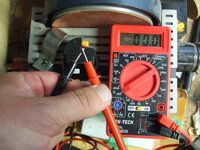
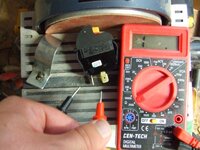
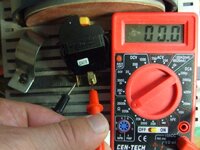
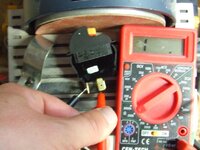
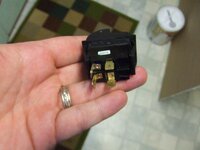
Got the camera working, sort of! Here are some pictures of the switch being tested.

Picture 1 - crossed probes to make connection
picture 2 - baseline (no connection)
picture 3 - switch set to 'on', testing one side poles
picture 4 - switch set to 'on', testing other side poles

Different measurement for pictures 3 and four:
One side shows 0
Other side shows 1
 

Attachments

  • DSCF9626.jpg
    DSCF9626.jpg
    67.2 KB · Views: 106
  • DSCF9629.jpg
    DSCF9629.jpg
    65.9 KB · Views: 114
  • DSCF9627.jpg
    DSCF9627.jpg
    62.3 KB · Views: 114
  • DSCF9628.jpg
    DSCF9628.jpg
    55.3 KB · Views: 123
Last edited:
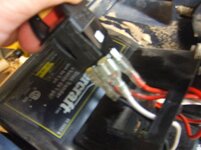
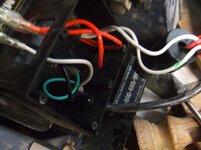
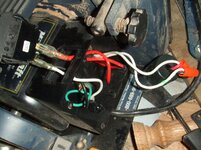
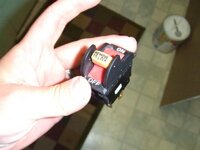
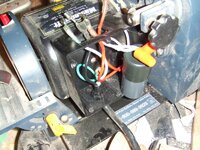
Some overall pictures of the wiring:

Model is 55-3512-8, but it's a Canadian Tire tool, so it's only sold there, and there's no schematic available anywhere, it seems...
 

Attachments

  • DSCF9608.JPG
    DSCF9608.JPG
    92.8 KB · Views: 108
  • DSCF9609.JPG
    DSCF9609.JPG
    101.3 KB · Views: 105
  • DSCF9610.JPG
    DSCF9610.JPG
    131.8 KB · Views: 101
  • DSCF9618.jpg
    DSCF9618.jpg
    37.5 KB · Views: 107
  • DSCF9619.jpg
    DSCF9619.jpg
    35.6 KB · Views: 98
  • DSCF9621.jpg
    DSCF9621.jpg
    87.3 KB · Views: 111
Looks to be DPST(dual pole single throw) The white and black come from the wall cord correct? When in off position there should be nothing flowing (meter should read 1) between anything on the switch (out of circuit). When ON (closed), the white should go to to 1 red on the same side would go to 0 on the meter. The black wire will go to the other red (again meter will read 0). Across the connections (white to black & red to red poles - OUT of circuit or you'll read the motors resistance) should read 1.
 
Some overall pictures of the wiring:

Model is 55-3512-8, but it's a Canadian Tire tool, so it's only sold there, and there's no schematic available anywhere, it seems...
One side of the switch is bad.... the side that reads 1 when the switch is on. When the switch is off both sides should read one.
 
Looks to be DPST(dual pole single throw) The white and black come from the wall cord correct? When in off position there should be nothing flowing (meter should read 1) between anything on the switch (out of circuit). When ON (closed), the white should go to to 1 red on the same side would go to 0 on the meter. The black wire will go to the other red (again meter will read 0). Across the connections (white to black & red to red poles - OUT of circuit or you'll read the motors resistance) should read 1.

That's exactly right, except while the white wire to the red on the same side changes, the black wire to the red wire on the same side never changes from 1 to 0

So the switch is kaput :smile:

Hey, these multimeters are neat!
 
Last edited:
You're thinking it from that last pic on the 1st set right? I saw that but I couldn't tell which connectors he was touching clearly enough.

Yes, that's the one - tough to take a good picture and hold the leads at the same time.

That last picture is the hot side, and it's always reading 1, so the switch is bad, I guess.
 
Busy Bee isn't cheap for shipping, I see - $10 for the switch, $10 for shipping, almost $3 for taxes...bloody expensive switch when the dust settles! :smile:

Maybe I can find one on eBay...


Don't be a tight a$$ !!! :rolleyes: $23 is a bargain !!! You got the diagnosis for free, nearly caused a fight and made me get my first deleted post !!!:mad::biggrin:

LOL, glad you're still alive though ( sort of...) :biggrin:
 
Busy Bee isn't cheap for shipping, I see - $10 for the switch, $10 for shipping, almost $3 for taxes...bloody expensive switch when the dust settles! :smile:

Maybe I can find one on eBay...


Don't be a tight a$$ !!! :rolleyes: $23 is a bargain !!! You got the diagnosis for free, nearly caused a fight and made me get my first deleted post !!!:mad::biggrin:

LOL, glad you're still alive though ( sort of...) :biggrin:
They get easier after the first:biggrin:
 
You could always take the switch apart and see why it stopped working. Might just be dirt on the contacts, or something else simple. Since you are going to throw it away anyhow, you don't have much to lose.

If you aren't sure how to put it back together after you open it up, just toss it.

Ed
 
Measure the size... some vary. Do you care about the removable safety "key"? If not check, local auto and boat part stores. Check then, many will have 2 ratings on them, 1 for DC and another for AC. Also, you could also use a DPDT and not use 2 of the terminals.
 
You could always take the switch apart and see why it stopped working. Might just be dirt on the contacts, or something else simple. Since you are going to throw it away anyhow, you don't have much to lose.

If you aren't sure how to put it back together after you open it up, just toss it.

Ed

This is an excellent suggestion... It won't be as "dust proof" any more, but a little cleaning or adjustment it may work again.... Now that you know how to test it, you'll know if it works when your done. :wink:
 
Please, just don't anyone tell him that he could just short out the two return wires and just use the good pole on the switch to control the live feed. At least he could still use his machine till the part arrived.
But don't tell him !!!:wink:
 
Now who is giving poor advise? Telling him to basically ignore the fact that it was a DPST switch and wire it back up as a SPST and all will be good without knowing the rest of the circuit?
 
Now who is giving poor advise? Telling him to basically ignore the fact that it was a DPST switch and wire it back up as a SPST and all will be good without knowing the rest of the circuit?
Hmmmm We agree on something else... but on the other hand I'm not sure why they're breaking the neutral as well as the hot side....
 
Now who is giving poor advise? Telling him to basically ignore the fact that it was a DPST switch and wire it back up as a SPST and all will be good without knowing the rest of the circuit?

Well, it's a single phase circuit therefore a single break will stop / start the machine. :wink:
In this instance one of the poles failed so that it wouldn't close, but it could have just as easily failed in the closed position ( contact weld ) and he would have been non the wiser as the other pole would still control the power.
I believe that in USA you basically have two types of domestic socket. Grounded and ungrounded. The grounded ones can only be plugged in one way round because of the earth pin, but the ungrounded ones can be turned upside down, right? These two pin plugs should really only be used on portable equipment that is rated as double insulated. In Europe items have a symbol that is a small square within a square to show the appliance complies. Maybe you have the same?
If you used grounded plugs ( the 3 pin ones ) and the socket was wired correctly, then the live feed would always be in the same place when it reached the machine. A single pole switch can therefore be used to isloate the supply as soon as it enters the machine. This means that power is only getting upto the switch and nowhere else when the switch is off.
If you use the UNgrounded type, then a single pole switch will still work but the power could ( 50/50 ) be live all through the machine and only be cut as it leaves the machine. This is perfectly ok until someone starts removing covers to fault find while the plug is still plugged in.
To make sure that the power is cut in either scenario as it enters the machine they use a double pole. :wink:

I did qualify my statement by saying UNTIL the new part arrived. :biggrin:
 
Now who is giving poor advise? Telling him to basically ignore the fact that it was a DPST switch and wire it back up as a SPST and all will be good without knowing the rest of the circuit?

Well, it's a single phase circuit therefore a single break will stop / start the machine. :wink:
In this instance one of the poles failed so that it wouldn't close, but it could have just as easily failed in the closed position ( contact weld ) and he would have been non the wiser as the other pole would still control the power.
I believe that in USA you basically have two types of domestic socket. Grounded and ungrounded. The grounded ones can only be plugged in one way round because of the earth pin, but the ungrounded ones can be turned upside down, right? These two pin plugs should really only be used on portable equipment that is rated as double insulated. In Europe items have a symbol that is a small square within a square to show the appliance complies. Maybe you have the same?
If you used grounded plugs ( the 3 pin ones ) and the socket was wired correctly, then the live feed would always be in the same place when it reached the machine. A single pole switch can therefore be used to isloate the supply as soon as it enters the machine. This means that power is only getting upto the switch and nowhere else when the switch is off.
If you use the UNgrounded type, then a single pole switch will still work but the power could ( 50/50 ) be live all through the machine and only be cut as it leaves the machine. This is perfectly ok until someone starts removing covers to fault find while the plug is still plugged in.
To make sure that the power is cut in either scenario as it enters the machine they use a double pole. :wink:

I did qualify my statement by saying UNTIL the new part arrived. :biggrin:
Most male plugs today will only plug one way - the neutral and hot leads have different width contacts on the plug - so even most ungrounded plugs go in only one way.
 
Wow, this thread caused a ruckus!

Contact Canadian Tire and see if they can order you a switch.

When I worked there about 15 years ago items like that switch could be ordered.

AK
 
Others may be getting testy, but I'm not.

Andrew that switch is used in tons of machines from all kinds of manufactures. You can find them in sanders, dust collectors, bench saws, lathes and just about anything else you look at. You may already have a couple other machines that you or your neighbour have in your garages that you could swap and see if it fixes your sander. Same goes for buying a replacement from any other brand. It will fit. :smile: As long as you can put the wires on the pins and it has the same or better rating the button side doesn't matter. As an example if you can get one of this type it will substitute nicely for the one in the machine.

SWITCH ROCKER PADDLE DP/ST 20/12A - Busy Bee Tools
 
Back
Top Bottom