Gas mileage....

Signed-In Members Don't See This Ad

SDB777

Member
Joined
Feb 6, 2010
Messages
6,619
Location
Cabot, Arkansas USA
Does anyone else question the gas mileage of the new cars(just started looking for another new vehicle)?

Reason.....back in the day(1983-1984), I had a Datsun B210 5-speed that would get 45-49 miles to the gallon everyday!(ok, the car wasn't a chick magnet, but I could always find enough change on the floorboards to go find a girl)

Flash-forward.....(yesterday), I look at a POS(2011 Ford Fusion)...and the salesman was doing cartwheels explaining the car gets 33MPG, and it can park itself.(I looked him square in the eye and told him that was stupid!)


Thirty year of humans getting smarter, and the gas mileage of new vehicles is going backwards? Or am I the only person that has noticed this??


Scott (rant off) B
 
Signed-In Members Don't See This Ad
IMHO, and at the risk of offending people in general, there is nothing in our Country to make me think that we are getting smarter. Does the phrase "the dumbing down of America" sound familiar? Weyall, this done been my too sents wuth! Merry Christmas and a safe and happy New Year!
 
Scott, I agree. I don't understand how with all of our technology that we don't have cars available that are getting 50+ mpg. When the Honda Civic first showed up, it got like 50 mgp. Sure it was small, but it had great mileage and it was cheap. I thought the SMART cars would be liek that. I was shocked to see they done even get 40 mpg and they are tiny. I just don't get it.
 
The Datsun B210 has a 2,000lb curb weight. The 2011 Fusion has a 3,285lb curb weight. That's a significant differance.
 
Does anyone else question the gas mileage of the new cars(just started looking for another new vehicle)?

Reason.....back in the day(1983-1984), I had a Datsun B210 5-speed that would get 45-49 miles to the gallon everyday!(ok, the car wasn't a chick magnet, but I could always find enough change on the floorboards to go find a girl)

. . .Thirty year of humans getting smarter, and the gas mileage of new vehicles is going backwards? Or am I the only person that has noticed this??

Scott (rant off) B

I am and always have been an MPG freak. I used to have a VW Diesel Station Wagon back in the early '80s. Loved the MPG.

I have a Prius now but the way that I have to drive to get the rated "in town" MPG doesn't fit me. I still manage to average 42 - 44 MPG highway and 32 - 36 in town on average.

The 48 - 55 MPG "in town" avg ratings requires watching the lights, using the vehicle in a synchronized signal light situation and avoiding lots of stop N go. Unfortunately, I live in a small town in which there is a 4 way stop about every two blocks. This prevents high MPG. In and around my town only, I get about 32 -36 mpg.

I can't complain too much. I know that I will not get the rated MPG and don't mind not getting it. To me, those ratings are a scale. However, in the end I am very pleasantly surprised that I can average 42 - 44 on average, with several 300 mile trips of 48 - 49 MPG for those trips.

But with what you are talking about - I agree with the fact that MPG is not as high as what was expected. I think that not as many people are interested in these performances as much as larger vehicles. The smaller and lighter weight vehicles with the high mpg just don't sell as well, so there has been less incentive to increase it there.

I lived in Toyota City from 2004 - 2010 and the Prius was a very popular car there, where gas (in all of Japan) ran around $2.00 a gallon on average more than the US, and has been for the past 20 years or so. Fuel efficient vehicles carried far more importance in the past 10 years in Japan. I was surprised upon returning to the US that actual fuel efficiency has not been a high priority rate here. I am not a "tree hugger" :wink: but I like to travel without having to eat the $1.00 burgers at McD's. :wink::biggrin:
 
Last edited:
With all the creature features and safety features added to cars nowadays, they are heavier than the V8 tanks of days gone by.

Mustangs used to be known as a rather lightweight muscle car..

Our 2003 GT convertible weighs 4500 lbs (Which BTW makes the power to weight ratio barely better than our sunfire GT.) The HIGHEST curb weight I can find on a 1982-1986 mustang GT of any style is 2850lbs... that's well over a 50% increase in weight... That's kinda the trend in all models.
 
Scott, I agree. I don't understand how with all of our technology that we don't have cars available that are getting 50+ mpg. When the Honda Civic first showed up, it got like 50 mgp. Sure it was small, but it had great mileage and it was cheap. I thought the SMART cars would be liek that. I was shocked to see they done even get 40 mpg and they are tiny. I just don't get it.

To make a car more economical is not good for taxes.....
 
Geo metros got 40+ and maxed out at 70 mph. The more electronic gizmos = less fuel mileage. Also look @ safety ratings the technology going into making the cars safer makes them heavier. Smart car weighs about the same as that datsun. If you are worried about it go get another Datsun B210...which offers a stick and a steering wheel and not much else.
 
........I drive a 2008 suburban, that is my wifes, and I get excited when I am on the highway getting 18-20MPG. The truck I just sold and will soon be replacing was a 2001 Z71 on 33's and I averaged about 11mpg. My next truck will be newer w/out the 4x4 and lift so I hope to average about 20 on it. How can you keep your chinsaw with you so you can grab logs when you see them driving a little car? I need a bed to haul things.
 
Been driving Jetta diesels for the last 6 years. averages 45 MPG a little better on the highway, plenty of power, good safety rating and comfortable ride. The standard transmission versions are rated a little higher than my automatic. As this is my company car and I can claim a mileage deduction, the car more than pays for itself. That said I would not buy a 2012. They cheapened the fit and finish to try to sell more and increase market share in the US.
 
MPG is at the bottom of my list of requirements for a vehicle. At the top are comfort, fun to drive and plenty of power. Our 2003 BMW 325i wagon meets my requirements and still gets a respectable 22 MPG with 90% in town driving. If we did a lot of driving I might change my priorities but last year we only put 3,200 miles on the car so our fuel bill doesn't amount to much.
 
I have a 2006 Suburban 4X4 and I get about 20MPG on the highway, 1 MPG less than my son gets in his 2010 Ford Explorer SportTrac.
Someone please correct me if I'm wrong, but it's my understanding that a major reason for the lower gas mileage is all the anti-pollution stuff required to eliminate the NOX emissions. Also, adding ethanol slightly decreases mileage, and if you burn E85, it drops even more.
 
Something not commonly known (and not intending to get political) but tires on most cars are manufactured, built and intended to operate in the 38 - 42 PSI range. Most car manufacturers still recommend 32 on average. Look at your tires on the side and see what the TIRE ratings are IN PRINT.

I learned this on a Prius forum. My Prius was not getting the MPG that I was expecting and checked the tire pressure - 32 PSI! I upped the pressure to 40 front and 38 rear and the MPG jumped up 2 to 4 mpg. This is on the Prius. I did some googling and found this to be consistent and true.

Car manufacturers recommend one thing but the tire manufacturers recommend another and for a purpose. And their engineering departments stand behind them in terms of safety. I don't have the Michelin Milage tires but they are designed for high tire pressure and in return higher gas milage. These will be the followup tires that I purchase.
 
I really don't think they try to get the cars to really high MPG. I think they spend their time getting the lowest performing cars, trucks and SUVs to minimally acceptable levels. My first car, a long long long time ago was 1968 Chevy Impala. It got around 8 MPG on a good day. A large car like that today probably gets in the low or mid 20's.
 
My 2¢- All of the mandatory safety features add weight. All of the must have standard features add weight. Weight robs performance and fuel economy. I had a crappy 95 Kia Sephia that used very little gas, but the ONLY features were heat and a radio. I DO NOT NEED more than that. Maybe A/C, but I don't have it now. That's where most of the fuel economy is going.
 
Well if weight is what robs milage what the the heck is so heavy in them? Everything I see is all Plastic not metal like my 79 f150 or 70 cutlass was. I have a 2011 Mit Endevor as a rental and hate it everything is plastic!!!! I want my 04 EB explorer out of the shop Ill deal with the 17 mpg around town!!
 
I'm with you

MPG is at the bottom of my list of requirements for a vehicle. At the top are comfort, fun to drive and plenty of power. Our 2003 BMW 325i wagon meets my requirements and still gets a respectable 22 MPG with 90% in town driving. If we did a lot of driving I might change my priorities but last year we only put 3,200 miles on the car so our fuel bill doesn't amount to much.

I drive about 350 miles a month in my pickup I think I get about 17 - 18 mpg in the kind of driving I do [usually less than 10 mile round trips] and about 24 highway. I went out looking at getting a small SUV style....had sales people giving me the hard sell on models that got 30/32 mpg. I tried to tell them that the kind of driving I did, 32mpg highway didn't mean a thing to me. Finally gave up and kept the pickup. Having a pickup is worth the lower mileage.

With all of the regulations regarding safety and environment, many of which add weight, going into US cars we're lucky to get the mileage we do. Add weight and leave everything else the same mileage decreases, that is physics and can't be debated.

My 1969 Chevy C10 pickup truck with an inefficient powerglide 2 speed automatic got about the same mileage in local driving as my 2007 Chevy Colorado pickup truck gets. A little lower on the highway. Had I bought a 68 the mileage would have been a tad better.

About once per decade we have a flap about fuel efficiency and the government passes some new regulation that is supposed to fix it 10 or 15 years down the road. But, the American people still want to drive cars big enough and heavy enough that they don't get blown off the road when they pass or get passed by an 18 wheeler doing 75 miles an hour
 
My F-150 is getting 20.8 miles per gallon highway and is a chick magnet. I'm happy, beats the 6-8 MPG I was getting with my Jeep Wrangler (much more comfortable too).


P.S. My truck is rated for maximum of 19 MPG highway.
 
Last edited:
Not true

Something not commonly known (and not intending to get political) but tires on most cars are manufactured, built and intended to operate in the 38 - 42 PSI range. Most car manufacturers still recommend 32 on average. Look at your tires on the side and see what the TIRE ratings are IN PRINT.

I learned this on a Prius forum. My Prius was not getting the MPG that I was expecting and checked the tire pressure - 32 PSI! I upped the pressure to 40 front and 38 rear and the MPG jumped up 2 to 4 mpg. This is on the Prius. I did some googling and found this to be consistent and true.

Car manufacturers recommend one thing but the tire manufacturers recommend another and for a purpose. And their engineering departments stand behind them in terms of safety. I don't have the Michelin Milage tires but they are designed for high tire pressure and in return higher gas milage. These will be the followup tires that I purchase.

The problem with your logic is that tires are made to fit many different models which all weigh different amounts. To get the best tread life and safety use what the auto manufacturer recommends. Over inflating tires is dangerous in that it decreases the surface area that contacts the road, resullting in the loss of braking efficiency. It will also result in premature failure as the middle of the tread will wear a lot faster than the outer tread. So you can over inflate but you will be buying tires more frequently and gambling on that wet pavement.
 
68 was a bad year

I really don't think they try to get the cars to really high MPG. I think they spend their time getting the lowest performing cars, trucks and SUVs to minimally acceptable levels. My first car, a long long long time ago was 1968 Chevy Impala. It got around 8 MPG on a good day. A large car like that today probably gets in the low or mid 20's.
68 was a bad year...it was the first year of the first anti-polution laws and the Chevy was big and heavy that impala was probably close to 4000 pounds. The emission changes made a huge impact on mileage along with the added weight.

I had a 67 Impala with a 335 hp 396 cid V-8 and it got 18.5 mpg highway (as long as I stayed below about 70) and about 16 local - curb weight was about 3500 pounds.

The 68 was a lot heavier, and slower off the dime.
 
Considering what is going on in Washington DC right now, and I blame them all regardless of what party's butt they kiss, my response would get deleted.

Suffice it to say that better gas mileage hurts profits and lessens "gifts".
 
Well I have quite a few cars. My daily driver, a 93 Caddy gets 18mpg in town and 26mpg on the highway. Pretty decent and very comfortable to ride in. My 75 Jeep Cj7 gets about 14mpg all the time. My 87 Mustang, which is an endless money pit, gets 5mpg.:eek: The mustang is definetly a redneck chick magnet, as it's primer gray. It also has a little over 700 horses in the motor. That thing really loves 97 octane.
 
I don't quite agree with that

Considering what is going on in Washington DC right now, and I blame them all regardless of what party's butt they kiss, my response would get deleted.

Suffice it to say that better gas mileage hurts profits and lessens "gifts".

My belief is that better gas mileage doesn't hurt profits at all for the automobile manufacturers --- except that smaller lighter weight cars don't sell as well because we like bigger cars.

If well fell in love smaller more fuel efficient cars the manufacturers would build them - I don't believe that's gonna happen.

Years ago if you wanted fuel efficiency you bought a low priced car that was small, light and easy on your wallet. They were not big sellers then and they won't be big sellers now.
 
I drive an '03 Dodge 2500 that weighs 7200 lbs empty. The turbo is messed up but in cool weather she gives me 33 t0 38 mpg at highway speeds, seldom over 75 mph rarely under 65. When Summer gets here with temps in the 90's it drops to 25 - 28. Pulling my 12,500 lb fifth wheel camper gives me 16 mpg. The mileage is set and the rest of the fuel os blown out the pipe. I grew up with a '55 Chevy V8 weighing nearly 4000 and it got routinely 20+ mpg on mostly gravel roads.
Charles
 
Hmmmm

I drive an '03 Dodge 2500 that weighs 7200 lbs empty. The turbo is messed up but in cool weather she gives me 33 t0 38 mpg at highway speeds, seldom over 75 mph rarely under 65. When Summer gets here with temps in the 90's it drops to 25 - 28. Pulling my 12,500 lb fifth wheel camper gives me 16 mpg. The mileage is set and the rest of the fuel os blown out the pipe. I grew up with a '55 Chevy V8 weighing nearly 4000 and it got routinely 20+ mpg on mostly gravel roads.
Charles
What 55 chevy was that? My '57 hardtop V8 weighed in at about 3200.... Is that a Typo ..... that would be an awful lot even for that great deisel....
 
Last edited:
I drive an '03 Dodge 2500 that weighs 7200 lbs empty. The turbo is messed up but in cool weather she gives me 33 t0 38 mpg at highway speeds, seldom over 75 mph rarely under 65. When Summer gets here with temps in the 90's it drops to 25 - 28. Pulling my 12,500 lb fifth wheel camper gives me 16 mpg. The mileage is set and the rest of the fuel os blown out the pipe. I grew up with a '55 Chevy V8 weighing nearly 4000 and it got routinely 20+ mpg on mostly gravel roads.
Charles
What 55 chevy was that? My '57 hardtop V8 weighed in at about 3200....

Probably the same 55 that Harrison Ford drove in American Graffitti:biggrin:
 
Hmmmm

I drive an '03 Dodge 2500 that weighs 7200 lbs empty. The turbo is messed up but in cool weather she gives me 33 t0 38 mpg at highway speeds, seldom over 75 mph rarely under 65. When Summer gets here with temps in the 90's it drops to 25 - 28. Pulling my 12,500 lb fifth wheel camper gives me 16 mpg. The mileage is set and the rest of the fuel os blown out the pipe. I grew up with a '55 Chevy V8 weighing nearly 4000 and it got routinely 20+ mpg on mostly gravel roads.
Charles
What 55 chevy was that? My '57 hardtop V8 weighed in at about 3200....

Probably the same 55 that Harrison Ford drove in American Graffitti:biggrin:
Ya know, I don't think I've ever seen that movie.
 
What's wrong with you Smitty!! That is a classic. The cars are unbelievable in it as well. One of my favorite movies, and it was made 15 years before I was born!!
 
hmmmmm....

Something not commonly known (and not intending to get political) but tires on most cars are manufactured, built and intended to operate in the 38 - 42 PSI range. Most car manufacturers still recommend 32 on average. Look at your tires on the side and see what the TIRE ratings are IN PRINT.

I learned this on a Prius forum. My Prius was not getting the MPG that I was expecting and checked the tire pressure - 32 PSI! I upped the pressure to 40 front and 38 rear and the MPG jumped up 2 to 4 mpg. This is on the Prius. I did some googling and found this to be consistent and true.

Car manufacturers recommend one thing but the tire manufacturers recommend another and for a purpose. And their engineering departments stand behind them in terms of safety. I don't have the Michelin Milage tires but they are designed for high tire pressure and in return higher gas milage. These will be the followup tires that I purchase.

The problem with your logic is that tires are made to fit many different models which all weigh different amounts. To get the best tread life and safety use what the auto manufacturer recommends. Over inflating tires is dangerous in that it decreases the surface area that contacts the road, resullting in the loss of braking efficiency. It will also result in premature failure as the middle of the tread will wear a lot faster than the outer tread. So you can over inflate but you will be buying tires more frequently and gambling on that wet pavement.
I think my truck recommends 32 but my wife's car does recommend 38 front and 40 rear I believe but that is with the tires they supply with the vehicle. If you don't replace them with the same kind you need to find another means to determine what they should be. The tire itself would be the best place to look - in my opinion. I have not checked lately but it seems to me that cars used to go by the manufacturers recommendation on tire pressure since many auto models used to have more than one source for tires. Have not checked that lately either maybe they've changed that along with so many other things.
 
ethanol

I have a 2006 Suburban 4X4 and I get about 20MPG on the highway, 1 MPG less than my son gets in his 2010 Ford Explorer SportTrac.
Someone please correct me if I'm wrong, but it's my understanding that a major reason for the lower gas mileage is all the anti-pollution stuff required to eliminate the NOX emissions. Also, adding ethanol slightly decreases mileage, and if you burn E85, it drops even more.
My mileage dropped about 5% when Delaware initiated 10% ethanol content in the gasoline. One of our problems is we don't have all the regulators on the same page (sometimes I think they aren't even in the same book) with respect to emissions, mileage and safety.
 
I remember sitting at the dinner table when I was but a wee lad. My Father who worked at Sears in the Automotive Department. selling shocks, batteries, tires....
Anyhow as we had our dinner he would expound on the day's events at work.
This particular night he told us of a customer who had a Pontiac Catalina with a big block 400 CID engine. The Customer had came in for the annual tune up. He was boasting that his car was getting great gas mileage. 30 miles to the gallon, great.... This was absolutely unheard of in the early 1970's. The Mechanic, hearing this boast, looked at the serial number on the Carburetor. Called a parts store for a new one, took the old one off and put the new one on.
Why? As I understand, GM had a certain number of experimental carburetors that were mistakenly put into the production line. An oil company, Union 76, had a $500 Bounty on them.

Now some will say this is all urban myth. Believe what you will. My father wouldn't lie. I feel that he was some what discussed at these turn of events.

My point is, the ability or technology to make a large engine provide mileage as a small engine today. by rights, we should have cars and trucks with the mileage above 150 MPG. Sadly someone did write that Gasoline is a cash cow in regards to taxes.
 
I'll stick to my 'American' iron.....

I have a 1999 Chevy Tahoe, big V8, powered everything, heated leather seats and tall enough to look over the cars, not looking at the trunk lock or the back of the person's head in the car in front of me and 4WD to boot!!!

I like seeing down the road and not feeling like I'm all squiched up the the vehicle........easy to get in and out of also....not like my son's Ford Focus that you have to contort yourself to get in and out of.

I feel you get what you pay for.....I don't get the mileage that a lot of you get, but I'm fine with that! I'd rather be the squisher than the squishee....:smile:


Barney
 
My 2005 truck gets 10 MPG better than my 1974 truck. The issue I see is I had a 1990 Mazda 4X4 truck it had a 2600 ci. fuel injected engine and got 20 MPG. It had plenty of power. I wanted to get a new one but that truck now only comes with a 4000 ci. engine and it gets worse mileage than the old one. If it never ran out of power with the smaller engine why put in a bigger engine. Ford is no longer making the Ranger because a 6 cyl. F-150 can get the same MPG as a fully decked out Ranger. Not great logic in my book, why not turn the Ranger back into the little gas sipping 4 cyl. 5 speed it used to be? It's too bad I'm to busy making pens to help the marketing director of Ford. :biggrin:
 
I've argued the same thing with my wife... we drive a 1996 Toyota Avalon - 6 cylinder... on the open highway running at 70-80 mph, I can figure on getting about 32 mpg... in and around town and on the backwoods roads here in East TN, I can still count on getting close to 28 mpg.... I have a 1991 Ford Ranger that I'm lucky if I get 20 mpg... it's a 4 cylinder.
 
Myth

I remember sitting at the dinner table when I was but a wee lad. My Father who worked at Sears in the Automotive Department. selling shocks, batteries, tires....
Anyhow as we had our dinner he would expound on the day's events at work.
This particular night he told us of a customer who had a Pontiac Catalina with a big block 400 CID engine. The Customer had came in for the annual tune up. He was boasting that his car was getting great gas mileage. 30 miles to the gallon, great.... This was absolutely unheard of in the early 1970's. The Mechanic, hearing this boast, looked at the serial number on the Carburetor. Called a parts store for a new one, took the old one off and put the new one on.
Why? As I understand, GM had a certain number of experimental carburetors that were mistakenly put into the production line. An oil company, Union 76, had a $500 Bounty on them.

Now some will say this is all urban myth. Believe what you will. My father wouldn't lie. I feel that he was some what discussed at these turn of events.

My point is, the ability or technology to make a large engine provide mileage as a small engine today. by rights, we should have cars and trucks with the mileage above 150 MPG. Sadly someone did write that Gasoline is a cash cow in regards to taxes.

I know that story has been around a lot longer than the '70s. I heard it in high school in the '50s only it was a Ford and it was Standard Oil and the 'bounty' was lower about $200 if my memory serves. I'd be surprised if my Dad hadn't heard it in the 30s or 40s.

I personally don't believe that every car company in the world (including those who's bread and butter was/is making high mileage cars) would conspire with the oil companies to keep the mileage on cars down. My opinion is if they could make a 150 mpg car somebody would be making it and the government would fall all over themselves to make everyone copy it.

 
Not surprised

I've argued the same thing with my wife... we drive a 1996 Toyota Avalon - 6 cylinder... on the open highway running at 70-80 mph, I can figure on getting about 32 mpg... in and around town and on the backwoods roads here in East TN, I can still count on getting close to 28 mpg.... I have a 1991 Ford Ranger that I'm lucky if I get 20 mpg... it's a 4 cylinder.
Small Ford/GM pickup trucks are in general not noted for getting especially great mileage. It's a tradeoff they make with the gear ratio and engine power. I had an 84/85 Ranger 4 speed with OD as the 5th gear that got pretty good mileage. It had no A/C and no power steering and a stick shift. It did have power brakes. I had a 99 that was a 5 speed stick and the mileage was only so-so. I also had a 94 chevy S-10, loved the truck but it was not a world beater on mileage nor was my 2001 S-10 Blazer built on the same chassis.
 
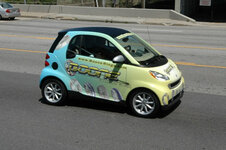
It's all about the aerodynamics. From working with bicycles and human powered vehicles, it's found that something like 98% of the drag on a bike is aerodynamic when the speeds are getting up there. My Smart Car gets about 43 MPG, but could do tons better if it were a nice aerodynamic shape. The record for a human powered vehicle (on level ground and no wind) is now 83 MPH! Those guys have aerodynamics dialed in.
 

Attachments

  • DSC_4607.jpg
    DSC_4607.jpg
    100.1 KB · Views: 99
To some degree

It's all about the aerodynamics. From working with bicycles and human powered vehicles, it's found that something like 98% of the drag on a bike is aerodynamic when the speeds are getting up there. My Smart Car gets about 43 MPG, but could do tons better if it were a nice aerodynamic shape. The record for a human powered vehicle (on level ground and no wind) is now 83 MPH! Those guys have aerodynamics dialed in.
You are right to some degree - aerodynamics does have some impact on mileage as well as top speed. But aerodynamics alone won't solve the problem. We do need to put people and things in the cars.
 
Signed-In Members Don't See This Ad
Back
Top Bottom