Blank storage

Signed-In Members Don't See This Ad

nsfr1206

Member
Joined
Jun 10, 2010
Messages
529
Location
Gainesville, Alabama
With all these blanks I've got, I've got a problem. Does anyone have a good way to store them without having to dig through a box trying to find the "right" one? You keep acrylics and wood together? What does everyone do?
 
Signed-In Members Don't See This Ad
I went to Harbor Freight and got a bunch of the small yellow storage bins. They come with brackets to hang them on the wall.They will hold several blanks and you can label the bins so you can tell what you have and how many of them
 
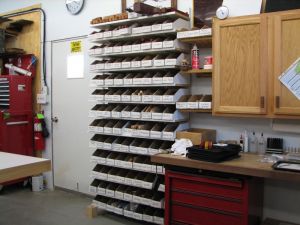
I built a wall hanging pigeon hole storage shelf. 6 x 6 inch pockets about 6 inches deep will hold quite a few blanks. Then I have wire racks for the longer sticks I've cut and cross stacked to dry. I have a wire shelf with bins I got at Sams Club I use for the kits and acrylic blanks as well as my pine cone and special wood blanks. It still gets messy.
 
I do something similar. I found at a garage sale a kids 3 level shelf unit that has red, blue and yellow bins of various sizes. From what I understand it was originally used to hold Lego pieces. I have my blanks split up by wood tones and acrylics. The wood tones are Red, Brown, Tan (White) and Black. The Acrylics in a separate bin.

Looking to do something like this but on a bigger scale.

Wes
 
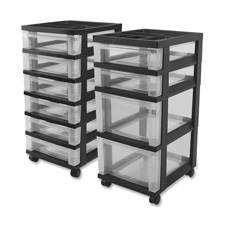
I use a five drawer plastic storage container. It's about 4 feet tall. The five drawers allow for some separation (acrylic vs wood and other special stuff). Longer sticks are on shelf brackets on pegboard. I also have several boxes of on a high shelf with some sorted wood blanks in various stages of drying and cutting. Basically I just find room and try to remember where the stuff is and put some labels with dates to remember when/where I got the wood. Organization is not my strongest suit!
 
All the suggestions so far are great, especially if you have the space to do it and label each box individually but I'm afraid I don't have that luxury. I use the medium priority mail boxes set on edge and they can hold usually over a hundred blanks. The problem you then run into is that all you have is a bunch of end grain blanks. So what I have done is, using a Sharpie, give each species it own unique number and keep track of the numbers on a piece of paper (for me it is many pieces of paper). I have collected over 900 species/variations of wood and yet this allows me to pretty easily find any species I'm looking for. I also write the species name on each blank just in case. Bob I.
 
I came across a great deal on an industrial nut/bolt storage bin and this now houses all of my blanks. The hardest part was listing all of the different types of wood so I could label the bins alphabetically. My acrylic blanks are stored separately since there is no way to identify them like wooden blanks.....besides, the bins are all now spoken for and I still have some wood types that need another bin.

Dave
 
I dont bother labeling the bins, I just write the name of the wood on the side of each blank. I know it takes longer but the blank doesn't have to be in its "right" spot to be able to identify it.
 
Still digging through "boxes" to find the right blank currently. But I like the fishing tackle boxes you pick up from sportsman type stores. Also keep my sets of pen components in each different box, someday I will label them.

The benefit to this is easy transport if you need to pack them off to a client to pick a blank. They are pretty transparent, and if you sort your blanks in any special way pretty fast to find what you want. Currently I don't have them sorted and enjoy the "hunt" because I forget about this one or that one!
 
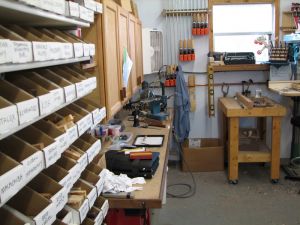
I use clear plastic bins. I mostly put one type of wood in each bin of the woods I turn the most. If I combine them, I make sure they are easy to tell apart (ebony and hackberry). I label them with masking tape so I can change them easily. When I only have a few blanks, I put them in ziplock bags and label the bags, then put the bags in boxes and put a list of the woods on the ends of the boxes with masking tape. Now that the storage wall is complete, I have two more double cabinets on the right side. They are already full.

IMG_2566%252520%25255BDesktop%252520Resolution%25255D.JPG
 
Last edited:
I use plastic bins also. They sit on shelves stacked three high on a shelf five wide on each shelf. Five shelves on the rack with the top shelf having stacks of five high. the shelves run along one wall. Each end is labeled what is in the box and boxes are grouped according to species, burl or spalted etc... Well I do have ten large Rubbermaid containers filled with other wood for the lathe that had not been cut into blanks for bowl or pens but those do not count, yet.

Now the bad part, last count my wife stopped at 300+ boxes. Figure 20 blanks in a box, closer to twice that really, and you see that the blank addiction is out of hand. I admit to 6,000 blanks but fear the number is twice that. About a third are plain blanks that I bought when I first started out. These only get used for inlay work these days. But several thousand are fancy blanks with all the figure, spalting or burl that we all like to see on a pen.

The only thing that has saved me from my wife's "doom" is that I use to sell large orders of pens and all the blanks have been paid for out of profits. No family money is tied up in these blanks. She did not even mention my eight lathes, 3 metal and five wood lathes. She must have been in a good mood that day.
 
Back
Top Bottom