

You are using an out of date browser. It may not display this or other websites correctly.
You should upgrade or use an alternative browser.
You should upgrade or use an alternative browser.
Bullet Casings
- Thread starter jimm1
- Start date
Signed-In Members Don't See This Ad
Signed-In Members Don't See This Ad

Jgrden
Member
Yikes. someone help this guy before he shoots something.

seamus7227
Member
Can anyone tell me how to get the firing pin out the the bullet casings?
Do you mean the primer? there are lots of questions first: was this a live round? Is the bullet removed? Safety, safety, safety!!!1st
MobilMan
Member
Don't even try it. Find someone that reloads ammo and they can remove it the safe way. You DO NOT have the means. You can buy them cheap enough ready for your needs without taking the chance.

Sylvanite
Member
Send me a PM and I'll help walk you through the process safely.
Regards,
Eric
Regards,
Eric
jimm1
Member
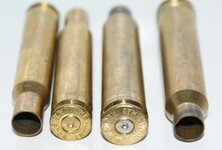
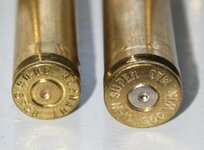
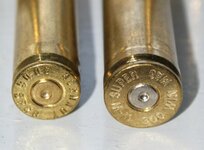
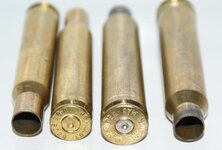
I am so not a hunter. I get these from my nephew. I need to remove that round "thing" in with the dimple in order to drill a bigger hole to put a brass tube inside, right? How do I get this out?
Stop laughing at me
Stop laughing at me
Attachments

Rick_G
Member
Ok they have been fired no problem. You need to punch it out from inside. Go to the dollar store and buy a set of real cheap jewelers screwdrivers. If you look down the inside of the brass casing you will see a little hole at the bottom. Pick the screwdriver that will fit through the hole. Set the casing on a board that has a small hole in it and then put the screwdriver through the small hole and hit it with a hammer, it will punch the spent primer out.
You can also use a small rod or anything else that will fit through the hole but I've found the cheap dollar store screwdrivers work great.
Don't do this with primers that have not been fired.
You can also use a small rod or anything else that will fit through the hole but I've found the cheap dollar store screwdrivers work great.
Don't do this with primers that have not been fired.

nava1uni
Member
I hold them gently in a vise and drill them with two drill bits. First the small one and then the larger, usually a 7mm so that the tubing fits easily. I use a piece of shrink to fit tubing over the end of the tube prior to putting it into the tube then I then solder the tubing into the body. It only requires that you hold the tube gently and that you don't hold it while soldering it.

Mark
Member
Post edited. It was not my intention to "Insult anyone's intelligence"
Good luck and I look forward to seeing your results.
Good luck and I look forward to seeing your results.
Last edited:

Dudley Young
Member
Jim: Those who think you want to punch out a live primer insult your intelligence. If you have a set of disassembly Punch's, use the smallest one and punch it out from the inside over a hole in a board. I do it all the time. I use an 8mm tube. The copper bullet pen nib looks good on it.

its_virgil
Member
I just watched an episode of "The Andy Griffith Show" (my favorite...I've seen them all no telling how many times) The freezer was broken and Aunt Bee was wanting to get it fixed but was not willing to spend the $$ and was trying to rig it so it would work. Andy keeps telling her "Aunt Bee, call the repairman...just call the man." She should have.
Eric has offered to help. He knows how to get it done safely. Jimm1, Call the man." Actually, jimm1, PM the man.
Do a good turn daily!
Don
Eric has offered to help. He knows how to get it done safely. Jimm1, Call the man." Actually, jimm1, PM the man.
Do a good turn daily!
Don
Can anyone tell me how to get the firing pin out the the bullet casings?
seamus7227
Member
Jim: Those who think you want to punch out a live primer insult your intelligence. If you have a set of disassembly Punch's, use the smallest one and punch it out from the inside over a hole in a board. I do it all the time. I use an 8mm tube. The copper bullet pen nib looks good on it.
I have to say the same, if you ever have live primers, stand the casing on the primer end, squirt about 5 drops of 3-n-1 oil into bullet end and let sit for a few days so the oil will soak in and that will defuse the primer and then use a punch or whatever you have chosen to pop it out. I have been dealing with this for over a year and only one has ever just "popped" (thats it) its not like its gonna explode and send shrapnel flying everywhere.

turnsomeantlers
Member
Absolutely, safety is first.
As long as the primer has a dimple in it, it is safe. If it does not it is more then likely live. Correctly stated, if a live primer goes off shrapnel will not fly but your ears may ring for a couple hours and your heart is gonna race for a while and your gonna need to find an outlet for the adrenaline dump you have just experienced. As a "hunter", "reloader" and "penturner" my advice would be the dollar general screwdriver mentioned earlier in the thread. If you're not sure if the primer is live, find someone who understands guns and bullets and seek their advise. Better yet find someone who reloads and have them de-prime the bullets for you. In the process tell them what you want it done for and I'm sure it will turn into a pen sale. Everytime I show mine off to a person in that crowd it ends up in a sale or 3. Kinda like Lays Potato chips, they can't eat just one.
As long as the primer has a dimple in it, it is safe. If it does not it is more then likely live. Correctly stated, if a live primer goes off shrapnel will not fly but your ears may ring for a couple hours and your heart is gonna race for a while and your gonna need to find an outlet for the adrenaline dump you have just experienced. As a "hunter", "reloader" and "penturner" my advice would be the dollar general screwdriver mentioned earlier in the thread. If you're not sure if the primer is live, find someone who understands guns and bullets and seek their advise. Better yet find someone who reloads and have them de-prime the bullets for you. In the process tell them what you want it done for and I'm sure it will turn into a pen sale. Everytime I show mine off to a person in that crowd it ends up in a sale or 3. Kinda like Lays Potato chips, they can't eat just one.

jskeen
Member
Actually, there is no real need to punch out the primer at all (as long as you make sure it's been fired). Just put a layer or two of masking tape around the casing, put it in your scroll chuck or collet chuck BACKWARDS, and drill it out along with the pocket it sits in. The inside of the casing slopes to the center, and will guide the drill bit to the exact center. If you are using a 30 caliber casing, a 7mm drill will fit through the case neck, and it's one step to finished hole.
Sylvanite
Member
... stand the casing on the primer end, squirt about 5 drops of 3-n-1 oil into bullet end and let sit for a few days so the oil will soak in and that will defuse the primer and then use a punch or whatever you have chosen to pop it out.
[size=+2]Don't Do This! It is unsafe![/size]
I've been reloading for many years and the myth that oil will deactivate primers just won't die. Nevertheless, it is a myth. Oil contamination may have damaged them in the 50's, but modern primers are remarkably resilient. Even if it worked, oil would still not be a [size=+1]reliable[/size] method of rendering primers inert.
There are many reloaders out there with holes in their ceilings from removing live primers. We all know that you're not supposed to press out unfired primers, but we all do it anyway. Sometimes, one goes off - and the force can be sufficient to blow the decapping pin out of the die. You don't want that to happen while you're pounding on a punch with a hammer.
If you understand the mechanics of metallic cartridge reloading, and appreciate the energies involved, then you can devise appropriate safety precautions to deal with live components. If not, don't mess with them.
Sincerely,
Eric
Sylvanite
Member
Usually, but not always. It is possible for a primer to not fire when initially struck but still ignite later. A fired case is just a hunk of inert metal, but if you aren't sure that it has been fired, treat it like it's live.As long as the primer has a dimple in it, it is safe.
That is good advice.Better yet find someone who reloads and have them de-prime the bullets for you.
If this is a one-time need, you can send me the shellcases. I'll deprime and resize them for you. If you expect to make more rifle cartridge pens, I can point you to the right tools for the job. It doesn't cost that much - you can get started for around $50.00.
Regards,
Eric
Sylvanite
Member
This is a good example of solving a problem by approaching it from a different direction. Drilling from the inside of the case generally works, with a couple of caveats:Actually, there is no real need to punch out the primer at all (as long as you make sure it's been fired). ... put it in your scroll chuck or collet chuck BACKWARDS, and drill it out along with the pocket it sits in.
- The case needs to be boxer primed (see below).
- Sometimes the primer anvil gets stuck on (and spins with) the drill bit. When this happens, the bit stops cutting. You need to withdraw the bit and remove the anvil before drilling through.
Be aware, though, that the flash hole is typically punched. It may not be perfectly centered and often has burrs on the inside. For the best concentricity, you may still wish to drill from the outside, and start the hole with a center bit.
Regards,
Eric
Jgrden
Member
Whew, they look "spent".I am so not a hunter. I get these from my nephew. I need to remove that round "thing" in with the dimple in order to drill a bigger hole to put a brass tube inside, right? How do I get this out?
Stop laughing at me

johncrane
Member
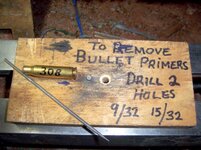
I use a piece of scrap wood drill 2 holes, one two hold the case in place, and the second hole to allow the primer too pass through
you can use a small punch or any think that will go through the small hole on the inside of the case this photo might help
you can use a small punch or any think that will go through the small hole on the inside of the case this photo might help
Attachments
jskeen
Member
Be aware, though, that the flash hole is typically punched. It may not be perfectly centered and often has burrs on the inside. For the best concentricity, you may still wish to drill from the outside, and start the hole with a center bit.
Regards,
Eric
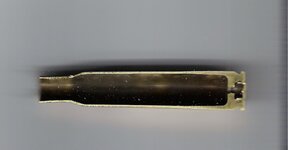
I was under the impression for some odd reason that the web of the average rifle casing was much more conical than flat, and that tended to guide the bit to the center. In the spirit of "a gram of finding out is worth a stone of talking about" I took a unfired USGI 30 cal shell, pulled the bullet, poured the powder down the sink and followed it with a dose of water, wrapped the casing in a paper towel, clamped in a vice with the open end pointing away from anything (including me) put a round tip punch on the primer and tapped it. Moderately loud bang ensued, but as the gas had plenty of room to expand and nothing to push, no other results were observed (or anticipated). I then took said casing over to Mr. Disk sander and removed half of it lengthwise.
A quick scan proved that Eric has a better recall of casing construction than I do. I have however to date not had any holes drilled from the inside of the casing that were unsatisfactory to me in their concentricity. This may however simply be due to lower standards on my part.
Just in case anybody is still reading this, a few facts about modern (post 1950) cartridge primers. The first non mercuric, non corrosive primers used Lead styphnate (lead 2,4,6-trinitroresorcinate, C6HN3O8Pb) as their primary explosive. This compound is a primary explosive, meaning that the chemical reaction is propagated by the shock wave traveling through the compound at about 17,000 fps. This is opposed to the deflagration of gunpowder, where the flame front progressing along the length of the charge propagates the reaction, producing a much lower pressure gradient.
Recently, Environmental pressure and levels of lead contamination in firing areas has pushed development of other lead free compounds, but all share the same basic effectivity.
Bottom line, primers produce an very high pressure spike when initiated IF THE GAS IS CONFINED. Given an unobstructed path to expand, the relatively small volume of gas produced is relatively harmless. HOWEVER... if something (like a jewelers screwdriver or punch) is significantly restricting the egress of gas, it will be almost instantly accelerated to very high speed. At short distances, they can be quite lethal.
"insert your favorite legal disclaimer here"
Attachments
Sylvanite
Member
Next time, instead of pouring the powder down the drain, sprinkle it on some plants (or see below). Smokeless powder is composed of nitrocellulose and nitroglycerine - and serves as a fertilizer. Water doesn't harm it (in fact, powder is sometimes stored in water during manufacturing).In the spirit of "a gram of finding out is worth a stone of talking about" I took a unfired USGI 30 cal shell, pulled the bullet, poured the powder down the sink...
I'm glad you made sure nothing was downrange. You can get quite a burn from just a primer. I once fired some primed cases (the safest way to deprime) from a revolver at dusk - and I could see flames coming out of the muzzle. The purpose of the primer is to produce a rapid, hot, and consistent flame (in order to ignite the powder), and that's exactly what it does.... and followed it with a dose of water, wrapped the casing in a paper towel, clamped in a vice with the open end pointing away from anything (including me) put a round tip punch on the primer and tapped it. Moderately loud bang ensued, but as the gas had plenty of room to expand and nothing to push, no other results were observed (or anticipated).
Or good drilling technique.I have however to date not had any holes drilled from the inside of the casing that were unsatisfactory to me in their concentricity. This may however simply be due to lower standards on my part.
Lead-free priming compounds are effective, but different than lead styphnate. When Winchester switched primers, they also enlarged the flash holes in their shellcases for better ignition.Just in case anybody is still reading this, a few facts about modern (post 1950) cartridge primers...
Yes and no. Primers burn at a fast rate (explosively) whether or not their gas is contained. That is evidenced by the bang (sonic boom) you heard when it ignited. Smokeless powder (not to be confused with black powder) burns rapidly (but not explosively) under pressure - and slowly when uncontained. That brings us to the other safe way to dispose of smokeless powder. You can pour it out in small piles (under 1 pound) and light it. The powder will burn, but not uncontrollably.Bottom line, primers produce an very high pressure spike when initiated IF THE GAS IS CONFINED. Given an unobstructed path to expand, the relatively small volume of gas produced is relatively harmless. HOWEVER... if something (like a jewelers screwdriver or punch) is significantly restricting the egress of gas, it will be almost instantly accelerated to very high speed. At short distances, they can be quite lethal.
But, the safety message is the same. If something is obstructing the flash hole when the primer ignites, it may become a projectile. Until you've had enough experience with safe unloading, it's best to avoid the hazardous parts.
Regards,
Eric
Mark
Member
But, the safety message is the same. If something is obstructing the flash hole when the primer ignites, it may become a projectile. Until you've had enough experience with safe unloading, it's best to avoid the hazardous parts.
That's all I was trying to say, back on page one of this thread. I didn't intend to insult anyone's intelligence. Safety first in my book. Nuff said.

Rfturner
Member
When it comes to fire arms and ammunition never take theing for granted. Always assume a gun is loaded and a primer is unfired.
I made a casing pen about a year ago, I bought 30 06 and some 308 rounds at a gun show, I ASSUMED that they were fired rounds that was my first mistake. I began to drill out the casing and very quickly realized it was a live primer. There was a very loud ear ringing noise that ensued. I have been around Fire arms most of my life and I knew better than to take it for granted. That is the first and last time I take it for granted. Safety is always the first step. I have plenty of friends that reload and I should have consulted them first.
I made a casing pen about a year ago, I bought 30 06 and some 308 rounds at a gun show, I ASSUMED that they were fired rounds that was my first mistake. I began to drill out the casing and very quickly realized it was a live primer. There was a very loud ear ringing noise that ensued. I have been around Fire arms most of my life and I knew better than to take it for granted. That is the first and last time I take it for granted. Safety is always the first step. I have plenty of friends that reload and I should have consulted them first.