Veneer question

Signed-In Members Don't See This Ad

Haynie

Member
Joined
May 20, 2011
Messages
3,515
Location
Page Arizona
These are some questions I have thought about for a while now and figure I will ask since, well, you guys know everything :biggrin:

Do you need expensive fancy special tools to veneer or can you get away with clamps, rollers, and glue?

Now for the more volatile question
Does veneer over plywood or MDF imply inferiority when compared to solid wood construction in the final product?

That second question comes from our furniture shopping a couple months ago. I thought a couple end tables were really cool looking, construction seemed really solid but the sales man steered me away saying it was "just veneer and the boss had ordered it by mistake.
 
Signed-In Members Don't See This Ad
These are some questions I have thought about for a while now and figure I will ask since, well, you guys know everything :biggrin:

Do you need expensive fancy special tools to veneer or can you get away with clamps, rollers, and glue?

Now for the more volatile question
Does veneer over plywood or MDF imply inferiority when compared to solid wood construction in the final product?

That second question comes from our furniture shopping a couple months ago. I thought a couple end tables were really cool looking, construction seemed really solid but the sales man steered me away saying it was "just veneer and the boss had ordered it by mistake.

I've veneered small stuff with heavy weights that fully covers the veneer. I've even edge banded home made veneer with just glue and a roller. For a large piece I would only use vacuum bagging. I tried to veneer a 4 x 8 sheet of plywood once just using clamps and weights. Trying to remove poorly applied veneer from a 4 x 8 sheet of plywood is no fun.

I can't imagine anyone saying that veneer is superior in any way to solid wood (of the same quality as the veneer). But a piece with really nice veneer work can be superior to a solid wood piece made with cheap wood.

Solid wood furniture can be refinished and can last for generations. Veneer not so much.

Ed
 
For larger veneer projects, you can make cauls that are slightly bowed in the middle. When you clamp on the outer edges, the cauls will distribute the pressure from the middle outward and give you a good bond. Just plan your clamping strategy ahead of time and prepare accordingly and you'll be fine.

Depending on the veneer, yellow glue is sometimes a better option than a contact cement.
 
It all depends upon the piece. Veneer can be superior to solid wood construction or it can be a cheap coverup.

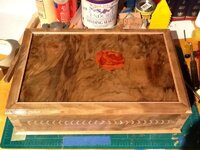
Here's a cribbage board that would be a cast iron b*tch to do with solid wood:

LouiCriSmb.jpg


I do mainly game boards and I just use an X-acto knife and a straight edge. For glue ups, I use TiteBond cold press glue and a vacuum bag made for skateboard glue ups. Roarockit Skateboard Company - Vacuum Press - Fine Woodworking Tool Review (for some reason, the company's website isn't working).

As for furniture, both solid wood and veneer have their places. You can veneer tops to get effects that would be impossible with solid wood and/or prohibitively expensive. You can veneer curved drawer fronts made from solid poplar much cheaper than making the same thing out of solid bees wing Sapele. You can make Stickley legs out of 4 pieces of quarter sawn oak with mitered lock joints or use 1 piece and veneer 2 sides to get rays on all 4 sides. If I were making a mahogany highboy, I'd use solid mahogany where needed and any veneering I'd do would be over solid mahogany as well just so I'd be sure that any movement would be consistent.

For gaming boards, I just use baltic birch plywood. Don't like or trust MDF for anything other than shop jigs. For a big beefy tabletop, a torsion box of plywood and veneer would beat a solid piece hands down unless you want to be able to flip it over and use it for cover.

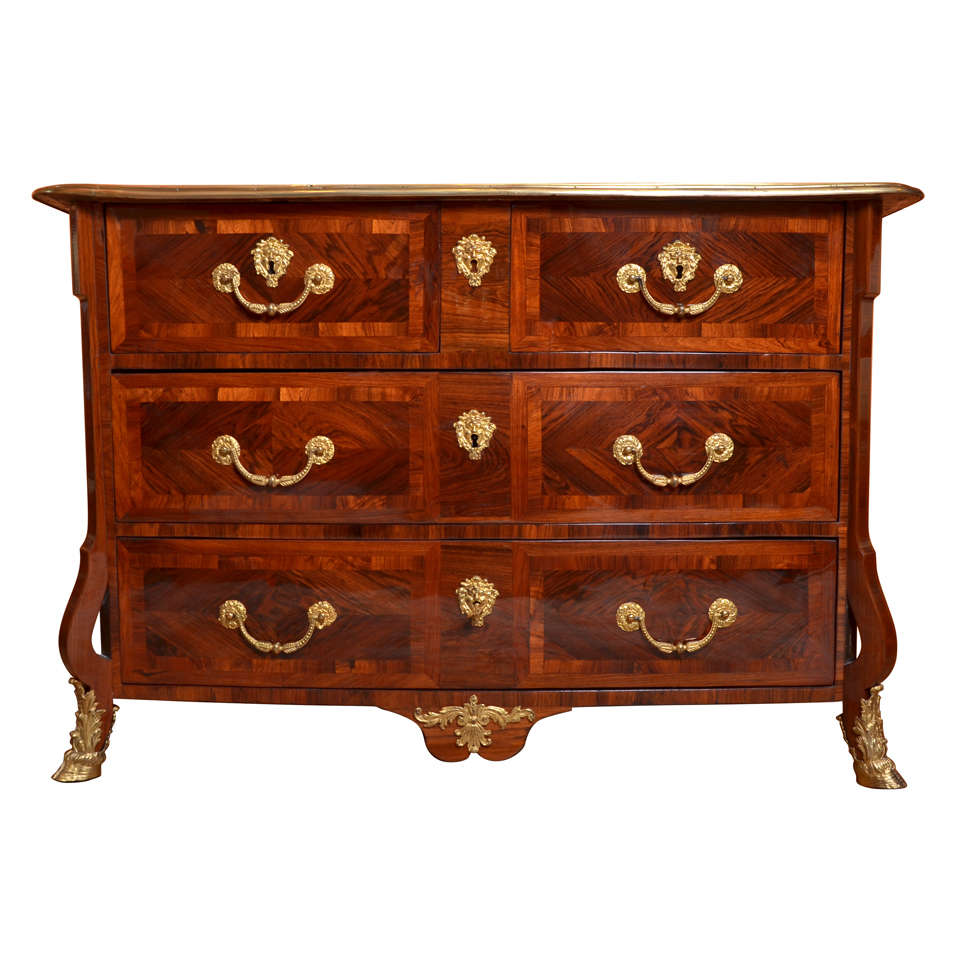
As far as "it's just veneer", it depends on how it was carried out. After all, it was good enough for European Royalty...
 
Last edited:
Hayine; You can even get by without the clamps. I have done many restoration projects, as well as using veneers for my own works, marquetry, and inlays. I will usualy use contact cement to cover larger pieces. All you need is a brush to put it on both surfaces, and a brayer or roller to remove air bubbles and smooth it down. After both surfaces have become non tacky, place dowels or stickers on one surfaceand place the veneer on top of the dowels. Align your corners, or allow for overhang, than slowly roll the dowels out of the way as you make contact with bouth surfaces. Work from one end to the other using your roller to push out any air as you go. Bad thing about this method, is you only get one chance. Once the two surfaces come in contact, you can't align them or get them apart. If you do get a air bubble someplace, take an exacto knife and make a small cut in it to let the air out, and than roll over it to flatten. The main reason I would use a plywood or HDF as a base would be to stop wood movement. As they said above, all you need is a sharp knife and a ruller for tools. Jim S
 
Last edited:
For large panels I use contact cement( 3m NF-30) and burnish the veneer to the sub-strait with a smooth hardwood block. You do not apply enough pressure with a roller. For smaller panels I apply wood glue thinly to both surfaces and leave open til tacky. I then apply the veneer and use a clothes iron on med to high heat to hot press them together. Use a cotton rag like a tee shirt between the iron and veneer.

In addition to being less expensive, mdf and plywood panels do not expand and contract as much as most solid woods. In better made furniture you will have a plywood or veneered mdf panel with solid stock edge banding, stiles, rails , frames and posts. Solid stock will be hardwood not stained poplar.

Even heirloom quality furniture uses veneers to achieve effects that are not possible or practical to do out of solid stock.

I call particle board with wood veneer faux-oak(foak) and particle board with paper or vinyl veneer joak.
 
I guess you are talking about making furniture? Or veneer for pens? For furniture, I would not use contact cement. I build furniture so it last for generations. If you want something for 10-20 years, maybe you would choose contact cement, or shop at IKEA. Contact cement will soften with just the heat of the sun in a south facing window. It can have trouble with early heavy coats of lacquer as that wicks through the veneer and softens the contact cement. I was taught to use adhesive that cures to a hard material like Unibond 800. That does not include Titebond. My instructor put some dried Titebond under a heating pad. Waited a couple minutes and it was as limp as a noodle. The veneeer, especially burl veneer, glued down with that will also creep under direct sunlight. Weights would be considered the bare minimum if the veneer is dead flat to start with. Really, cauls or a vacuum bag should be considered a necessity. Go to Joewoodworkers site for cheap help.
 
I am employed at a high end office furniture manufacturer and we use veneer exclusively. Not so much to save on costs but rather to achieve a distinct look and consistency that 'solid' panels can not provide. The equipment and finishing lines are million dollar machines so the final product is distinct and the finish unmatched. Veneer works best in this type of business.

On a personal scale and work from my small personal workshop, I use solid wood panels exclusively. So what I am trying to say that there is room for both styles depending on preference. There is inference that veneered pieces are necessarily cheaper than poorly made solid works but this may not be the case.
 
Last edited:
Veneer is used on very high end furniture and it is not a sign of low quality. Many woods are getting rare and figured woods are hard to aquire, or afford, in quantities to make a large piece of furniture. By using a plywood or mdf substrate and figured or rare woods cut into veneer for the face, back and edges the piece can be made at a price that many can afford and it saves valuable resources that can be used for other items. Veneers can be purchased, but nowdays commercial veneer is very thin, 1/40" or less, and still expensive per square foot. If you have a piece of figured lumber that you want to use it can be sawn into thicker veneer, say 1/8" on a band saw and flattened on a drum sander. David Marks on his old TV show Woodworks demonstrated many times how to turn a small board into enough veneer to cover a good sized project. David's finished pieces sell for very high prices and the quality is superb. I have taken a veneer class with David at my local Woodcraft store and he is a excellent woodworker and teacher. The process of veneering a plywood substrate also has the advantage of making a finished panel that does not change size or warp with changes in humidity as a solid wood panel will.
 
Everybody has a different method and glue they favor for certain applications. If we want to go back in history, even as far back as the Egyptians, animal, or hide glue was the glue of choise. Mater of fact, it was the only choise. Things clued with this method have lasted thousands of years. Hide glue can still be boughten today, and a lot of purest furniture makers will use only hide glue. One of the qualitys of hide glue, contact glue, or any other glue that will soften with heat or hot water, is the fact that it can be reversed in order to repair something that has been damaged. These glues can also take vibration and wood movement, such is found in musical instruments. A lot of todays glues, because of the need for speed, are cured with ulta-voilet lite, sonic waves, heat, or a chemical two part system. Some can be reversed, some can't. Even super glue can be reversed. I know, I've done it on my fingers many times. Jim S
 
Veneering

Your question is a good one yet there is no correct answer without further qualification of what you are trying to achieve. What you are basicly looking at is the arts of marquetry and parquetry. The attached picture is a marquetry project measuring 15" x 24". Utilizing the double bevel technique it was adhered to a piece of 1/2" Russian Birch plywood, using Unibond 800 adhesive and a vacuum press. The piece from the link below was featured on the cover of "The American Marquetarian" summer 2010

Having made numerous veneered pieces over the years with various adhesives, substrates, techniques i'd be happy to try and answer any specific questions you may have.


IAP Home - Photos - USMC Marquetry
 

Attachments

  • image.jpg
    image.jpg
    47.3 KB · Views: 137
Ok, Specific questions

I want to make something like these but with my own design.

It will contain between 8 and 12 black light bulbs with fans of course but the box will get pretty warm on the inside. The boxes will most likely live in a room that will either be very humid or very dry depending on what I am doing at the time. Just because of what the box will be subjected to I think plywood will provide the best material for the box but I think plywood is ugly. The inside of the box will be painted white but I want the outside to look as good as possible and that is where the veneer will come in.

If it works out I might be able to scare up a few customers to build them for.

I have also seen some really cool tables on the net that used veneer. I also like the fancy woods but there is no way I could afford to build out of solid wood. Some day Marquetry or inlay. Who knows. Basically it looks like a good way to do some cool stuff. That salesman's words "it is just veneer" keeps running through my head. I guess I have to get over that.
 
Last edited:
You know you can get quartersawn oak, cherry, or walnut plywood right? Nothing ugly about those. My local Menards is advertising those plywoods now, but I would only buy USA manufactured product, from an industrial supplier if I wanted the best stock available. What you do need to consider is that the quality of all plywood has diminished over the years, and having it stay flat after cutting is becoming a major issue for cabinetmakers. Different conditions on the inside versus outside of the box isn't going to help with the flatness.
 
You don't live where I do. We have make-a-wall plywood, and some birch plywood. Granted it has been a few years since I had to get some plywood but there was no issue with flatness in the 1/2 inch and up I plan to use.
 
Last edited:
For your proposed project I agree with Low48, veneered plywood is an excellent choice. The material is less expensive than veneering it yourself, very stable, and easy to work. Should you desire to make a custom box with material not commercially available I would seek out paper-backed veneer sheets. These are available up to 4'x8' sheets, price varies with species selected. If you go this way contact me and will be happy to guide you. ButchF18A@aol.com
 

Attachments

  • image.jpg
    image.jpg
    72.4 KB · Views: 121
Why paper backed veneer?

Paper backed veneer is available in a wide range of species. The advantages include the sizes available that is difficult to obtain in normal veneer, as well as it is extremely stable. Wood can be sliced much thinner, thus saving valuable resources. The paper simply reenforces the veneer layer.

I'm not sure why you would want to veneer the boxes indicated, though you surely could. As previously stated by myself and others, I would look into veneered plywood should you desire a choice of species and appearance not available with plain plywood. Including your finer birch plys.
 
Here you go. It's "just veneer":

Yes a little project that would be impossible with solid wood. Assuming you made the piece, outstanding.


No, that's a piece of Louis XIV furniture. It was meant to show what can be done with veneer as opposed to solid wood and that the term "it's just veneer" is as wrong as "that meteorite is just a rock" or my wife being let loose in the kitchen is "just a little bit dangerous".
 
Stephen. You are very correct. While I recognized the period piece, thought maybe you had completed a well executed repro. Still accurate assesment. Back in the day solid wood was prohibitively expensive in addition to the fact that such pattern work would not be feasable with solid material.
 
Back
Top Bottom