looking for a new AC/HP unit

Signed-In Members Don't See This Ad

Russianwolf

Member
Joined
Jul 13, 2007
Messages
5,690
Location
Martinsburg, WV, USA.
Looking around to see what I should do.

We currently have baseboard heat and a attic installed AC unit that's 20 years old and needs a new blower motor (assuming the guys can find it I may have it rewound for this summer).

I figure its time for a new system and thought a HP unit would be most cost effective. The house is 2000 square foot finished and my shop is 900 square foot in the basement. The one issue is the space that has the Kitchen,Living room, dining room and loft are all connected one large space with only the three bedrooms separate.

Right now, we are running window units in the master, one of the lower bedrooms and the livingroom, but 36k btu won't keep it cool in the heat of the summer so now is the time look at a change.

So what should I do? I don't like having the unit in the attic as its a pain to get to to service and if the condensate drain clogs the leak damages the ceiling. The ducting is the worst possible (flex tubing) and at least one of the guys said he thinks there is some mold in it.

I've been looking at either getting a new traditional system installed in the basement with some new ducting, but how to get it to the upstairs poses a problem. The other idea is the mini split systems that use no ducting. I may even be able to do most of the install myself and just have them come out and do the final hookups.

What do you guys think?
 
Signed-In Members Don't See This Ad
My understanding is that you don't have ductwork (or space for ductwork) for central A/C?

A heat pump and a conventional central A/C are essentially the same, except the heat pump also works in reverse, and air conditions the outdoors and heats the indoors in the winter.

If you don't have the ductwork--have you considered mini-ducts? Uses 2-inch circular ducts, and can supposedly be inserted in joists, walls, etc. without major structural alterations to the house.

Think of it as a 2" reverse dust-collector :biggrin:
 
Mike, first in your area, I would be cautious of a heat pump. They loose efficiency as the outside temp drops. somewhere in the area of 32 degrees F the efficiency of heat transfer drops to that of just the electric furnace. I would check out the availability of natural gas and the price of that compared to propane or electric to run the heat cycle of your system in the winter. The summer cost should be the same for A/C or H/P unit. I would absolutely go with the split system using an A/C unit outside with a furnace inside.

You are correct in getting the unit out of the attic. If at all possible, place the unit where it will be in the shade as much as possible with very good circulation of outside air to get the heat away from the unit in the summer.

This opinion is worth exactly what it cost you, nothing.
Charles
 
My understanding is that you don't have ductwork (or space for ductwork) for central A/C?
ummm. no. We have a 20 year old central AC in the attic with flex tubing ductwork that may be contaminated with mold. I'd prefer to move the unit to the basement to prevent leak damage from the condensation drain (already happened and I have to fix the bedroom ceiling due to it). There is no ductwork going from the basement up, so I don't know how easy it will be to get the upstairs ducted from there.

A heat pump and a conventional central A/C are essentially the same, except the heat pump also works in reverse, and air conditions the outdoors and heats the indoors in the winter.

If you don't have the ductwork--have you considered mini-ducts? Uses 2-inch circular ducts, and can supposedly be inserted in joists, walls, etc. without major structural alterations to the house.

Think of it as a 2" reverse dust-collector :biggrin:
okay, I'll keep the mini-duct in mind.
 
Mike, first in your area, I would be cautious of a heat pump. They loose efficiency as the outside temp drops. can't be less efficient than 20 year old baseboard heaters. somewhere in the area of 32 degrees F the efficiency of heat transfer drops to that of just the electric furnace. I would check out the availability of natural gas Not available in our area, wish it was.and the price of that compared to propane propane isn't an option, too expensive and no place to put a larger tank.or electric to run the heat cycle of your system in the winter. The summer cost should be the same for A/C or H/P unit. I would absolutely go with the split system using an A/C unit outside with a furnace inside. Not the kind of split I was talking about, here is a link to the mini-split systems I'm thinking of. http://www.fujitsugeneral.com/wallmounted.htm

You are correct in getting the unit out of the attic. Only the air exchange unit is in the attic, the condenser is outside. But the exchange unit is what has already caused damage by the condensate drain plugging. If at all possible, place the unit where it will be in the shade as much as possible with very good circulation of outside air to get the heat away from the unit in the summer.

This opinion is worth exactly what it cost you, nothing.
Charles
understood, I get what I pay for. :tongue:
 
We have a mini split unit in our room above the garage, it is a room that is 15X36 open space. It heats and cools it without any problems at all. THey make a unit that splits off for separate rooms and also some that mount in the ceiling. I have the Sanyo as it has the best warranty, and reputation. The LG is also a good unit. My brother who installs heat and air siad if you get one be careful ordering online and it shipping from Florida as most of those were in the last hurricane and have damage and do not last.

Hope that helps

Phil
 
Hey Mike,

As you know, I am a custom home builder. I specialize in super high quality, super energy efficient, cutting edge homes. I know homes as a system better than most.

A heat pump is most likely not the best option in your climate since they are not effective below 32° F. Below that temp, the axillary electric heat strips kick in and you loose any benefit of the heat pump. A heat pump is only beneficial on the heating side of things. They are the same on the cooling side as any other AC system. Here in Texas, where we don't get below 32°F for any extended period of time, a heat pump is the best way to go with a traditional type of system.

That said, I would HIGHLY consider the mini-split system. I have used them on the last 2 houses that I have built for the complete house system. I use Daikin VRV systems. Daikin is the Cadillac of mini-splits and carry a similar price tag so you may want to consider LG or Mitsubishi.

The benefit, especially for your situation, is that you do not need any duct work. The other HUGE benefit is that you can control the temp in each room individually. If you want one room cooler or warmer than another, it is very easy to do so. The Daikin system, at least, also has sensor in it that detects motion and IR. If you have it set to use this feature, when it senses that no one in is in the room, it automatically changes the set point 3 degrees higher or lower (depending on heating or cooling) so that you are not wasting energy when no one is in the room. As soon as someone walks back in the room, it changes it back. Another feature is the ability to aim the air to where you want it or to have the blower oscillate back and forth.

From the energy stand point, they are the most efficient systems out there. the really nice thing is that if your home needs 3 tons of AC capacity by calculation, for example, with a traditional system, you must install a 3 ton unit and it will be running at 3 ton capacity even when you don't need it. With the Daikin system (or any mini-split) the outdoor unit only runs at the tonnage that is actually being called for by the indoor units. In other words, if they system only needs 2 tons of capacity, then the outdoor unit will run as 2 tons. The benefit here is that if you want to leave a couple of rooms with the unit set at 83 in the summer (never leave any room un-conditioned) then the system will balance itself and run at a lower capacity. With a regular system, your only option is to close a vent which messes up the balance of the system and is not a good ideas.

The Daikin, at least, also has a dehumidify only mode. If you have it set, it will run the AC just long enough to remove humidity. Lower humidity results in cooler feeling air.

In my professional opinion, a mini-split system is ABSOLUTELY the way to go!
 
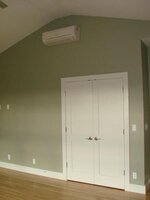
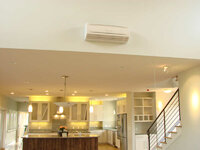
Oh yeah, the downside is that you have the air units on the wall in each room. Some folks don't like that look but to me it is worth it for the benefits. They are SUPER quiet too. Here is a pic from the last house I finished with the Daikin system. Oh yeah, my clients LOVE the system. This is installed in a $750,000 home.

attachment.php


attachment.php
 

Attachments

  • DSC09825.jpg
    DSC09825.jpg
    15.5 KB · Views: 456
  • DSC09824.jpg
    DSC09824.jpg
    37.7 KB · Views: 446
Thanks Curtis,
Two quick follow up Q's

1) would you recommend that I purchase the unit myself then pay someone to install separately or have them bring the unit with them.

2) speaking of the efficiency of the heat side of the HP units. Are they better than the standard baseboard heat that I currently have? They are at least actively moving the air while the baseboard depend on the air moving itself.

Don't get me wrong, I'd love to have a NG furnace and separate AC, but I don't have that option. So which electric heat is better? (I may eventually convince the wife to get a wood burning stove, but that's another battle.

Also we keep our home cooler than most. During the summer we target 68 and in winter 64. We don't like heat, and neither do the huskies.
 
Don't envy you

It looks like you got some pretty good advice, so I'll not say much other than to advise you to pay attention to those who said stay away from heat pumps. You have 5 months a year where the average outdoor temperature is too low for them and 2 more months where it is marginal.
 
See my replies in red.

Thanks Curtis,
Two quick follow up Q's

1) would you recommend that I purchase the unit myself then pay someone to install separately or have them bring the unit with them.
The problem with purchasing it yourself and then having someone install it is that you are then completely responsible for the warranty on the equipment yourself. In my experience, this never works well. The installer will blame the equipment and the equipment manufacturer will blame the installer. It is much better, to me, to have one person responsible. Then if you have a problem, you simply call them up and say fix it and fix it now!

2) speaking of the efficiency of the heat side of the HP units. Are they better than the standard baseboard heat that I currently have? They are at least actively moving the air while the baseboard depend on the air moving itself.
That is impossibly to quantify but I would guess it would be more efficient. However, you are going to pay more for a heat pump and you will most likely never get any benefit from it. In very basic terms, a HP is an air conditioner run backwards. When the air conditioner is on, it is removing heat from the inside air of the house and moving it to the outside, thus cooling the air. With a heat pump, you are removing heat from the outside air (basically air conditioning the outside in simplistic terms) and moving that heat inside. When the outside temps are low, there is not enough heat to remove and therefore, the electric heat strips have to kick in. If you spend the money and get a HP with super efficient back-up heat, then you would be golden but in that scenario, you may as well forget the heat pump and just go with standard high efficiency electric heat. You will pay more for the heat pump and will mostly likely never see a return on your investment.

I think what you may not be realizing is that you do not have to have a heat pump to have electric heat.


Don't get me wrong, I'd love to have a NG furnace and separate AC, but I don't have that option. So which electric heat is better? (I may eventually convince the wife to get a wood burning stove, but that's another battle.

Also we keep our home cooler than most. During the summer we target 68 and in winter 64. We don't like heat, and neither do the huskies.
 
See my replies in red.

Thanks Curtis,
Two quick follow up Q's

1) would you recommend that I purchase the unit myself then pay someone to install separately or have them bring the unit with them.
The problem with purchasing it yourself and then having someone install it is that you are then completely responsible for the warranty on the equipment yourself. In my experience, this never works well. The installer will blame the equipment and the equipment manufacturer will blame the installer. It is much better, to me, to have one person responsible. Then if you have a problem, you simply call them up and say fix it and fix it now!

2) speaking of the efficiency of the heat side of the HP units. Are they better than the standard baseboard heat that I currently have? They are at least actively moving the air while the baseboard depend on the air moving itself.
That is impossibly to quantify but I would guess it would be more efficient. However, you are going to pay more for a heat pump and you will most likely never get any benefit from it. In very basic terms, a HP is an air conditioner run backwards. When the air conditioner is on, it is removing heat from the inside air of the house and moving it to the outside, thus cooling the air. With a heat pump, you are removing heat from the outside air (basically air conditioning the outside in simplistic terms) and moving that heat inside. When the outside temps are low, there is not enough heat to remove and therefore, the electric heat strips have to kick in. If you spend the money and get a HP with super efficient back-up heat, then you would be golden but in that scenario, you may as well forget the heat pump and just go with standard high efficiency electric heat. You will pay more for the heat pump and will mostly likely never see a return on your investment.

I think what you may not be realizing is that you do not have to have a heat pump to have electric heat.


Don't get me wrong, I'd love to have a NG furnace and separate AC, but I don't have that option. So which electric heat is better? (I may eventually convince the wife to get a wood burning stove, but that's another battle.

Also we keep our home cooler than most. During the summer we target 68 and in winter 64. We don't like heat, and neither do the huskies.

So point me in a direction. I'm open to it just don't know what to look for on that side.
 
Update

Well, after calling a couple guys and having them over to check out what we have and do the measuring they needed I have the following.....

2 quotes for 3 ton 14-16 SEER traditional AC units that I got when the system died last year.

Sears made an appointment to come by but canceled and I wouldn't let them reschedule on my time. I took a day off and they canceled less than 24 hours before.

I had a guy come out specifically to talk about the Mini-splits and he promised quotes on both the mini-split and traditional. I've called numerous times and haven't heard a word back.

Lillian got the guys from Costco to come out. They gave me quotes on a mini-split and traditional. Their prices were double that of any other quote.

Got a local recommendation, he gave me a quote for a traditional unit on the spot, but hasn't been able to get info on the mini-splits.

So, we called the 2 guys from last year to see if they would honor the old prices or if they needed to make any adjustments to keep them in the mix.

Now I have scheduled one of the ones from last year to come out next Friday and install a 16 SEER American Standard traditional AC for the same price he quoted me last year. $5400. Not the cheapest, but far from the most expensive we had.

I'm disappointed that I couldn't get any real quotes on the Mini-splits. But I have to get this done. The one guy that did quote (from Costco) was $11k for a traditional 14 SEER and $12k for a mini-split 19 SEER.
 
Thanks for the thread. There is a lot of education in there. I sure hope they get you set up soon with all this heat we have been having.
 
Hey Curtis--
I know nothing about these "new" (to me) systems. Is there a "box" in every room? If you have standard height ceilings, they look like they are a couple feet across and at least a foot down from the ceiling--in a 10 by 10 bedroom, where do you put it? Could it mount in a closet and have just a vent in the room?

If you can point me to a website that will explain all this, that's fine---just want to learn---not make YOU write a book!!

Thanks!!
 
Hey Curtis--
I know nothing about these "new" (to me) systems. Is there a "box" in every room? If you have standard height ceilings, they look like they are a couple feet across and at least a foot down from the ceiling--in a 10 by 10 bedroom, where do you put it? Could it mount in a closet and have just a vent in the room?

If you can point me to a website that will explain all this, that's fine---just want to learn---not make YOU write a book!!

Thanks!!

Here are the basics Ed.

If you go down the page a bit there is a section on the different types of indoor units.

http://www.acdirect.com/ductless_cooling_heating_.php
 
Cool thread. We were about to dive into a HP. Not sure it would be beneficial though. We got some serious extremes here. AZ is not always sunny, nor is it always warm.
 
Oh yeah, the downside is that you have the air units on the wall in each room. Some folks don't like that look but to me it is worth it for the benefits. They are SUPER quiet too. Here is a pic from the last house I finished with the Daikin system. Oh yeah, my clients LOVE the system. This is installed in a $750,000 home.

attachment.php


attachment.php

Curtis the way I understand this is that the main unit is outdoors and refridgerant lines run to each unit? Is this correct? I'm assuming that each room unit would also need electric? The louvered style that fits in the ceiling is looking very attractive!
 
mick, yes the indoor unit needs power as they have the circulating fans in them. But I think the power is fed to them from the compressor unit outside along with the coolant lines.


The basics are the same a traditional systems, just no ducts. The compressor is outside, the air exchanger and fan are inside. no ducts means no loss of efficiency between the air exchanger and the room.


Another way to think of it is to take a window unit and cut it in half. The portion that's hanging outside the window is the compressor section and the part that's hanging inside is the air exchange section. In a window unit they are just combined in a single box whereas these units have the two units separated by the coolant lines. So the compressor noise stays outside.

I really wish I could have gotten competitive quotes on them, but seems like few want to talk about them.
 
Mike :
Have you considered a dual fuel system? They are super popular here because of the efficiency.

The 14 seer HP works until the temp drops below 40 degrees. Then a 90 percent efficient gas furnace kicks it. Gas heat really is much warmer that most other heat sources. Additionally the Thermostats for dual fuel systems dovetail very nicely with all home automation systems, making it easy to adjust environment conditions from anywhere in the world with an Internet or smart phone connection.

The power company here offers substantial rebates to customers that up grade to the efficient systems. They also qualify for a tax credit.
 
Hey Curtis--
I know nothing about these "new" (to me) systems. Is there a "box" in every room? If you have standard height ceilings, they look like they are a couple feet across and at least a foot down from the ceiling--in a 10 by 10 bedroom, where do you put it? Could it mount in a closet and have just a vent in the room?

If you can point me to a website that will explain all this, that's fine---just want to learn---not make YOU write a book!!

Thanks!!

As I understand it, you basically have three choices as far as 'central' AC goes.
  • A traditional unit that sits outside and is connected to your home with ductwork.
  • A split system where a condensor unit sits outside and is connected to the home via tubes. Refrigerent travels through the tubes to and from another unit that typically lives in a closet or attic space. From that unit, ducts go to the individual rooms.
  • The new mini-split units where you have the outside condensor and a small unit that mounts on the wall of the room (or rooms) to be cooled.
Our home has two levels. The main level is served by a big traditional unit while the second level uses a split system. A benefit for us in this scheme is that over the last decade or so, we've had each of these units die. That has left us without AC in half the house for as long as a week until we've had the unit replaced. While this was annoying, it wasn't a huge deal as we simply shifted operations to the cool part of the house.
 
Back
Top Bottom