Can’t get it to stop bouncing.

Signed-In Members Don't See This Ad

dozuki

Member
Joined
Mar 18, 2005
Messages
256
Location
washington, dc, USA.
I made pens before. I thought I was fairly decent at it, looks like I was wrong. I am trying to make pens after taking a long break from turning. I purchased a new lathe and no matter what I do it seems like all the blank wants to do is bounce around. I've tried new mandrel and old mandrels and I get that bounce. I think it's aligned but still that bounce. I welcome all advice
IMG_5091.jpeg
 
Signed-In Members Don't See This Ad
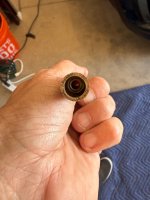
post a photo of your setup when you are ready to turn a pen, maybe we can see something then. The photo you posted looks like you're aligned.
 
I think I see the problem. You are probably using an older pen mandrel without an MT2 end. Look at the two centers above. There are two different angles used on the centers. The one on the right has a 60° center and is correct for the dimple in the end of the mandrel. The point on the left is used for WOOD, not metal pen mandrels. Metal pen mandrels REQUIRE a 60° center on both ends. Most mandrels come with a MT2 on one end and require a 60° dimple on the other. IF that is the case, you should not be using the wood point on the left side.

The point on the LEFT will roll around inside the dimple of a mandrel because it (the point) is too narrow and has space to roll around inside the dimple. You need a 60° DRIVE center to match the 60° live center of the tail stock.

What ever the problem is - there should not be the disparity of a 60° on one end and wood drive point on the other end.

 
Last edited:
We will need some more info and also a photo or two will. help. You say mandrel and we need to know which one. Also are you turning 2 blanks at the same time. ?? if so the first suggestion is to shorten the mandrel and turn only one blank at a time. The closer to the head of the lathe the more stable it is. But before all that is said do a couple things. Everyone likes to show the 2 point lining up which is good if they truely do. Do they rotate on that same axis all the way around. Sometimes the points look good from the front but from the sides they can be off. Next make sure the lathe is flat on a solid surface and not racked. Check level on the bed. Third run the lathe at different speeds With a dead center. You should be using one at times. So you should own one. The live center you have, is that a 60 degree live center or a 45 degree. If using a pen mandrel you need a 60 degree. If you are using a 45 degree you may have hallowed the dimple out and it will wander on you. These are some things to start with. The membership will get it figured out for you so be patient. That wood spur center you show on the left should not be used in pen turning at all. Could be first problem.
 
I think Hank nailed it if you are using a mandrel that rides between centers. If you use that spur drive, it will not allow the mandrel to remain stable. Consider buying either a dead 60 degree drive, a mandrel with an MT end or abandon the mandrel totally and turn between centers.

Kevin
 
I think I see the problem. You are probably using an older pen mandrel without an MT2 end. Look at the two centers above. There are two different angles used on the centers. The one on the right has a 60° center and is correct for the dimple in the end of the mandrel. The point on the left is used for WOOD, not metal pen mandrels. Metal pen mandrels REQUIRE a 60° center on both ends. Most mandrels come with a MT2 on one end and require a 60° dimple on the other. IF that is the case, you should not be using the wood point on the left side.

The point on the LEFT will roll around inside the dimple of a mandrel because it (the point) is too narrow and has space to roll around inside the dimple. You need a 60° DRIVE center to match the 60° live center of the tail stock.

What ever the problem is - there should not be the disparity of a 60° on one end and wood drive point on the other end.
Thanks for the ideas. I just used the spur drive on the left to see if the points matched correctly.
 
Tried to do a video but it's not having it. Thanks again for any ideas
I'm going to say that the light bouncing means you can see the pen blank bounce in the light and it isn't the electric fixture with the bulb in it bouncing.

Your original post says you've tried old and new mandrels. Honestly, that's my first guess is that the mandrels are bent/bowed a little. It could be that they're bowed from too much inward pressure from the tail stock.

Does anything else show the bounce when you have it on the lathe as just a regular turning like a small spindle? Maybe the headstock has some play or the lathe is vibrating whatever it's sitting on a little too much.

If no bounce with other turning types then I might just abandon mandrels in favor of turn between centers and see if that helps everything. I had a little movement in a couple of mandrels even with a mandrel saver and went to to that method (got my setup at Exotic Blanks) last year and haven't looked back.
 
Seing the light shake is probably vibration because it is attached to the lathe body. Do not use that as a reference to shaking. Do you feel vibration as you turn. Are the blanks coming out turned evenly all around the tube?
 
I am assuming you do not have a dial indicator? It would be very useful in determining the amount of runout (TIR) on your lathe and on the various centers and mandrels you are using. Without one you could maybe just install brass tubes on your mandrel and run your tool rest up very close to them Then slowly rotate your your lathe by hand and watch to see if the gap between your tool rest and the brass tubes changes. - Dave
 
Seing the light shake is probably vibration because it is attached to the lathe body. Do not use that as a reference to shaking. Do you feel vibration as you turn. Are the blanks coming out turned evenly all around the tube?
It looks like it is pretty even to me. Maybe I'm just nuts.
 

Attachments

  • IMG_5121.jpeg
    IMG_5121.jpeg
    402.7 KB · Views: 3
I am assuming you do not have a dial indicator? It would be very useful in determining the amount of runout (TIR) on your lathe and on the various centers and mandrels you are using. Without one you could maybe just install brass tubes on your mandrel and run your tool rest up very close to them Then slowly rotate your your lathe by hand and watch to see if the gap between your tool rest and the brass tubes changes. - Daveexcellent idea. I will try that this evening and maybe look at dial indicators on line
 
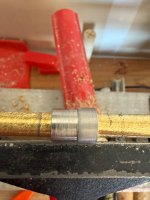
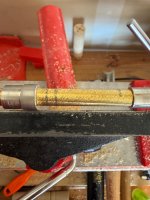
Put one of my mandrels with brass tubes on the lathe and put a pencil on the tubes in a few places and there were gaps on the tubes when I turned it by hand. So I'm thinking that mandrels is bad
 

Attachments

  • IMG_5123.jpeg
    IMG_5123.jpeg
    436.3 KB · Views: 1
  • IMG_5122.jpeg
    IMG_5122.jpeg
    488.3 KB · Views: 1
Back
Top Bottom