Air Conditioning

Signed-In Members Don't See This Ad

moke

Member
Joined
Dec 30, 2009
Messages
1,337
Location
Cedar Rapids, Iowa
I am considering buying one of those free standing air conditioning units that have a vent hose running to the window. Please forgive my lack of knowledge of ACHV type things.

I usually loose a month or two during the summer to hot days in the shop. I live in Iowa...we can wear four coats and still work, but I draw the line when sweat is dripping off of me onto my equipment causing rust spots.

Anyway, are these units worth owning? I have only two small windows in a 36x 24 with 8' celings- shop and do not wish to take any wall space up nor cut up my walls installing one. I am also not looking for it to be 68 degrees as a result of this unit, rather even mid 80's would be ok. Can anyone with any experience please give me some advice here?
 
Signed-In Members Don't See This Ad
Most of the ones I have seen are only about 12,000 btu. If you had an 8x10 room with 8 foot ceilings it would be ok, but with the size of your shop, I don't think it could keep up. Maybe if you have phenomenal insulation it might be bearable. It would take a very long time to cool down after being off for any significant time. I think you would need more than one.
 
got one it is a small one but I use it when over 100 to help the 15000 window unit. HP has heat and cool 15000 unit for about the same as the one you are talking about
 
I am considering buying one of those free standing air conditioning units that have a vent hose running to the window. Please forgive my lack of knowledge of ACHV type things.

I usually loose a month or two during the summer to hot days in the shop. I live in Iowa...we can wear four coats and still work, but I draw the line when sweat is dripping off of me onto my equipment causing rust spots.

Anyway, are these units worth owning? I have only two small windows in a 36x 24 with 8' celings- shop and do not wish to take any wall space up nor cut up my walls installing one. I am also not looking for it to be 68 degrees as a result of this unit, rather even mid 80's would be ok. Can anyone with any experience please give me some advice here?
Quick estimate based on room size Mike, you'd need about 18000 BTU....but like a car AC if you can direct the flow properly you can be comfortable even if the room isn't.
 
I use one but my shop is a lot smaller (8 x 16). If you are insulated, it may work enough to take the edge off. Definitely will reduce the humidity. A little bit of a pain to drain the water periodically so if you have a drain nearby that will help.

Agree with Smitty about directing the flow. The air blowing out of it is cool if you can keep it nearby.
 
Last edited:
one more thing to consider. They are power hogs, and you will basically lose whatever circuit it is on. Also, they make a lot of water (at least in my area), so plan for it.

I bought one as a temp fix when our house AC unit died. They work. But as mentioned they can only keep up with so much. Now the home unit is replaced and we are much happier. I'm hoping to keep it in storage.
 
I have one in the shop which is 12X24 and it cools me off just fine and I live in southeast Texas 100 or better in the summer. I also have three of them in my home. One in the med. size sun room and one in the very large living room and one in the master bedroom and the elect. bill is lower than the central air which I no longer use. It works for me.
Jallan
www,cedarcreekcustompens.com
 
Can anyone tell me the proper name of that type of unit and if there is a better brand.

My shop/garage is fairly well insulated, the doors are the typical insulated doors from a big box store though....so I am assuming that is the weak link. The rest of the walls are peg board, but have considerable insulation behind them.

So if I do this 18,000 btu or better is what I should look for? And as for the condesation, it has a floor drain, so I should be ok. I have a multitude of fans available too.

Thanks for the help!!!
 
Last edited:
Can anyone tell me the proper name of that type of unit and if there is a better brand.

My shop/garage is fairly well insulated, the doors are the typical insulated doors from a big box store though....so I am assuming that is the weak link.

So if I do this 18,000 btu or better is what I should look for? And as for the condesation, it has a floor drain, so I should be ok.

Thanks for the help!!!
portable air conditioning unit should do it.
 
use to - the portable AC unit were not much larger than 12,000 BTU - you might find it difficult to even find a 18,000 BTU (or larger) unit

doing a quick search, the largest I see is 14,000 BTU
 
Last edited:
use to - the portable AC unit were not much larger than 12,000 BTU - you might find it difficult to even find a 18,000 BTU (or larger) unit

doing a quick search, the largest I see is 14,000 BTU
10,000 plus 8000 equals 18000 and you can use two at the same time.......They do make an 18000 BTU Portable Unit if money is no object.

Actually if you aren't trying to cool from 100 degrees outside to 70 inside you might be able to make a 14K unit do the job. Especially if you have only small windows and good insulation (particularily in the roof) and the building is a bit air tight so you can recirculate inside air.
 
We got a Whynter 14,000 BTU Dual Hose Portable Air Conditioner from Amazon for about $450.00 and free shipping with Prime. My wife's quilting room is a large room over the garage that gets very warm in the summer. The Whynter AC does a good job keeping it comfortable. I do recommend that whatever one you get is a dual hose type. With a single hose exhausting the warm air it has to intake air from somewhere and that can only be from outside the room that you are trying to cool. Not very efficient. Also, this one doesn't need to be drained unless it is in a very humid atmosphere. We haven't had to drain ours yet.
 
We got a Whynter 14,000 BTU Dual Hose Portable Air Conditioner from Amazon for about $450.00 and free shipping with Prime. My wife's quilting room is a large room over the garage that gets very warm in the summer. The Whynter AC does a good job keeping it comfortable. I do recommend that whatever one you get is a dual hose type. With a single hose exhausting the warm air it has to intake air from somewhere and that can only be from outside the room that you are trying to cool. Not very efficient. Also, this one doesn't need to be drained unless it is in a very humid atmosphere. We haven't had to drain ours yet.
Sounds like good advice to me.
 
one more thing to consider. They are power hogs, and you will basically lose whatever circuit it is on. Also, they make a lot of water (at least in my area), so plan for it.

I bought one as a temp fix when our house AC unit died. They work. But as mentioned they can only keep up with so much. Now the home unit is replaced and we are much happier. I'm hoping to keep it in storage.
Right...regardless of BTU rating I expect that all manufacturers suggest nothing sharing the circuit just as they do for window units.
 
If you are getting one to use while you work primarily in one area of the shop such as - if 75% of your work will be at the lathe or within 5 or 6 feet or so either way, Use some plastic curtains or a thin floor to ceiling room divider and keep the AC there, provided you can vent it to the outside from there. Sure some cool air will leak out but it will contain most and concentrate it where you need it.

It will save a bunch. I have done that before for heating and for AC.
 
I agree with Hank. From experience I used heavy plastic curtains to cut off certain sections of the shop area I wasn't using, and as a result was able to keep the areas I was using nice and cool. Since cool air sinks, closing off the bottom was the key. Once the sun went down, it was easier to cool the whole area. I was using a window A/C unit, but the principle is the same.
 
This was very interesting conversation... I've considered some sort of AC unit for my shop, but being a little on the cheaper side, didn't want to spend the money. My shop is a stand alone metal building, not insulated, 12 x 24 with a peaked roof 7 ft at the walls to 10 ft at the peak. It sits under some trees so I do get shade for part of the day, but midday it's pretty much in direct sun light. I keep a couple of circular fans going in there during the summer and can usually stand the temps up to about 90 or so... it gets a little uncomfortable at 100, but if I direct the fans right at me, can even stand that. With either AC or heat, I have to close the door and that gets a little close for me... I like having the door open so I can see out and get better ventilation. So aside from being cheap, that is another deterrent to spending for an AC unit... My problem is more from the cold in winter than the heat of summer... I have to close up in winter to try to heat a little.
 
Last edited:
The guidance often provided for HVAC systems assumes that you are trying to maintain a certain target temperature under any external temperature.

In your case however really it boils down to what delta temperature do you require, how well insulated is the area and the exposed surface area. Add any heat sources.

Assuming that you have a normally insulated structure with four exposed walls, and want to drop the temperature by 10F, it would take about 7000 BTU. A poorly insulated structure would double that.

Now add heat sources, starting with yourself at 300 BTU
Assuming 1 HP lathe 2500 BTU
Assuming 1.5 HP dust collector 3750 BTU
Assuming 200 watts of lighting 700 BTU

You are now at a total of 14000 BTU for a normally insulated structure of your size to hold the temperature 10F below outside assuming the internal heat sources I describe, and assuming that your DC is not venting cooled air to the outside.

If the temperature drops at night to comfortable values, and you can bring in outside cool air, the thermal mass of the place can help buffer the daytime rise.

For example, in CT it may be hot during the day, but by using a fan in the evening and early morning to blow in cool outside air, I can cool my garage shop, and it will hold that temperature during the day while I am away at work fairly well. It may be 90s when I get home from work, but the garage is still holding high 70s when I get home from work. I leave the car outside to avoid the soakback heat from the car heating the garage until dark.
 
Mike:
I don't know if this would be possible in your shop, but it really is worth making the phone call to find out.

The through wall room systems (Carrier and Mitsubishi make great ones) are made to do exactly what you want them to do. They can come with 7 day programmable thermostats. They can be heat pumps , also to make your shop more comfortable in the winter.

These units start at $600 installed (here anyway) and most are 14 SEER or better. While this price is considerably more than the "portable" A/C, the portables are energy pigs. So, overall, the new efficient room air conditioners end up being much more cost efficient.

These are used in the "bonus rooms" of the new lake houses being built here and they really work well. Amana did make great a/c products very near you. You might get lucky and find an Amana employee that can get you a deal?
 
Last edited:
Will work - OK

The through the wall units will work fine and are more efficient -- they will be costlier but probably would pay for themselves overtime. I don't know how heat pumps work in IA, we have milder winters here in DE and they are quite popular.
 
One other thing to consider is that you'll have to clean/replace the filters on whatever unit you buy quite frequently. Less frequently if you have a good dust removal system. I like Hank's plastic curtain idea. I'm going to have to take a look at that.
 
Don't know much about these but I have been considering one myself. Just got an email from neweggDOTcom and they have these in all sizes. They have free shipping and today have 15% off (you might have to ask for a promo code)

Jeff in northern Wisconsin
 
The through the wall units will work fine and are more efficient -- they will be costlier but probably would pay for themselves overtime. I don't know how heat pumps work in IA, we have milder winters here in DE and they are quite popular.

The "will or will not work" question must be answered by if there is room or a way to get a refrigerant line set through a wall (in my case, the answer is no, because they'd have to drill through 6 inches of stacked stone THEN 18 inches of 5000 psi concrete with 3/4 inch rebar in it. Nobody wants to do it.

If he's just using "a fur coat" for winter shop time, the heat pump IS markedly better. Additionally, the units can be configured with "emergency electric heat strips", BUT, using these strips bring the efficiency WAY DOWN!
 
Wow!! Thanks all for the bunch of great info. I will look at the through the wall unit. Last I knew, the Amana around here, which is not in Amana any more, made only refrigerators.

I actually have a hanging plastic room with a zipper for a door that I can put up for flat work finishing, I could reconfigure it to wall off some of the room. Great idea! The whole garage has forced air heat unit taken from a two story house. My wife hates the cold, and agreed to keeping the garage no lower than 45 all the time and turn it up as needed. It is a more pwerful unit and it is "T Shirt" warm in minutes. But most Iowans are stoic when it comes to cold weather and sissy's about the hot and humid. I thought about central air, but it sounds expensive and wasteful.

Thanks again for all the ideas---I'll post what we do...
 
The through the wall units will work fine and are more efficient -- they will be costlier but probably would pay for themselves overtime. I don't know how heat pumps work in IA, we have milder winters here in DE and they are quite popular.

The "will or will not work" question must be answered by if there is room or a way to get a refrigerant line set through a wall (in my case, the answer is no, because they'd have to drill through 6 inches of stacked stone THEN 18 inches of 5000 psi concrete with 3/4 inch rebar in it. Nobody wants to do it.

If he's just using "a fur coat" for winter shop time, the heat pump IS markedly better. Additionally, the units can be configured with "emergency electric heat strips", BUT, using these strips bring the efficiency WAY DOWN!
But he already mentioned his walls ain't that:biggrin:....That sound like my old celler wall one of them was stone and 3 feet thick the others were also stone and mostly about 12 or 14 inches.
 
You are right, Smitty! I missed the 2 small windows in the original post. That means that he's not underground (like my shop) and can definitely use a through wall unit.

I was just out on eBay and noticed that they are even selling the through wall units on eBay!

Home Depot on line has then starting @ $849, with a 2+ ton unit for less $1549.00. The price on these has gone way down and at the same time the efficiency has gone way up!
 
Last edited:
You are right, Smitty! I missed the 2 small windows in the original post. That means that he's not underground (like my shop) and can definitely use a through wall unit.

I was just out on eBay and noticed that they are even selling the through wall units on eBay!

Home Depot on line has then starting @ $849, with a 2+ ton unit for less $1549.00. The price on these has gone way down and at the same time the efficiency has gone way up!

IF you can find someone to give you a quote on them.

When we were looking last year. I called several places and specifically asked for a quote on them and regular units. Ever time someone came by I'd say that I wanted a quote on both traditional and "ductless" units (what they are called). And we would even discuss how we wanted the units set up (one compressor outside running to two or three units inside).

I got back quotes from 3 places out of about 8 interviewed. only one quote contained a quote on a ductless and his was double the other two quotes for either the ductless or traditional. Wound up with a 16 SEER traditional unit since I couldn't find a reasonable quote for anything else.

They are great units. Used as the standard throughout SE Asia and Europe now. But finding someone that will install them seems to be the big problem.

When I can afford to add supplemental AC to the house (couple parts get warmer than I'd like), I'll be going that direction since I won't have as big of a time crunch and will have the time to find the RIGHT installer.
 
Mike:
One reason I edited the last quote is because it is easier to get them, now. For example: HomeDepot.com has them online AND they offer $99 installation, just like they do on carpet, hardwood floors, etc.

A year ago, you had to go to a HVAC company that MAY OR MAY NOT give you a quote.

I'm sure Lowe's does the same thing as HD, but I'm not allowed to look as the wife works for HD Corporate.

The HVAC companies here are complaining that the new "ductless" units that are going into ALL new lake and resort home are putting them out of business. Personally, I have no sympathy for them. If they had paid attention when home owners wanted to retro these ductless units, their backlog of work would have been overwhelming. Instead, the companies here only want to do condensing unit change outs.
 
Mike:
One reason I edited the last quote is because it is easier to get them, now. For example: HomeDepot.com has them online AND they offer $99 installation, just like they do on carpet, hardwood floors, etc.

A year ago, you had to go to a HVAC company that MAY OR MAY NOT give you a quote.

I'm sure Lowe's does the same thing as HD, but I'm not allowed to look as the wife works for HD Corporate.

The HVAC companies here are complaining that the new "ductless" units that are going into ALL new lake and resort home are putting them out of business. Personally, I have no sympathy for them. If they had paid attention when home owners wanted to retro these ductless units, their backlog of work would have been overwhelming. Instead, the companies here only want to do condensing unit change outs.
We won't tell Andy.:biggrin:
 
The "will or will not work" question must be answered by if there is room or a way to get a refrigerant line set through a wall

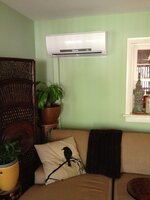
Don't let the through the wall thing be a deal breaker. We had a Mitsubishi 12,000 23 Seer rated unit put in our Florida/Sun room this past November. There is a brick wall behind where the unit was mounted. The installer ran the connections up the interior wall through the crawl space then enclosed it with a section of drain pipe. I painted the drain pipe the same color as the wall. Looks nice and passed inspection by the boss.

It qualified for a $300.00 income tax credit too.

Chuckie
 

Attachments

  • IMG_1073.JPG
    IMG_1073.JPG
    47.2 KB · Views: 90
Around here several people are installing the ductless units themselves, then having someone come charge them with refrigerant. A friend of mine did his own and said it was scary easy. With any luck the financial ferry will smile on us, this summer, and I can put one in our shop office.
 
I live in Phoenix, AZ and have a 12,000 btu window unit in my shop and it keeps it about 80 degrees and costs me a dollar a day to run. I turn it on in the morning and turn it off at 10 pm most days. I use a fan to help circulate the air. My shop is heavily insulated, however.

It has 1 inch foam in the walls and 4" fiberglass in the ceiling. It is a 20x20' carport conversion with one 8' insulated rollup door and one 24x34" window (especially for the AC unit.) This is our 3rd season using it and it has never raised my electric bill more than $35 a month.

It might not be efficient in an uninsulated shop.
 
My shop is 24 X 28 and I put an 8,000 btu window unit in on one end. That end of the shop isn't cold in the Summer but is a good temp to work in through the morning until early afternoon when it gives me a good excuse for a nap. Cools back off nicely after the sun sets. Power usage is low with this unit.
 
I live in Phoenix, AZ and have a 12,000 btu window unit in my shop and it keeps it about 80 degrees and costs me a dollar a day to run. I turn it on in the morning and turn it off at 10 pm most days. I use a fan to help circulate the air. My shop is heavily insulated, however.

It has 1 inch foam in the walls and 4" fiberglass in the ceiling. It is a 20x20' carport conversion with one 8' insulated rollup door and one 24x34" window (especially for the AC unit.) This is our 3rd season using it and it has never raised my electric bill more than $35 a month.

It might not be efficient in an uninsulated shop.
I doubt it would be that cheap here with as many 100 degree days as you get. Our electric rates are out of sight.
 
I live in Phoenix, AZ and have a 12,000 btu window unit in my shop and it keeps it about 80 degrees and costs me a dollar a day to run. I turn it on in the morning and turn it off at 10 pm most days. I use a fan to help circulate the air. My shop is heavily insulated, however.

It has 1 inch foam in the walls and 4" fiberglass in the ceiling. It is a 20x20' carport conversion with one 8' insulated rollup door and one 24x34" window (especially for the AC unit.) This is our 3rd season using it and it has never raised my electric bill more than $35 a month.

It might not be efficient in an uninsulated shop.
I doubt it would be that cheap here with as many 100 degree days as you get. Our electric rates are out of sight.


The real thing is "its a DRY heat!" Actually that makes a big difference. Average summer humidity is 7 percent.
 
Back
Top Bottom