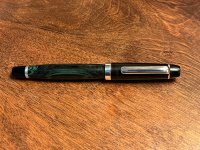
My First Pen - Green Ebonite and Argentium Silver

Signed-In Members Don't See This Ad
See more from ruadh80

ruadh80

Member
Joined
Sep 25, 2026
Messages
15
Location
Indiana
I posted these pictures in my welcome thread, but then I saw this forum. I figure I am more likely to get feedback here.

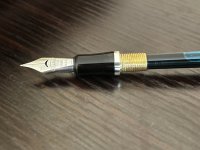
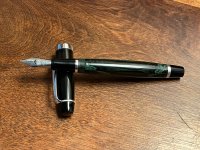
This is the first pen I have made. It is made from ebonite and silver. It was also my first endeavor in making things out of silver. I made a small brass insert for the section because I wanted to use a threaded converter and I also wanted to limit the pen's diameter to 14mm. Trying to do both caused the wall of the threaded portion of the section to be too thin, so I made the brass insert because it can handle having a wall thickness < 0.5mm. The section to barrel thread is M9x0.75 and the cap thread is M12x0.75. I'd love to have a triple start tap/die for the cap, but I don't plan on selling these, so I really can't justify spending the money on that.

I think I am going to remake the cap because in bright light the middle of it is slightly brown. I'm not sure if it was just a bad section in the ebonite or if I got it too hot while turning, but none of the other black parts had that happen. I tried sanding it down a bit, but it appears to be brown all the way through. I also didn't follow my original plan of making the ring for the clip first, turning the cap to be flush with the ring, and then soldering the clip portion onto the ring last. I was impatient and too excited to try out my clip idea that I completely assembled the clip before turning the cap. Then when I turned the cap, the clip ring ended up being slightly proud of the cap surface. I would prefer everything be smooth as you run your fingers down it. Another thing I would do differently are the threads on the barrel. I made the barrel flush with them because I think it looks really good, but after adding the cap, I think having a very slight step at the base of the threads would make it look better when capped.

The whole thing definitely took some trial and error.
 

Attachments

  • IMG_3523.jpeg
    IMG_3523.jpeg
    527.4 KB · Views: 89
  • IMG_3521.jpeg
    IMG_3521.jpeg
    587.6 KB · Views: 88
Signed-In Members Don't See This Ad
Excellent!

My preference is for the threads to transition into the barrel with no step (just as you have done here), probably I had a pen with a sharp step sometime in the past and it's stuck in my head.

Black ebonite does go brown when it oxidizes, you might be able to restore it with some hand polishing with a mild abrasive (such as toothpaste) or a reducing agent (maybe lemon juice - it works on apples!)

Do you have any prior experience of metal work, or was this whole thing a new adventure for you?

Great job either way!
 
This is a very strange post. The first pen you ever made was a kitless green ebonite body with Argentium silver bands and a brass sleeve. I think there is a backstory missing. Nice pen.
 
Excellent!

My preference is for the threads to transition into the barrel with no step (just as you have done here), probably I had a pen with a sharp step sometime in the past and it's stuck in my head.

Black ebonite does go brown when it oxidizes, you might be able to restore it with some hand polishing with a mild abrasive (such as toothpaste) or a reducing agent (maybe lemon juice - it works on apples!)

Do you have any prior experience of metal work, or was this whole thing a new adventure for you?

Great job either way!

That is exactly why I did the threads this way. Maybe I don't need to make a ledge, maybe I just need to make the cap a little narrower. I wasn't sure how thin I could make the walls of the cap, but since it has a silver ring around the bottom, I can probably go thinner.

I already tried sanding down the cap and polishing it again. I think I overheated it while drilling it out and caused it to oxidize all the way through. I'll just make another one.

No real metalworking experience, I have plenty of electronics soldering experience with a soldering iron and I have sweat/soldered a few copper pipes in the past, so I know the basics of how soldering works. The first ring for the pen I fused (because I was too cheap to buy silver solder), but then I quickly realized that I just got lucky with that one because the next several I melted. So then I bought the silver solder and it was much easier. The fusing would probably work better if I had a jewelers torch and not a propane torch for plumbing that I had laying around.
 
This is a very strange post. The first pen you ever made was a kitless green ebonite body with Argentium silver bands and a brass sleeve. I think there is a backstory missing. Nice pen.
No backstory, I just really don't care for kit pens. I do have lots of previous woodworking experience, but I just got my lathe about a month ago. I started out making conducting batons for my wife (hobbies are better when your spouse gets something out of them). I got a lot of inspiration for pens from this site.

I started my pen journey making the section out of black ebonite (cheaper). After throwing 2 or 3 of those in the trash before figuring out a design that worked, I moved onto the barrel. I practiced threading on some scrap black ebonite, which was a good thing because I ruined plenty of it figuring out that when I try to turn the die by hand, I strip the threads. However if I just apply some pressure on the die and let the lathe do the turning... it works perfect. Once I figured that out, I had enough courage to try using the more expensive green ebonite and all went smoothly. Then I moved onto trying to make silver rings out of bezel wire. I got super lucky with the first one and fused it on the first try. Then I melted several and finally gave up on the fusing and bought some silver solder. Soldering was a lot easier and I was able to churn out silver rings in no time. I settled on the clip design mostly because I could make it with preformed silver wire and it would require very little "shaping" on my part. I ruined a couple clip rings trying to solder them together because I was mounting the clip portion (5x the mass of the ring) and putting it into a vise (an even BIGGER heat sink) and of course I couldn't get the clip portion hot enough for solder to flow before the tiny little ring melted into a puddle. So again I had to resort to buying more stuff (this is the most expensive pen I have ever held in my hand at this point). I bought some ceramic plates to do the soldering on and now I could get the clip up to temp without melting the ring.

I wanted to use silver because I figured it would be easier than trying to use the plated rings they sell for pens. My logic was that I could stack everything together on the lathe and turn it down flush vs a plated ring I would have to very carefully sneak up on the right diameter because if I touched the ring with a tool or sandpaper, it would go through the plating.

So yeah, this was all a brand new adventure for me, but that doesn't mean I don't have 3 pen sections in the trash bin, a cap that I should remake, and a baggie full of melted silver
:)
 
Here is the brass insert I made for the section. It is M9x0.75 on both ends to screw into the section and the barrel. On the inside it is threaded differently on each end, one end for the converter and the other for the nib housing.

IMG_3527.jpeg
 
Nice pen!

I have had good luck with La Belle Epoque Deoxidizer to restore ebonite. Originally used for ebonite pipe stems, it's also used in pen restoration. Messy, but it works.

I find that water can cause discoloration like the one you described. Soaking your ebonite parts in water to clean oil residue can cause the ebonite to oxidize quickly.
 
Nice pen!

I have had good luck with La Belle Epoque Deoxidizer to restore ebonite. Originally used for ebonite pipe stems, it's also used in pen restoration. Messy, but it works.

I find that water can cause discoloration like the one you described. Soaking your ebonite parts in water to clean oil residue can cause the ebonite to oxidize quickly.
Thanks, I might try that sometime. This time however, I'm pretty certain it is oxidized all the way through caused by heat when I drilled it out. I sanded it down and polished it again and the brown still remains. Also, it is only brown in a very well defined band in the center of the cap. I drilled out 3 different diameters and there is no brown where I drilled the largest and the smallest diameter. Only in the middle where I drilled out at 10mm. So I think when I drilled out the 10mm diameter I let it get too hot.

You bring up a good point though, I knew UV, heat and water caused ebonite to oxidize, but I didn't even think about that and wet sanded it. That was probably a poor idea.
 
That is exactly why I did the threads this way. Maybe I don't need to make a ledge, maybe I just need to make the cap a little narrower. I wasn't sure how thin I could make the walls of the cap, but since it has a silver ring around the bottom, I can probably go thinner.
If you can find those 3 trashed sections, maybe use them to experiment to see how thin the ebonite can be turned without breaking up. Metal, as you say, is much stronger.
 
If you can find those 3 trashed sections, maybe use them to experiment to see how thin the ebonite can be turned without breaking up. Metal, as you say, is much stronger.
That is exactly why the sections are in the trash... I was trying to make the end threaded M9x0.75 on the outside to thread to the barrel and M7.5x0.75 on the inside to thread the converter into. I found that ebonite cannot go that thin. The silver band is only a little under 0.5mm thick and is placed over a tenon cut in the ebonite. But I bet even that little bit of silver is enough to let me make that ebonite tenon really thin. It probably needs to be just barely thicker than the threads (which of course would have to be drilled and cut AFTER I attach the silver sleeve).

I've got plenty of scrap black ebonite and luckily it just isn't that expensive... only about $1/inch. In comparison to everything else I have purchased, it just doesn't matter :-( I swear this lathe has become the most expensive tool in my shop. I didn't think anything could add up faster than when I decided I wanted to start using hand tools for my woodworking, but this has. I also thought that my wood hoarding addiction was bad, but pen turning material???? I've only made one pen and I am already accumulating a ridiculous amount of it. I mean... they will grow more trees, but that ebonite/acrylic/cellulose rod might not be there tomorrow!
 
If your using acetylene use a bushy flame not a sharp pointed one. You dont want a hissing flame, heat everything at the same time.
Two 3rd hands with stainless steel tweezers will hold the clip and ring in position for soldering. Argentium doesnt transfer heat as quickly as std sterling with copper. Boric Acid, mixed into denatured alcohol and coated on your clips will turn a glassy black just before it reaches melting temps for Easy solder. Boric acid, beside jewelers supplys is the main ingrediant in many products like Roach Proof etc. its 99% pure and cheaper than most places. Argentium as you have found out doesnt have the red glow like Std sterling as it heats up. It goes from grey to gone in a heartbeat. By the time it does go red its melting. Dont quench Argentium it will become so brittle it will crack and break, let it air cool. You can work harden it by heating it back up in an oven. I let it sit at 500 degrees for an hour and a half up to 2 hrs and then let it air cool. Thats a great first pen.
 
If your using acetylene use a bushy flame not a sharp pointed one. You dont want a hissing flame, heat everything at the same time.
Two 3rd hands with stainless steel tweezers will hold the clip and ring in position for soldering. Argentium doesnt transfer heat as quickly as std sterling with copper. Boric Acid, mixed into denatured alcohol and coated on your clips will turn a glassy black just before it reaches melting temps for Easy solder. Boric acid, beside jewelers supplys is the main ingrediant in many products like Roach Proof etc. its 99% pure and cheaper than most places. Argentium as you have found out doesnt have the red glow like Std sterling as it heats up. It goes from grey to gone in a heartbeat. By the time it does go red its melting. Dont quench Argentium it will become so brittle it will crack and break, let it air cool. You can work harden it by heating it back up in an oven. I let it sit at 500 degrees for an hour and a half up to 2 hrs and then let it air cool. Thats a great first pen.

That is great info!

I have never used regular sterling silver, so I can't really compare argentium to it. Sadly, right now I'm using a plumbers propane torch, so its a pretty crude setup. Things got a LOT easier once I started using a ceramic plate to solder on rather than a big steel vise that acted as a big heat sink. I have noticed that you need to remove the heat immediately after the solder flows and when fusing you need to remove the heat the instant you see it go "shimmery". I will try your boric acid and alcohol trick!

But hey, the more I accidentally melt, the closer I am to having a reason to try sand casting... and then investment casting.
 
Back
Top Bottom